
SCARBOROUGH – Every year since getting “off the grid,” Scarborough’s Debra McDonough has opened her home to Maine Solar Tours on the first Saturday of October. But soon, her place on Minuteman Drive will be open to the public all year round, at least on the Internet.
Starting this spring, Scarborough’s Energy and Recycling committee, on which McDonough sits, will begin filming video clips of her home, chosen because it’s one of the relatively few in Maine that produces all of its own electricity needs.
The McDonough family has, since 2007, put in new windows, buttoned up the home’s insulation, installed solar hot water – which also runs radiant-heat flooring, and a 3,300-watt solar array, in addition to switching from standard oil heat to wood pellets. All in all, says town Councilor Judy Roy, it’s a model the energy committee hopes to replicate across Scarborough.
“What we want to do is go to her house and do some quick short videos, five to 10 minutes each, showing people what they can do to prevent heat loss here or increase efficiency there,” said Roy. “It’s all about burning less oil and being conscientious about carbon emissions.”
“When you can create your own source of electricity and locally produce whatever you need to sustain the mission of the building – in this case, to maintain a home – there’s not a lot in the entire state that we can term as ‘net zero,’” said energy committee Chairman Rick Meinking, who spends his days as business program manager for Efficiency Maine, an independent trust dedicated to promoting the efficient and cost-effective use of energy.
“The videos are not necessarily meant to encourage everyone to be as aggressive as the McDonoughs in getting off the grid,” said Meinking. “But we are hoping homeowners might take on some of those tips they might see, to help them reduce energy costs by picking off the low-hanging fruit.”
The videos will be posted to the energy committee page on the town website, www.scarborough.me.us, and will run on Scarborough Community Television, which is slated to help with productions, said Meinking.
The whole point, Roy said, is to open of the eyes of local residents who may not realize that, even in a Scarborough subdivision, it is possible to be energy independent, or nearly so, because there are people like McDonough doing it already.
In the long run, the committee hopes more energy efficient homes will be as good for the local economy as for individual homeowners, Meinking said.
“If you can save 50 gallons of fuel oil over the course of a winter, at $3 per gallon, that’s $150 in your pocket,” said Meinking. “The family that does that might go out to eat one or two additional times, or spend that money locally someplace else.”
Technically, McDonough is not off the grid. Her home is still connected to a Central Maine Power line and she pays a minimum use and transmission fee every month, even when her home uses no electricity, or when it actually makes enough of its own that it pushes excess power out onto the grid. But, even so, she said, the power bill has dropped to an average of less than $10 a month, saving the family about $750 per year on electricity bills.
“That’s why I often lead with the economic benefit, instead of the environmental thing,” said McDonough, “because that doesn’t always resonate to those who are not predisposed to the idea.”
Still, as a microbiology professor at the University of New England, McDonough was as highly motivated by the environmental issues as the economic.
“For those of us who teach what some of the biological impacts are, it starts to feel like something we can’t play a part in anymore,” she said. “I just can’t go along with continuing to light things on fire. I mean, yes, we use wood pellets, but wood is ‘modern carbon,’ not fossil carbon, so that feels much more comfortable. It’s a faster carbon cycle. Trees are growing back now where these pellets came from, rather than with oil, which comes from sources that took millions of years to produce.
“Also, I’m not comfortable with the geopolitical impacts of oil utilization or the environmental impacts at the source, like the drilling. So, it just felt important to start taking the steps we could.”
Those first steps where re-doing the insulation in the home, built in 1996. Then came installation of a solar hot-water system in 2007. Following installation of the first array of solar panels in 2008, the McDonoughs extended the solar hot water to include radiant heating in the floors. That knocked another 200 gallons off the annual oil delivery, saving about $2,000 per year, combined.
The home achieved electrical independence in 2011 when a second array of solar panels was put on the roof. The first solar project cost about $24,000 and has a 20-year payback, said McDonough. However, the price had dropped enough by the time of the second build-out, and federal and state grants had grown, reducing the payback on the second set of solar panels to roughly 17 years.
Although some people can take out loans for the work and make payments from the energy savings, McDonough and her husband, Jim, chose to save and complete each stage as they had funds.
“We don’t buy new cars or go on fancy vacations,” she said. “This is what we choose to do.”
In January 2012, the most recent phase was complete with the “plug-and-play” conversion to wood pellets. By that time the family was down to using just 400 gallons of heating oil per year. But with the cost of oil compared to the use of 3.5 tons of pellets last year at $239 per ton, it worked out to another $550 savings.
In all, the McDonoughs are paying about $3,300 less per year to heat and power their home, they say.
“All of these things that we’ve done are things that will pay for themselves over time,” said McDonough, recommending re-insulating a home first as single the biggest, quickest impact. Then, she said, a solar hot water system is the next best step, because of the short five- to six-year payback on installation costs.
“It is true that some work can be cost prohibitive,” said Meinking, “so, it’s really an individual homeowner’s call on how far they go.”
Meanwhile, McDonough says she is “always” looking for new energy efficiency projects. She hopes to take advantage of zoning rules the Town Council amended three years ago to allow for residential wind turbines. That would help make her next dream a reality – to produce enough electricity on site to run not just her home, but her car.
“That would be the dream,” she said.
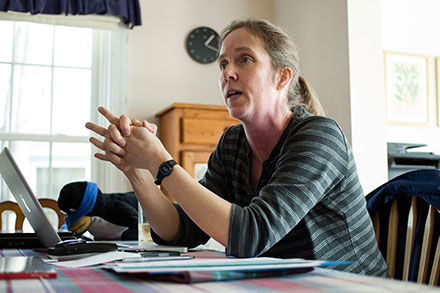 A wood pellet furnace, solar hot water and photovoltaic panels help Deb McDonough and her family live “off the grid” in a Scarborough subdivision.
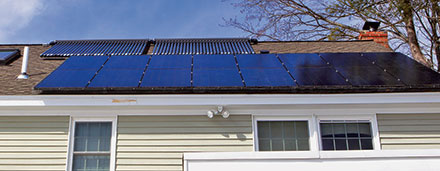 Sixteen photovoltaic panels on the roof, and more on the garage, generate enough electricity to meet almost all the family’s needs.
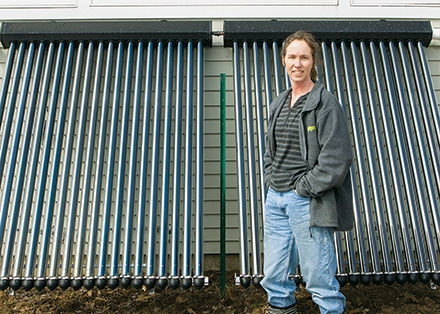 A ground-mounted array of collection tubes faces south on the back of Deb McDonough’s house in Scarborough, providing hot water to warm the house through a radiant heating system in the kitchen floor. Soon, videos made by the town featuring the McDonoughs, who also use photovoltaic panels and a wood-pellet furnace, will be used to show residents how they can be more energy efficient.
Comments are no longer available on this story