
FREEPORT – Tom Wilbur has never been to Africa, but he’s hoping to have a profound effect on thousands of lives on the continent. Through the Freeport Rotary Club, the award-winning chocolatier has started a local chapter of Crutches 4 Africa, an effort that sends used crutches and other mobility devices to needy patients in Africa and other parts of the world. Wilbur recently took a few minutes out of his busy schedule to discuss how he got involved, why the project is important and what the public can do to help.
Q: How did you hear about Crutches 4 Africa?
A: David Talbot, the founder of the organization, came and spoke to the Freeport Rotary Club a few months back. I had never heard of the organization before. Talbot is a polio survivor and while filming a documentary in Uganda, he realized how widespread polio still was in Africa. Often, these people are ostracized from their communities because of their disabilities. He saw a need and kept noticing a surplus of crutches in Dumpsters when he was back in the United States.
Q: What made you want to get involved?
A: It struck me as a great idea. Just hearing how kids and adults in Africa had to move around on their knuckles and stumps with no mobility equipment, I thought of how crutches are often a temporary reality for Americans and thrown away. So, to me it was just a perfect use for the discarded crutches. I had also participated in the Rotary Youth Exchange program and met kids from Ghana and Kenya. That was a fascinating experience to say the least, and exposed me to the unique culture of Africa. I’ve never been but would certainly like to.
Q: Are donations limited to strictly crutches?
A: No, the organization will take other mobility devices such as walkers, canes and even prosthetic limbs.
Q: Where can people donate locally?
A: The Rotary Club will take crutches and also Freeport Community Services via the thrift shop, who tend see a lot of crutches, canes, and walkers come through their door. We are hoping to have a bin in Freeport where people can drop off crutches in the near future.
Q: How do the donations eventually reach Africa? What is the process?
A: There is a collection point in Scarborough and then the crutches are shipped overseas. In 2011 alone, the organization shipped five, 40-foot containers to four different Africa countries. David Talbot visited three of the countries to set up delivery and distribution plans.
Q: Are there any other local organizations involved?
A: The Salvation Army in Portland has agreed to donate their crutches to us. They used to send them out to be scrapped for the metal. Now they are collecting them for us and we are going down to pick them every few weeks.
Q: Where else are these crutches and mobility devices being shipped to? Does it extend beyond Africa?
A: Yes, a container full of crutches was sent to Mongolia and I believe Afghanistan. Crutches 4 Africa has a global reach, but the majority of donated items do up in Africa.
Q: Is there a specific part of Africa where there is a pressing need?
A: Kenya and Uganda receive the most, but I’m not sure why.
Q: How many crutches and other mobility devices have been donated so far?
A: Close to 55,000 since Crutches 4 Africa began in 2006. It’s just a great idea, organization, and simple way to make a huge difference in someone’s life.
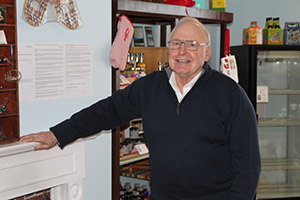 Wilbur’s of Maine Chocolate Confections co-owner Tom Wilbur, in his Freeport store on Feb. 20, says the Crutches 4 Africa program “struck me as a great idea.”
Comments are no longer available on this story