
In a matter of weeks, Maine voters will be heading to the polls to decide whether same-sex couples should be allowed to marry.
While voters must determine where they stand on the controversial and long-running issue, which was the topic of a ballot measure in 2009, churchgoers throughout Maine are reacting to the referendum in a variety of ways. Those multi-layered reactions, each stemming from altering interpretations of the Bible, range from wholehearted support based on acceptance of others to devout opposition based on tradition.
In an effort to gauge the diverging religious views on the issue of gay marriage from congregations in the area, Current Publishing interviewed pastors from various churches and denominations around southern Maine.
‘MOMENT OF DECISION’
While the Roman Catholic Dioceses of Maine played a vocal role in opposing the failed 2009 gay marriage proposal, the church has had a mostly hands-off approach in 2012. Monsignor Michael Henchal, pastor of four parishes in Cape Elizabeth, Scarborough and South Portland, said the referendum isn’t nearly as discussed within the church as it was three years ago.
“My impression is it’s not affecting the congregation very much,” Henchal said. “I think that nothing has really changed from three years ago, [which] was a moment of decision for them, and they had to figure out where they stood and what they truly believed. They went through that three years ago. So I don’t see nearly as much unsettledness or contention around it this time.”
Henchal said the Portland Diocese has been working with the gay rights movement since the 1990s advocating for hospital visitation rights and similar issues. However, the cooperation ends when the issue of gay marriage arises.
“We always told them that marriage would be the bridge too far because our very definition of marriage implies the diversity, which is male and female,” Henchal said, explaining that Catholics view gay marriage as an affront to natural law.
“Marriage pre-exists all religion. Marriage comes before the church. Marriage comes before the state. So for us it’s not a religious question, it’s a question of natural law: What is the very nature of the human being? For instance we’re opposed to murder, but our opposition to murder isn’t because the Ten Commandments says you shouldn’t murder. Our opposition to murder is because it’s contrary to the very nature of human beings to kill one another. So that pre-exists all Scripture, and all philosophical and religious reflection,” he said.
LOVE, ABOVE ALL
While the Catholic Church may be sitting out the 2012 campaign, liberal church congregations are actively politicking, with several denominations and church leaders taking a leading role in the get-out-the-vote effort in support of gay marriage.
The Rev. Michael Gray, of the United Methodist Church of Old Orchard Beach, says his flock, which includes an openly lesbian couple, has taken a faith journey of sorts toward supporting gay marriage. Gray, who has appeared with his wife on Equality Maine commercials supporting gay marriage, said the Methodist denomination does not support gay marriage, but his congregation does.
“My particular congregation here in Old Orchard Beach actually voted unanimously to join the coalition in favor of same-sex marriage, so we are 100 percent in favor of the proposed law,” Gray said.
Gray says congregants have become comfortable with the idea of same-sex marriage, having interacted with the lesbian couple in the church that has been together for 20 years.
“One grew up in the church, and she has always said I will not get married in the church unless the church wants me to,” Gray said. “She is always the type who says I don’t want to make waves, I just want to live my life. And I think that that’s a very powerful witness for people. So when you get to know people personally, it takes on a whole different way of thinking.”
Theologically, Gray said the issue for him and his congregation comes down to their view of homosexuality.
“There are those of us out there who don’t necessarily believe homosexuality is a sin. And that right there is the breaking point for a lot of clergy,” Gray said. “When we cut it right down to its absolute bare-bones facts, that’s the big issue – how do view homosexual activity? Do you view it as sinful or not sinful? And there’s a whole mess of us out there that view it as just another way God has created us. But there’s a whole group of people out there who say no way, God wouldn’t create us that way. And that really, truly is the core issue.”
Gray, who was opposed to gay marriage, says he used to view same-sex marriage only in terms of sex.
“Gay marriage isn’t about sex. It’s about love, just as much as heterosexual marriage is. And when I finally made that conversion that these people just happen to love people who happen to be of the same gender, the whole thing changed for me,” Gray said.
MIXED REACTION
Some churches have congregations who hold opposing views on the matter of gay marriage. Tim Higgins, rector of St. Ann’s Episcopal Church in Windham, said his church does not encourage members to vote one way or the other, though he and the Episcopal Diocese of Maine support the gay marriage proposal.
To encourage discussion within the congregation, Higgins invited Stephen Lane, the Episcopal bishop of Maine, to the church in early October for a discussion regarding the referendum.
“We have a vestry member who said, ‘I’ll be there Thursday night, I hope the bishop is ready for me.’ And I said he will be and that’s why we’re having the conversation, to give folks the chance to verbalize where they’re at, how they feel,” Higgins said. “And again, we cannot encourage folks to vote in a particular direction. So you won’t see signs hanging from our church. But we’ve got to give folks a chance to talk about it so they have an informed vote, an informed conscience as they vote.”
Higgins said the denomination – which is the American version of the Anglican Church of England begun when Henry VIII split from the Catholic Church on a range of issues, one being marriage – encourages individual thought.
“The beauty of the Episcopal church is that we can embrace ambiguity and embrace questions, embrace differences and thus everyone has a voice and you talk about it and figure it out together over the long-term,” Higgins said. “We embrace everyone coming through the door, and we’re not afraid of that. Everyone has their own right to their own thoughts around a particular issue, and that’s what separates us from the Roman Catholic tradition.”
With a similarly split congregation on the matter of gay marriage, the Rev. Nancy Salisbury, of the First Congregational Church of Gray, has congregants of both political persuasions but says the church body makes the best of it.
“People of faith see things differently, and the trick is to get along respectfully as we explore what our faith means in such a day when we’re asked to consider civil rights of a group of people who hadn’t been recognized previously,” Salisbury said. “But I’d say, it is an amicable split in our church. We respect each other’s beliefs and feelings, and try not to get drawn into partisan discussions. And, most importantly, we encourage people to think for themselves.”
OF LIKE MIND
Other churches, including ones in Sanford and Gorham, are more unified and open with their advocacy for gay marriage, hoisting signs in the front of the church building and making calls on behalf of the Yes on 1 campaign.
Sanford Unitarian-Universalist Church and the First Parish Congregational Church of Gorham are both host sites for Equality Maine phone banks.
The Rev. Sue Gabrielson, of the Sanford church, works part time for Equality Maine and is the faith director for Mainers United 4 Marriage. And the congregation fully backs her efforts, often turning out by the dozen to man the phones.
“Our congregation is very involved in advocacy for same-sex marriage. We’ve had several of our worship services dedicated to it. We have a banner hanging from the church saying ‘Our church supports the freedom to marry.’ So we’re very supportive,” she said.
Gabrielson said one of the church’s main principles is honoring the inherent worth and dignity of all people and seeking justice and equality for all people.
“From a religious standpoint, we believe marriage equality is a religious issue. Some of the greatest teachings we get from the Bible is that God is love, and that you should love one another the way Jesus loved us,” she said. “And [we believe in] the golden rule, which is really something that is in all religions, that you should do unto others as you would have them do unto you. So for us it’s really all about standing on the side of love. Trying to err on the side of love if we have a choice,” she said.
David Butler, pastor of the First Parish Congregational Church of Gorham, said the ability to marry shouldn’t be limited to heterosexuals. In a world of ethical grays, Butler said, Christians should err on the side of love, which he defines as acceptance of those of different lifestyles.
“We are an open and affirming congregation and we are open and affirming of gay and lesbian and bisexual and transgender people,” Butler said. “And we believe that this referendum is about letting all people have the right to make a commitment, that’s recognized by the state, to another person based on love. Love being the highest value that we hold, we believe that a commitment to base your life around love should be something sacred and holy. And should be celebrated and blessed.”
CHURCH/STATE
Butler, who has performed almost a dozen same-sex ceremonies, is frustrated that the government doesn’t recognize those marriages.
“We feel if there’s an issue of the state being unbiased on this issue it should recognize the wedding ceremonies we perform here as well as the wedding ceremonies performed in any other congregation of people. And obviously I’m bothered that I perform a wedding ceremony for two people who love each other that are gay or lesbian, and the state refuses to recognize that,” he said.
Rabbi Jared Saks, of Congregation Bet Ha’am in South Portland, is likewise frustrated regarding the civil-rights aspect of the marriage question and believes the referendum will ensure equal treatment under the law.
“The referendum allows civil licenses for same-sex couples while protecting religious freedom,” Saks said.
Since Saks desires the ability to perform a gay marriage ceremony, he argues his religious freedom is being denied, as well as the rights of same-sex couples wishing to get married.
“Right now, I’m not allowed to sign a civil marriage license for a same-sex couple, so the way I practice my religious tradition as a rabbi is restricted under our current framework. The goal of this referendum is to ensure each religious tradition can operate as it sees fit,” he said.
Saks, who is gay, has been rabbi at Bet Ha’am for less than a year, and says the congregation has been “very supportive about extending the freedom to marry to same-sex couples.” He said their only concern is appearing political.
“There are obviously diverse opinions within any community, and we’ve had members express concern about the synagogue being involved in what appears to be a political issue. So they are more concerned about separating us from politics than they are about whether or not same-sex couples should have the freedom to marry. But, by and large, the community has been very supportive,” Saks said.
FIRST THINGS FIRST
While many liberal traditions within the religious community support the referendum, conservative churches are just as adamant in their viewpoints against it. But, similar to Henchal and the Catholic Diocese, some seem to be steering clear of what has become a divisive political issue.
Some churches have posted signs supporting traditional marriage, but many choose not to, in an attempt to avoid what has become a political issue. Many ministers, when called for comment, also chose not to be interviewed. Others were critical of the media’s past treatment of the issue but spoke anyway.
The Rev. John Wentworth, of the First Congregational Church of Pownal, said his congregation is mostly of one mind when it comes to the issue.
“I think there’s a very strong consensus on this issue. We’re not the kind of church that would scorn people for having their own opinion, but I think the general idea is they’d oppose gay marriage,” Wentworth said.
Wentworth said the “prevailing voice in Maine is more progressive, and that makes conservative churches feel a little more isolated. But I don’t think there’s any great sense that we need to go out and oppose this thing. We’re not that passionate. We’re not about opposing gay marriage. We’re about loving people and showing the love of Christ and the reality of God and our faith in the Bible.”
Wentworth explains that his purpose is not to win a political victory in the ballot box, but to win souls for Christ.
“And included in that is going to be moral stands and I think that’s important, too. If we believe in something we have to stand for it. But there seems to be such a backlash – if you’re not for this measure, you’re a hater. And we’re not haters. We don’t hate or oppose gay people, we’re just against this measure and where it takes the moral fiber of our state. We just feel traditional marriage has worked for a long, long time and it continues to work.”
Wentworth says the issue of homosexuality seems to have taken center stage in America when in God’s eyes, he says, all types of sin separate man from a right relationship with God.
“Jesus was accepting of everybody, but he was not accepting of everything. What he opposed very clearly was sin. Homosexuality is no more of a sin than adultery or pedophilia or anything else. There’s been such an emphasis on homosexuality, and somehow we give a green light to everything else. Sin is sin. Nobody’s perfect,” he said.
Trent Boyd, pastor of the First Free Will Baptist Church in West Buxton, said his congregation, which opposes same-sex marriage, sees the ballot question as a “slippery slope.”
“Broadly across most of our congregation, they would take a stand for what I would call a biblical model for marriage,” Boyd said. “And there are people in this church that are concerned about the long-term effects of it. Just what they see down the road, what you could call the slippery slope.”
Randy Turpin, pastor of Royal Ridge Church of God in Scarborough, said his church congregation would fall into the conservative camp that would oppose gay marriage but that politics isn’t high on their list of concerns. Similar to Wentworth, Turpin says the church’s role is to show God’s love, not focus on political matters that could cloud that divine message.
“We’ve not brought a lot of emphasis to this issue in our church, we really haven’t, because we’re really trying to equip our members to take the good news of Jesus Christ to everybody, no matter what their lifestyle is or preferences are,” Turpin said.
“These types of agendas are not the kinds of things we want to make our primary focus. We’re here to represent the Kingdom of God.”
However, Turpin said, the Scarborough church is opposed to altering any view of marriage that would take it away from being between a man and a woman.
“That, we’re very clear on. But we’re not in the crowd that will be shouting in people’s faces and carrying placards down the streets,” Turpin said. “We’re here to meet every man and every woman right where they are in their life. And if anything needs to transformed, or changed, I think we can trust the Holy Spirit and the word of God to do the work of transformation in a person’s life.”
Turpin doesn’t agree with the “open and affirming” tenets of the liberal congregations, which err on the side of acceptance.
“If a patient has cancer, the loving and compassionate thing is to say hey, you’ve got cancer, we need to do something about this,” he said. “Sin is sin. And it ultimately destroys. It leads to spiritual death. The truly loving thing is not to pretend everything is OK. If the Scripture is clear on something being a sin, well we’ve got to deal with that.”
 Election 2012
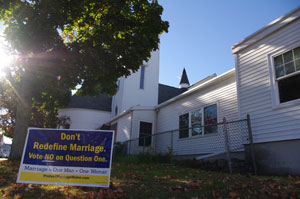 The First Baptist Church of Westbrook shows its support of traditional marriage by posting a No on 1 sign on its front lawn on Main Street.
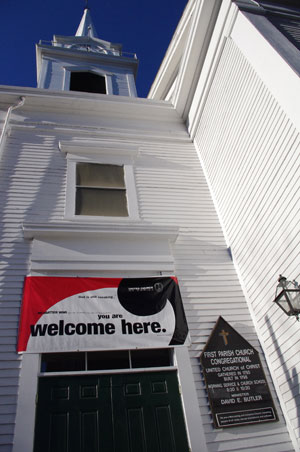 The First Parish Congregational Church of Gorham is supportive of gay marriage.
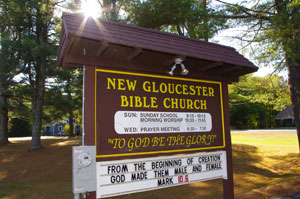 The New Gloucester Bible Church shows its support of traditional marriage on its readerboard along Route 100.
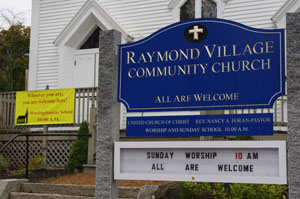 The Raymond Village Community Church UCC is welcoming of all people and has members of differing opinions regarding gay marriage.
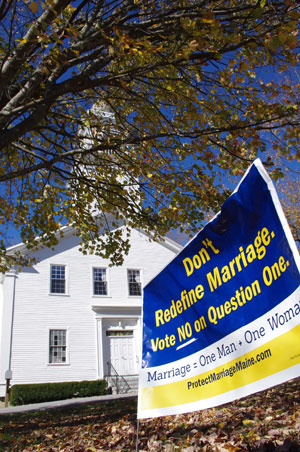 The First Parish Congregational Church of Pownal on Route 9 shows its support of traditional marriage with a lawn sign.
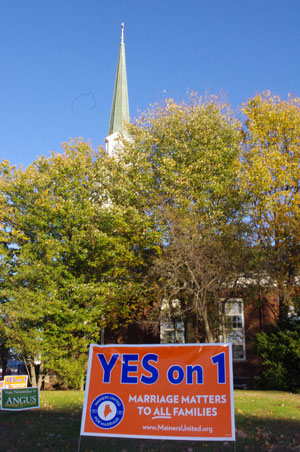 Some churches have thrown their support for same-sex marriage referendum including, The First Congregational Church of Cape Elizabeth.
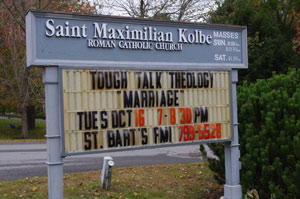 The St. Maximilian Kolbe Roman Catholic Church in Scarborough, which supports traditional marriage.
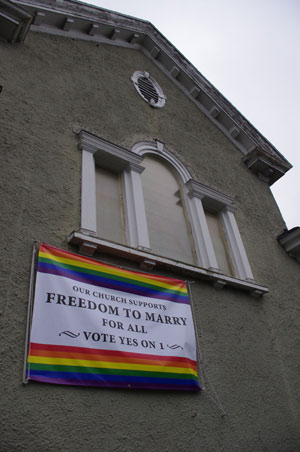 The Sanford Unitarian Universalist Church supports same-sex marriage.
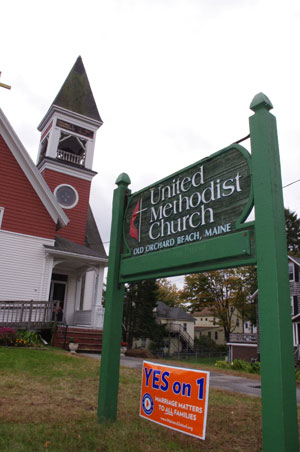 The United Methodist Church of Old Orchard Beach supports same-sex marriage.
Comments are no longer available on this story