
LAKES REGION – Local efforts have been successful in pushing back milfoil from the Songo River, where hopes looked dim just a couple of years ago. Officials are preparing to turn their sights to Sebago Lake for the next big battle against the damaging plant.
LAKES REGION – The battle against invasive milfoil in the Lakes Region and around Maine seems to be turning.
Local efforts have been successful in pushing back milfoil from the Songo River, where hopes looked dim just a couple of years ago. Officials are preparing to turn their sights to Sebago Lake for the next big battle against the damaging plant.
After a fierce heat wave in August 2010 swelled the infestation of invasive milfoil in the Songo River, the Bridgton-based Lakes Environmental Association called for the closure of Songo Lock. The closure would have prevented further spread of the milfoil and sent a message to the public that milfoil was a serious threat, not only to the environment but to the lifeblood of Maine’s tourism-based economy.
Two summers later, thanks to the hard work of milfoil removal teams sponsored by the lakes group, invasive variable-leaf milfoil is nowhere to be found in the Upper Songo and Brandy Pond. Teams have completed removal of milfoil from half of the Lower Songo, as well. Overall, it’s a turnaround not even the association’s longtime executive director, Peter Lowell, could have predicted.
“This time last year, I was expecting to keep the Upper River and Brandy Pond under control and control a 1,000 feet downriver from the lock as a buffer area,” Lowell said, “Now there’s some hope we can clean the entire river up, and if we keep getting the resources we need, it’s feasible to clean up the whole Songo River within a couple of years.”
Lowell doubled the diver assisted suction harvester (DASH) crew on the Songo from four team members to eight this year thanks to two major donations, one of which comes from an anonymous donor the identify of whom even Lowell doesn’t know. Lowell usually receives about $30,000 a year for milfoil eradication efforts. The money comes from several sources, including contributors to his group, the town of Naples and the milfoil sticker program run by the state Department of Environmental Protection. This year, he’s been able to bulk it up to $50,000.
Led by veteran milfoil remover Adam Perron, who has worked on the river for six seasons, the teams attacked the boat ramp at Sebago Lake State Park in June before boat traffic spiked, clearing a swath out to the Songo River. They have been working downriver from the lock since then and have reached about the midway point between the lock and Sebago Lake. Most of the work is performed by divers who hand-pull the milfoil, feeding it through a vacuum tube to the deck of a pontoon boat, where other team members bag the plants.
Perron said the milfoil infestation started in Sebago Lake and has moved north since about 2001, meaning unsuspecting boaters were carrying and depositing milfoil fragments upstream. Perron credits the recent gains on an experienced removal crew.
“I think as a whole our project has been really successful because we’ve had time to develop methods,” Perron said. “We’ve been working out on the river with the suction harvester for six summers, so we’ve gotten really comfortable with it. We’ve had a lot of progress.”
Guarded optimism
With nearly a decade of news stories detailing new infestations of milfoil around the Sebago Lake region and other areas of Maine, Lowell said many residents have given up on eventually defeating the milfoil invasion. Lowell, who has spent more than 30 years as the director of the group, was starting to feel beaten until recent gains have left him more hopeful.
“It’s not a guarantee because we’re dealing with nature, but given the progress we’re making, something I thought last year was hopeless looks like in the medium-term might be possible,” Lowell said.
Just last year, boats leaving the state park’s boat ramp were “draped with plants” since the milfoil was clogging the lower waterway, he said. Courtesy boat inspectors helped boat owners remove the milfoil, and also checked props as the boaters moved through the Songo Lock. This year, inspectors are seeing many fewer plants.
“There is some optimism. It’s probably never going to end, but this is the first year I’ve felt optimistic,” Lowell said. “It’s a pretty depressing outlook when you think you’re going to have to do the same thing over and over every year, so when you see some real progress out there, it does make you feel good.
“You can’t assume that every year, because it’s a natural system and things happen, but based on everything that we’ve seen over the past few years, there is finally cause for optimism.”
Lowell is joined in his optimism by Roberta Hill, invasive species program director for the Maine Volunteer Lake Monitoring Program, which was founded in 1971 and is the oldest organization of citizen-driven lake patrollers in the country.
“We’re getting a real good handle on it,” Hill said of the statewide efforts. “We’re cautiously optimistic that the plants have been eliminated from a couple of water bodies for good, and in those cases it was early detection that allowed that to happen.”
Hill said less than 1 percent of Maine’s water bodies are infested with milfoil. Those infestations are limited to York, Cumberland, Oxford, Androscoggin and Kennebec counties. She said two water bodies have been recently taken off the infested list and that six others are nearly milfoil-free. Hill credits early detection from keen-eyed and knowledgeable plant patrollers for the gains.
“At the VLMP, our primary mission is to train volunteers to be the early detectors because if you find an infestation soon after it was introduced, you have a much better chance of ridding the lake of that invader,” she said. “If you don’t detect it early, then you’re into this constant management phase and it’s expensive, time-consuming, very labor-intensive and the chances of complete eradication are very low.”
Hill said another local water body, Middle Range Pond in Poland, was removed from the list this year after three years of not having milfoil.
“That’s another great story of complete eradication,” she added.
The real challenge
While smaller ponds, rivers and lakes are showing signs of success, the looming battle, one that has invasive experts such as Lowell a little overwhelmed, involves the dozens of infestations on Sebago Lake.
Lowell said something needs to be done and is planning to convene a special task force this fall to begin planning the attack.
“After Labor Day, we’re planning to have a summit on cleaning up Sebago Lake because nobody dares to talk about it because it’s such a massive problem,” he said. “There’s no plan. No strategy. Everybody’s working in their own domain. So that’s what we want to deal with next.”
Much of the infestation is located in Raymond and has been battled for years by Raymond Waterways Protective Association, which this year hired a new full-time executive director, Betty Williams, who served for more than a decade as director of the Cumberland County Soil and Water District in Windham.
Williams said she is hopeful for eradication of the more than two-dozen swaths in Raymond, but agreed it will be an uphill battle.
“There is a lot – numerous infestations – and they all vary in density,” Williams said. “Some are really dense, some are very light.”
The worst areas are in Deep Cove, Turtle Cove, Port Harbor Marine, Panther Run Marina, and the canals around Bay View. Even Frye Island reports milfoil infestations, she said.
“So there’s quite a bit,” Williams said. “And we’re really trying to get a handle on that so we keep it there. We don’t want it to spread to other lakes in Raymond, which is why we have our courtesy boat inspectors out there.”
In Michigan, Williams said, some lake associations use an underwater lawn-mower device to cut the thick milfoil six feet below the surface so boats can ply the waters freely. Without the efforts of divers and the employment of benthic barriers that rob milfoil of needed sunlight, Sebago Lake and other water bodies could be dealing with similar infestation, she said.
“Yes I am hopeful. I know that we can get a handle on it, and maintain it and keep it bay,” Williams said. “I think with vigilance and with everybody being more aware, we’re going to at least be able to keep it where it is and not let it spread.”
And the group’s ultimate motivation is clear, Williams said. If left unchecked, milfoil could ruin the waterways of the Lakes Region devastating the local economy.
“I know several people I’ve talked to who are interested in purchasing property on area ponds and lakes and if I mention milfoil, they say, ‘OK, forget it.’ They don’t want nothing to do with it,” she said. “So it’s going to hurt the bottom line for home values. At some point, it’s going to make a big difference if it hasn’t already.”
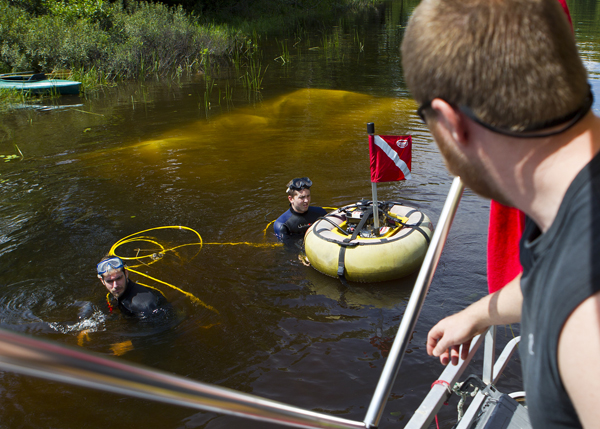
Photo by Rich Obrey

Photo by Rich Obrey
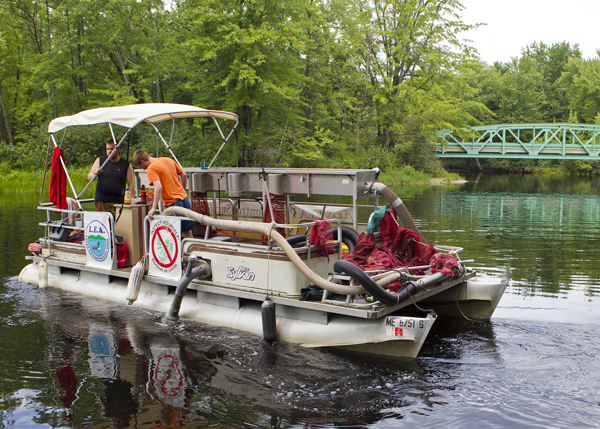
Photo by Rich Obrey
Comments are no longer available on this story