
WESTBROOK – For as long as he can remember, Westbrook resident David Pierson has been a TV junkie. He grew up watching it, and as an adult, he has made a career out of studying it.
“Television is sort of my thing,” he said.
Pierson’s “thing” has been analyzing popular television shows such as “CSI,” “Seinfeld,” and “Mad Men,” in a series of professional journal articles and book contributions. His work examines the role of television in society, and what a show’s popularity and content shows us about ourselves.
Pierson, 53, integrates his studies into his teachings as an associate professor of communication and media studies at the University of Southern Maine. His new book is an in-depth study of a TV classic, “The Fugitive.” The book, which has the same title, breaks down the program’s themes and draws parallels with the social and political climate during the show’s 1963-67 run.
The show starred David Janssen as Dr. Richard Kimble, an innocent man wrongfully convicted of his wife’s death. Sentenced to death row, Kimble managed to escape, and spent the entire series on the run from the law, trying to find his wife’s killer. Along the way, Kimble took time to help others, all while being hunted by Police Lt. Philip Gerard, played by Barry Morse.
A native of Shreveport, La., Pierson got a bachelor’s degree in 1980 in radio/television/film from the University of Texas at Austin, and got his master’s in the same field there in 1993, followed by a doctorate at Penn State in 2001. Pierson said he did his master’s thesis on “The Fugitive,” and the new book gave him a chance to expand on what he wrote then.
“I was always interested in going back and revisiting it,” he said.
The show debuted in an era where television lionized medical and legal professionals in programs such as “Dr. Kildare” and “The Defenders.”
“Here (in ‘The Fugitive’) you had a fallen professional,” Pierson said. “You had this show that was almost like the dark side of the Kennedy years.”
But while the show’s somber, almost film-noir tone made it a tough sell to the networks, Pierson said, once it finally got on the air, ratings took off. In fact, he said, the show’s dramatic, two-part climax set the record for a season finale audience, and held it until 1980, when the famous “Who-shot-JR?” season finale of “Dallas” took in more viewers.
Pierson said Kimble’s struggle against a system that had turned on him resonated with a public that had grown weary of the McCarthyism of the 1950s, and was on the verge of rebelling against authority and convention.
“Kimble is, in many ways, kind of a true ‘victim hero,’” Pierson said. “He always had to keep looking over his shoulders. He was paranoid. He never could really settle down.”
The program, Pierson said, was ahead of its time, acting as a harbinger of the counterculture movement that soon followed. Pierson said Kimble’s example of a peaceful-minded wandering traveler navigating a violent and dangerous world also set the standard for other characters that appeared in the decades to come, such as David Carradine’s Kwai Chang Caine in “Kung Fu,” Michael Landon’s Jonathan Smith in “Highway to Heaven” and Scott Bakula’s Sam Beckett in “Quantum Leap.”
While his book sticks to the TV series, Pierson said he did watch with interest the 1993 film remake of “The Fugitive” starring Harrison Ford as Kimble and Tommy Lee Jones as Gerard. Once again, he said, the film was a reflection of the times, but unlike the TV series, the film’s script cast an unfavorable light on the corporate pharmaceutical industry, and cast Kimble as a man caught in a web of conspiracy.
“If anything, the Kimble character is more vulnerable in the film than he was in the TV show,” he said.
Pierson has lived in Westbrook for the past five years, coming to the Portland area in 2001. He said he dabbled in film and video production earlier in his career, and studying and deconstructing film and television as an art form for any would-be filmmaker is time well spent.
And Pierson isn’t done with television by a long shot. Right now, he said he is working on a study of the AMC series “Breaking Bad,” about a high school chemistry teacher who becomes a synthetic drug maker and dealer.
“I’m still a big TV watcher,” he said.
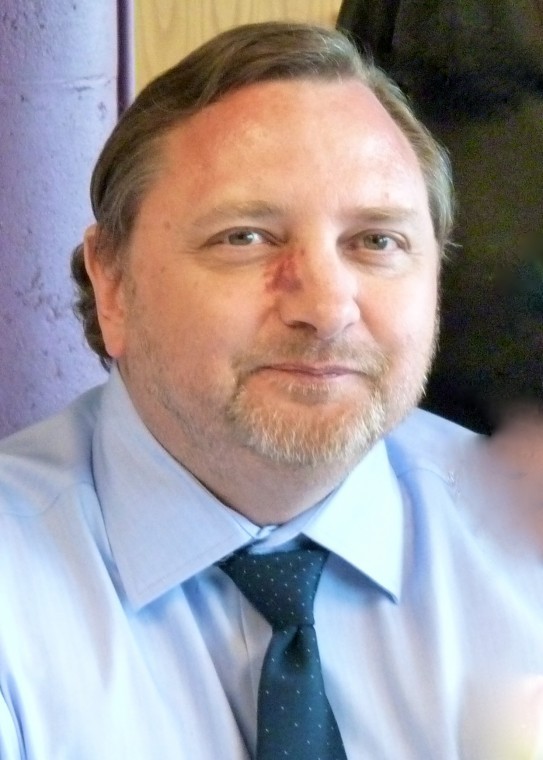 “I’m still a big TV watcher,” says David Pierson, a Westbrook resident whose new book examines the old show, “The Fugitive.” (Courtesy photo)
Comments are no longer available on this story