
BRIDGTON – While it’s rare that an author would describe herself as an entrepreneur, Alice Anderson is a committed one, through and through.
The Columbia School of Business graduate began her own magazine profiling women business leaders in Maine. Wanting to remain in the business world while pursuing her preferred vocation of writing, she started penning company histories. After 100 such profiles, as well as other books, including biographies, Christian fiction and devotionals, she’s still going strong. She aims to write a series of small-town love stories based in Bridgton, similar to Jan Caron’s popular “Mitford” series.
The Portland native has recently completed a biography of Windham Weaponry owner and well-known Lakes Region resident Dick Dyke, and sat down for an interview with the Lakes Region Weekly to discuss the new book as well as life as an author.
Q: How did you get into writing books?
A: For three years, I published the Maine Woman magazine, which was very popular, distributed to grocery stores and places like that, all over Cumberland, Oxford, Androscoggin counties. And we put a woman on the cover each month who was a volunteer in a nonprofit organization and we used her to represent all of the volunteers, so we were really promoting volunteerism with the magazine. And on the inside we had columns written by professionals.
And somewhere between issues my sales manager and I got married. Then we divorced about a year and a half later and he went and got a different job and I couldn’t do the magazine myself. But I had 39 women’s cover stories and I kept thinking I ought to do something with this. And all I could think of was a coffee table book.
At the time, in 1998, I was living in an old, old camp on Panther Pond in Raymond that was converted to a house with little thin boards for a ceiling and the walls too. And so, I’m drinking my coffee and ladybugs are falling out of the ceiling into my coffee cup, dive bombing the dog, driving my mother and me and the dog crazy, and I said, I’ve had it. I went to the Internet, I typed in ladybugs and the first thing that came up was Ladybug Press, so I thought, what is Ladybug Press? Well, it was a publisher in California looking for manuscripts for women’s books. Hello? So, I sent her what I had and she sent me a contract. I got published right out of the shoot. I never got a rejection notice. And other writers hate me when I tell them that.
Q: How did you turn that first book into a career?
A: I knew I wanted to make my living writing, and I know that’s not easy to do, so I had the lights off, the dog and I were on the couch in front of the fireplace in that same old house and I just said, “Lord, I need to know how to make a living. And I believe I’m supposed to do it through writing, and I’m not moving off this couch until you tell me what to do.” Within a few minutes, the idea popped into my head, if I wrote the history of companies, they would pay to be in the book. So I took my pen and clipboard waiting for him to tell me how to do it. But he never told me another word. So I figured out a plan. I went to the Bureau of Corporations in Maine. I had a few criteria – they had to be able to pay me, they had to have enough of a history to write about. I had a wonderful time. I traveled all over the state, interviewing people. I got samples of everything.
And that was so much fun that I did one in New Hampshire and also one in Vermont.
Q: You’ve now written dozens of company histories. How do you get these jobs?
A: I go after them. That’s the only way.
Q: So, you’re an entrepreneurial author, it sounds like. Sort of like your recent subject, Dick Dyke? What did you learn about Dyke and did you enjoy writing his story?
A: He was probably one of the top five clients I’ve ever had. He was absolutely terrific. He’s a businessman. He’s got a great sense of humor. He’s a compassionate human being and there isn’t any part of Dick Dyke I don’t feel 100 percent tickled with. He’s just a terrific person. He came from nothing and now he has everything anyone could ever want just about. He is a genuine person. He’s real. If he says something, you can believe it. And if he does something, you can trust it. And he’s a great addition to my life. I so enjoyed going down and having coffee with him and his two dogs [at his house on the Naples Causeway] and doing our 7 a.m. interviews on the causeway. It was fun.
Q: Can you talk about the mechanics of writing a biography?
A: Basically, they tell me their story. Having been a journalist myself, I know how to start a conversation. And so I ask leading questions and they usually tell me exactly what I need to know. And if I don’t understand something I ask. Sometimes I ask a question because even though I might understand it, maybe the readers don’t. You always write for the reader. Always. I have to write this so that somebody understands.
Q: After reading Dyke’s biography it seems you like to work chronologically?
A: Dick’s was chronological, but it doesn’t have to be. Sometimes I start with a cataclysmic event, like a woman who was falsely arrested and incarcerated for nearly four years, we started with the arrest, and then went back and told her life story.
Q: With Dyke’s book, there was some intertwining of history, such as his meeting the queen, his early days fighting crime in Las Vegas and growing up in old-time Maine and how he helped Husson College blossom.
A: Well, I think Dick Dyke is pure Americana.
Q: You’ve done company histories on Chalmers Insurance, Oakhurst Dairy, Palmer Spring. You met politicians who are quoted in these books. So, you’ve really gotten to know Maine culture very well through your chosen genre.
A: Well, I was born and raised here. So I knew a lot about it, but I sure got to know it driving the back roads.
Q: Who is the audience for these types of books?
A: I always ask the client what they’re going to do with the book, and then I know how to gear the writing so it’s aimed at the right target audience. Dick’s book was simply to document his life and pass on some lessons he had learned. So that was really simple to do that. I’ve had some clients, actually one that I ghost-wrote for, who had the germ of an idea and I took it from there. I come up with the plot, I come up with the characters, I came up with everything.
Q: Sounds like you’re a writer-for-hire?
A: Yeah, it’s like I’ve got a smoking pen.
Q: Are you able to make a decent living doing this?
A: I’ve been doing it for 13 years. Sometimes it’s a little thin, but sometimes it’s a bit much. Last year I was working on three books. And I live in mortal fear of putting the wrong character in the wrong book.
Q: How often do you write?
A: I keep a workday schedule. I’m an early riser and an early-to-bedder. So I’m usually in bed and asleep between 9 and 10 p.m. And I wake up five hours later and that’s all the sleep I happen to need. And I’ve been doing that for years. Plus, what are you supposed to do in the morning that early? Sometimes I put on the news and sometimes I start writing.
Q: Is Bridgton a good place for an author? Does the small-town feel inspire you?
A: Every 10th book, I write one of a spiritual nature to encourage people and help them. And that’s my gift to God. He’s given me a lot of gifts, so I give him one back every time I can. And one of the books I’m working on is called “The Tide Dancer,” which is a Christian romance. I want to write a series of these and they all take place in Bridgton.
And I was sitting at Ricky’s Diner on Main Street having breakfast one day and I’m hearing all this conversation and there are 12 men wearing baseball caps that say ROMEO embroidered on the front, which stands for Retired Old Men Eating Out. And I thought, this is Bridgton. And then I found out there’s a group of women who come the day before and they’re called the JULIETS, and that stands for Just Us Ladies Indulging in Eating Together. And their conversation was just as much fun to listen to. So I went over to the women and said, “I’m writing a book about small-town America and it’s going to be based in Bridgton and I want you to know you’re going to be in it.”
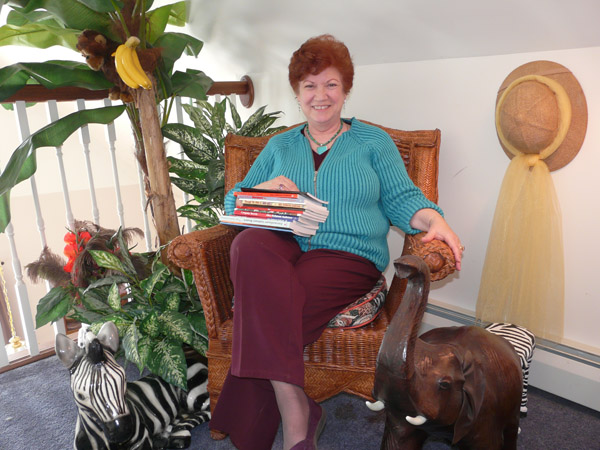 Alice Anderson, seated among her beloved animals at her home in Bridgton, is an author who works in many genres, ranging from fiction to company histories and spiritual works. Last year, Anderson wrote three books, one of which was a biography of Windham Weaponry owner Dick Dyke. (Staff photo by John Balentine)
Comments are no longer available on this story