
RAYMOND – There’s a game of chicken going on in Raymond.
Both sides in the ongoing debate regarding rooster noise presented their cases Tuesday to selectmen and the public, and neither side showed any signs of caving.
At the end of the discussion, which attracted a crowd of about 25 residents, selectmen asked for further legal review on the proposed animal noise ordinance. Similar rules from other communities will now be used as a guide, after the town’s existing dog ordinance, on which the proposal was based, was found to be outdated and unenforceable.
During the public hearing Tuesday, rooster owner Julie Sutherland and her fiance?, John Russo, spoke in opposition to the proposed ordinance. On the other side are Sutherland’s neighbors, Wayne and Joanne Gelston, who consider her roosters a menace to the peace and quiet of the neighborhood.
Other residents at the hearing said it is unfortunate that the neighbors could not resolve the issue without the town’s help.
“Any time we infringe on rights of individuals, especially as frivolous as this, I mean we’re dealing with neighbors that obviously can’t get along,” said former Selectman Dana Desjardins. “To make a broad statement for the town of Raymond because of two individuals who don’t want to come to an agreement to me is like punishing everybody for one person’s bad deeds.”
Sutherland, who lives at 51 Ledge Hill Road, considers her 3.8-acre operation a farm, with her two horses and 16 roosters the livestock. She said there’s no way she’s giving up her roosters, since they provide insect control and represent the rural lifestyle that led her to move to Raymond in 2010.
Gelston approached the town last fall in the hope it could help him with the incessant noise, which he said starts at 4:30 a.m. and continues all day and into the night. With the help of the town lawyer, officials drafted an ordinance that would ban all animal noise lasting longer than 10 minutes and impose fines that increase with each occurrence.
After the meeting, the two sides were still at loggerheads, just as they have been since last summer, when Sutherland first brought home the original 25 chickens, all roosters.
“We’re frustrated because of one couple who didn’t even come over and talk to us,” Sutherland said. “They went to the selectmen and have wasted so much taxpayer money and time.”
Sutherland said she has made concessions by agreeing to keep her roosters enclosed in the winter, partly because of a wolf-hybrid patrolling the area and partly because she is deferring to the Gelston’s complaints. She’s waiting until 6:30 a.m. to feed, and has also sealed cracks in the coop and bought insulation that she is waiting to install in warmer weather.
“It doesn’t matter – all the money and time I’ve spent, the later feeding times, the crack insulation, the new coop. It doesn’t matter,” Sutherland said.
Russo had some words for Joe Bruno, chairman of the Board of Selectmen, who he said is “very, very biased. And he tries to bully the other selectmen into doing things his way.” Referring to the ordinance, Russo added, “And he loves wasting the taxpayer’s money.”
Sutherland said rather than her roosters harassing the Gelstons, she feels the Gelstons and Bruno are harassing her.
“Bruno’s friends with the Gelstons,” Sutherland said. “So there’s a lot of bias and favoritism and he’s trying to push it their way. It’s not the concern of all the residents. It’s very discriminative harassing.”
Gelston, who wears earplugs to bed so he doesn’t wake up to rooster crowing, said he and Bruno are friends but that it has nothing to do with the issue at hand. He said he’s tried to work with Sutherland but has been rebuffed, even when he suggested she not replace the roosters as they died off.
“During mediation, we offered to let them keep them all and when they died off could you just keep one or two, I asked, and they wouldn’t agree to it,” Gelston said. “So I’ve tried to be as flexible as I could. We don’t want to fight with anybody.”
While he remains hopeful a new town ordinance can be drafted to protect homeowners from excessive noise, if the town doesn’t help him, he’s prepared to sue in civil court under the private nuisance law.
“We’ll see how this [ordinance] shakes out, but of course, if it comes to that, I won’t back down,” Gelston said.
While some in the audience were there to defend farmers’ rights or wondered why the town was getting in the middle of a dispute between neighbors, others were eager to give their opinion on the matter.
The Gelstons were the only residents to speak in favor of the ordinance. Desjardins and Teresa Sadak, a former member of the Raymond School Board, spoke against the ordinance.
Sadak, an owner of six acres, said she is concerned about her neighbors and wouldn’t bring home 25 noisy roosters.
“It goes back to the common courtesy and common sense for your neighbor,” she said.
Former Raymond Planning Board Chairman Steve Crockett, who said Leach Hill Road was conceived of and designed for house lots, not as rural farmland, questioned the wisdom of creating a new ordinance.
“Why doesn’t this come under disturbing the peace?” he said. “I mean, if a neighbor is having a wild party, you call the sheriff’s [office] and they’d show up. So why doesn’t this come under disturbing the peace?”
The five selectmen, including Bruno, seemed conflicted when it came to the proposed ordinance.
Sam Gifford said he was “terribly disappointed we are considering an ordinance, which is in fact a law, to govern this. It seems to me a neighborhood [dispute] can be taken care of without sticking our noses in. On the other hand, if it can’t be solved any other way, I think we do need to move forward, but it’s just disappointing this is the only way we can get there.”
“I hate having any more ordinances in town, but we have a real problem here,” Bruno said. “Many towns have ordinances against just this thing: Scarborough, Cape Elizabeth … There are a lot of examples of towns out there that are dealing with this.”
Bruno then said other towns’ animal noise ordinances all refer to Title 7 of the Maine Statutes, which defines farms as producing a product that is sold, comprising a minimum of 5 acres, and yielding more than $300 a year in earnings from product sold.
“Nowhere in Title 7 does it talk about roosters being used for agricultural purposes. That’s a fact in state law,” Bruno said. “Roosters are not agriculture.”
Bruno then quoted Sutherland, saying, “By her own admission, she’s saving the roosters. That’s more animal rescue than agriculture. Insect control is nowhere to be found in Title 7.”
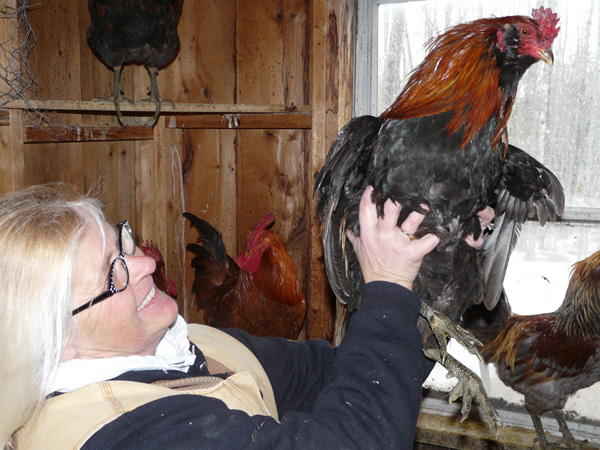 Julie Sutherland, of Leach Hill Road in Raymond. (Staff photo by John Balentine)
Comments are no longer available on this story