
CASCO – Efforts to remove Christian symbols from Hacker’s Hill in Casco – and clear the way for the conservation of the site – hit a snag this week, as a national legal group stepped up to defend the presence of the items, which include religious signs and a cross formed by a thunderstorm.
A Virginia-based Christian law firm, The American Center for Law and Justice, submitted arguments this week opposing the Maine Attorney General Office’s request that all religious imagery on the hill be removed before state funds are used in the purchase of the site. The state Land For Maine’s Future program has promised to donate $220,000 to the campaign aimed at preserving the hilltop, which has been owned by the Hall family of Casco for about 150 years.
While owner Conrad Hall laments the potential loss of the religious imagery and enlisted the help of the ACLJ to fight the attorney general’s interpretation of law, the state funding is deemed essential to the purchase by the Loon Echo Land Trust, which has until June to raise $800,000 to purchase the property from the Hall family.
Background
Earlier this year, the Land for Maine’s Future board of directors pledged the funds to Loon Echo’s “Hacker’s Hill Campaign.” The hill, which has been maintained and kept open to the public for decades by the Hall family, is a popular destination and offers an unparalleled vista of surrounding countryside.
However, because the hill features religious signs and statues, Loon Echo’s sponsoring organization, the Maine Bureau of Parks and Lands, requested a legal opinion this summer from the Maine Attorney General’s Office. The group wanted to determine whether the religious aspects of the site could complicate the state’s funding and open the state to lawsuits based on religious discrimination since the imagery is exclusively Christian.
In an email addressed to David Rodrigues, senior planner with the Bureau of Parks and Lands, Assistant Attorney General Amy Mills explained that all religious statues, as well as a cross atop the hill, would have to be removed if the state were to fund the project, to avoid violating the Establishment Clause of the U.S. Constitution, which bans the government from endorsing religious activity.
“With respect to Hacker’s Hill, I understand that the state will not own this site, that the state is contributing only a portion of the acquisition costs, and that this site is a known recreational and scenic location,” Mills wrote in the email. “Nonetheless, it is conceivable to me that based upon these facts a court could conclude that the religious symbolism and services/activity at the site outweigh the secularizing elements such that the allocation of public dollars to this project may give rise a First Amendment violation. There is at least some liability exposure here that, it would seem to me, should inform the LMF/BPL review process and distribution of funds.”
Since the release of Mills’ email – which she qualified this week as an unofficial opinion that was not based on an exhaustive analysis of the proposal – messages have gone back and forth between local and state officials regarding Mills’ opinion. Selectmen and residents have debated the possibility of the imagery’s removal at Casco Board of Selectmen hearings. Concern about the religious elements being removed led Hall and Don Fowler, a longtime caretaker of the land, to request two months ago – and received this week – a legal opinion from the ACLJ.
Hall, who helped clear the hilltop with his father, Hacker, in the 1950s and ’60s, said he and others in town are concerned that part of the wonder of the hill, especially a hilltop pine tree that broke in 1997 and formed a cross, would be ruined if removed.
Rangers
Hall and Fowler have essentially served as the hilltop’s park rangers since the early 1990s, when Hall inherited the acreage. Believing the vista has spiritual importance they wanted to share, Hall and Fowler have teamed up to mow the 27 open acres, and maintained hilltop toilet facilities, picnic benches and an access road for visitors. Fowler also runs High Country Mission, an outdoor service held Sundays atop the hill that Hall and his family attend.
While the hill didn’t feature religious images years ago, in 1997 a pine tree split and broke in two during a thunderstorm. The top section of the tree fell and nestled in the trunk of the tree, forming a cross. Fowler was present when the lightning bolt hit the tree, and for both Fowler and Hall, the tree is a testament to God’s power.
“Who beside God could have done that?” Fowler said.
In successive years, several other religious symbols were installed, including an anonymously donated carved statue of Jesus holding a child, a recreation of Jacob’s Well, and a sign at the base of the hill.
Needing money to retire, Hall put the property on the market in fall of 2009 for $1.6 million but didn’t get any bites. Last May, he entered a one-year agreement with Loon Echo, based in Bridgton, allowing the land trust a year to raise enough money to purchase the property.
Hall was under the impression that the hill would be preserved as is, symbols included, if Loon Echo were successful in raising the $800,000. However, with Loon Echo saying funding sources are in short supply, and the state’s contribution deemed necessary, Hall became worried by the attorney general’s comments. But he still hopes the religious images can be saved, mainly because he feels they are intrinsically important to the history and popularity of the hill.
“We may be having a Bible study on a Sunday morning and 20 motorcycles come by and they’re very respectful. They idle it down and go on up through and park and walk back and look around. Very respectful,” Hall said. “But where I’m going with this is I think when they come up and see that cross or these spiritual (signs and statues), subconsciously they all of a sudden feel, ‘We want to respect this.’ It gets to them without anyone saying anything.”
Fowler agrees and says the removal of the religious items would take away some of the soul of the place.
“It’s held it together for many years. We’ve never had to be the policemen here, which is saying something,” Fowler said. “The symbols have never been vandalized, never. So, I’m grieved, and I’m concerned. If this stuff goes, what’s going to happen? None of us asked for it, none of us bought it. God did it. Guaranteed. He did this project. All he needed was a caretaker, and Conrad, being the owner, and I fit the bill.”
New legal opinion
However, Hall and Fowler hope the ongoing discussion of religious symbols on Hacker’s Hill will lean their way on account of the second opinion provided this week by the ACLJ.
Erik Zimmerman, an attorney with the Virginia-based firm that specializes in defense of religious liberty, sent a 13-page opinion to the various parties on Tuesday. In it, Zimmerman cited previous taxpayer-funded donations to historical landmarks that feature active religious worship and imagery such as the Old North Church in Boston (where Paul Revere’s famous ride was signaled from the steeple) and the Ebenezer Baptist Church in Atlanta, where Martin Luther King Jr.’s sermons sparked the civil rights movement.
“(Land for Maine’s Future’s) proposed funding is similar in many respects to the funding provided to the Old North Church and Ebenezer Baptist Church,” Zimmerman wrote. “Just as the Establishment Clause did not require those churches to remove all religious symbols or cease all religious activity on the premises before receiving federal funds, it does not require Loon Echo to take similar action as a prerequisite to receiving LMF funds.”
Zimmerman went on to argue: “LMF aid is provided on the basis of neutral, secular criteria … and the program does not incentivize religious activity. The minimal religious imagery or worship that is present on the property is clearly not attributable to the state of Maine. LMF funds further the secular purposes of the program, not any incidental religious message that is of a recipient’s own choosing.”
Flipping the tables on the attorney general’s opinion, Zimmerman also argues removal of longstanding religious items on the hill could also be an infringement on the Establishment Clause and religious freedom.
“An absolute bar on any and all future religious worship or imagery at Hacker’s Hill could itself be unconstitutional. Various individuals and small groups freely enter and use the property for a variety of purposes,” Zimmerman wrote. “To allow all manner of secular discussion on the premises, while prohibiting religious worship, exhibits a hostility toward private religious speech that contradicts the First Amendment’s fundamental principle of government neutrality toward religion.”
Caught in the middle
Fowler sees Loon Echo, which already owns or maintains 3,750 acres in the Lakes Region, as “caught in the middle” and said they’re coping with an economy that makes fundraising difficult. Nevertheless, Fowler is focused on the future uses of the hill, including his informal High Country Mission, and is hopeful the cross, statue, signs and services can remain.
Loon Echo, on the other hand, is focused on the secular aspect of the hill, with the group’s executive director, Carrie Walia, saying the land trust plans to accept the sizeable pledge from Land for Maine’s Future and go along with whatever requirements the state attaches to the $220,000 donation.
“LELT’s position is that it intends to accept the state’s funding,” Walia said. “There is no other known large funding source that can replace the LMF award. So if it were to be withdrawn, for any reason, the project would likely fail.
“It is too risky to reject the funding in hopes for some unknown source to appear,” Walia continued. “If there were other funding alternatives, those involved in advocating for the protection of the hill since it was placed on the market in November of 2009 would have stepped up to the plate and applied such sources themselves. While LELT is pleased with its progress of raising $435,000, we’ve also already appealed to the most dependable donors and funders, so the remaining $365,000 will not be easy to come by.”
Walia said she appreciates the tender nature of the debate over the cross and statues – and the feelings of the owner and caretaker.
“LELT doesn’t have a position on the religious symbols themselves,” she explained. “LELT’s position is that the organization is working to preserve the natural qualities of the hill, and that everyone, no matter their religious beliefs or physical ability, should be able to enjoy all that the hill offers.”
She also said the land trust has been lobbied by local residents with wide-ranging religious views regarding whether to keep the imagery.
“LELT has been approached by Christians who appreciate the structures and wish they could stay; by Christians that understand that public funding means no religious structures and that’s the sacrifice that will have to be made to keep the hill as open space; and from non-Christians who said that they’d feel much more welcome at the hill if the dominating structures were not present,” Walia said. “Nearly all people say that they can practice spirituality at the hill, or anywhere else, and do not need permanent structures in order to worship. So, if LELT were given the opportunity to make a decision about the religious structures on its own (with public input of course), it would have to do so very carefully, and there would be no guarantee whatsoever that the structures would stay in the end. LELT’s a 501(c)3 charity, and we have to keep the best interest of all the public in mind when making such decisions.”
Hall and Fowler, too, have been approached by residents who would be similarly grieved if the hill’s character changed. The town of Casco’s $75,000 pledge might have to come to a revote, Fowler said, since voters assumed the hill would remain as it is.
“There’s been a lot of controversy throughout the nation on religious statues, paraphernalia, so forth and so on,” Hall said. “But I say, if it ain’t broke, don’t fix it. It’s worked very well up to this point, and there are those out there that want to fix it, make it different. And as far as getting rid of (the imagery), I could live with everything, I guess, if I had to, except seeing the cross come down. We didn’t put that there. Someone bigger than any of us did.”
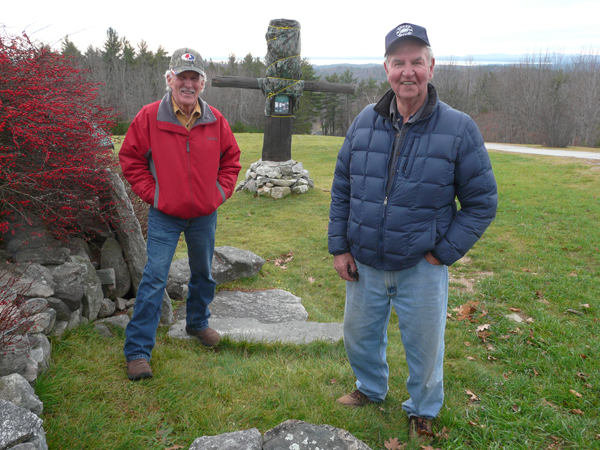 Hacker’s Hill property owner Conrad Hall, right, and longtime
caretaker Don Fowler have enlisted the help of a national legal
firm in their quest to see religious imagery, including the cross
in the background, remain in place. The firm was enlisted after the
attorney general argued that First Amendment rights, namely the
inability of government to show favoritism to any one religion,
would prevent the state’s involvement in the purchase of the
property if the imagery is allowed to stand. (Staff photos by John
Balentine)
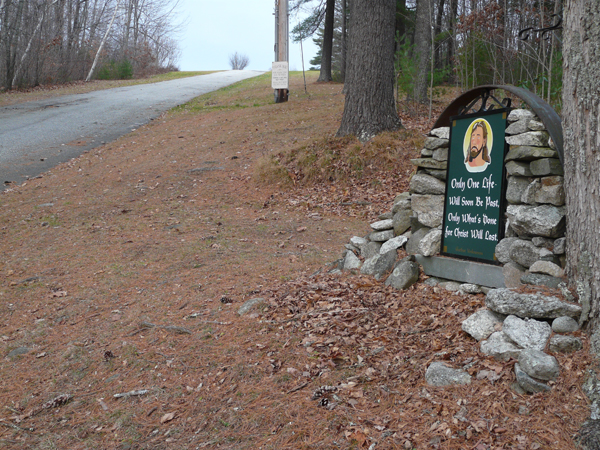 The Maine Attorney General’s Office has informally deemed the
religious imagery on Hacker’s Hill, such as this sign at the base,
as possibly exclusionary of people of non-Christian faiths.
Comments are no longer available on this story