
WINDHAM – With evidence collected earlier this year showing widespread PCB contamination at the former Keddy Mill in South Windham, the state is turning up the heat on the mill’s owner to clean up the site.
According to Jean Firth, Brownfields coordinator for the Maine Department of Environmental Protection, the state sent a letter Aug. 26 to the mill’s owner – HRC-Village at Little Falls, LLC based in Portland – seeking clarity on the owner’s willingness to voluntarily clean up the site. The owner has until Sept. 30 to respond to the DEP with a detailed mitigation plan.
If the company does not meet the Sept. 30 deadline, the state, Firth said, would move to clean up the site under authority given it by federal law. Any costs incurred by the state would be passed on to the mill’s owner for repayment.
Starting last October and continuing in April, soil scientists from Maine DEP and the town of Windham’s consulting firm, Summit Environmental, worked with the federal Environmental Protection Agency to collect and analyze hundreds of samples from inside and outside the mill structure. A brownfield assessment grant obtained by the town of Windham paid for the testing at no cost to the mill owners. Once those soil tests determined PCB contamination at the site was worse than suspected, the state requested the owner erect a fence in an attempt to keep people out of the area. The owner spent about $20,000 erecting the chain-link fence in May.
Since then, Firth said, “not a lot of steps have been taken” by the mill’s owner to either further investigate or mitigate the pollution, which in places is 42 inches deep in the form of PCB-laced metal shavings, byproducts from when the mill’s primary function was cutting steel.
PCB, which was used up until the 1970s as a lubricant, is able to withstand high temperatures such as those found in electrical transformers in mills and is a known carcinogen. Firth said health concerns are minimal for area residents as long as the soil remains undisturbed.
Concerning Keddy Mill’s level of contamination relative to other former mill sites that used PCB lubricants, Firth said, “This one is rather unique for Maine. There’s nothing quite analogous to the toxicity levels we found.” Locals have long suspected contamination was profound at the site, but the mill has been vacant for more than two decades.
“We’re at the point something has to happen,” Firth said. “The owner has so far been in a voluntary program, but if they not willing to (comply voluntarily), then we would put them in a program that has enforcement elements.”
Those “elements” would require payment for remediation, which Firth said could vary significantly depending on what a full-scale site investigation finds. Estimated clean-up costs based on initial findings could be as low as $800,000. But with riverbed contamination likely as well, an item Firth said would also be investigated in a full investigation, Firth expects higher mitigation costs.
“And $800,000 is probably low. It’s probably a few million,” Firth added.
If the mill owner decides to work with the state, the Sept. 30 proposal would have to include a remediation plan consistent with federal PCB removal methods. The bulk of the mitigation costs, Firth said, would be the actual hauling off-site of the PCB-contaminated soil and concrete and then whatever costs there would be associated with dumping the material in a federally licensed facility.
The amount of material would likely be significant, since initial testing found contamination “widespread, but low-level” throughout the site, including in the concrete floor of the building. While initial testing of the floor found similar concentrations of PCB at depths of a half-inch and an inch, Firth said the contamination likely seeped deep into the flooring making partial removal questionable since it would compromise the integrity of the entire structure.
“Where we come down is that there is a threat to public health, and it needs to be addressed,” Firth said.
The property owner’s representative, Renee Lewis, who once had plans to build condominiums at the site, did not return a request for comment on how the company is planning to proceed.
Tom Bartell, Windham’s economic development director and the town’s liaison for the Keddy Mill issue, said the town is off the hook for any cleanup costs, something town councilors wondered at last week’s council meeting. He said the only role the town has had has been paying for the recent brownfield assessment that helped determine whether there was pollution at the site. While the town is not responsible for cleanup, Bartell said, it is interested in the site’s future since it represents a major eyesore for area residents.
“We’re interested in getting the mess cleaned up and putting the site back working for the community. That’s always been the town’s goal,” Bartell said. “DEP has seen what they need to see, and now they’re following up with the owners with the intent of moving forward with the project.”
Bartell said the mill’s owner have been dealing with “legacy issues” since buying the mill, problems inherited from past owners who used chemicals thought to be safe at the time. Bartell, who was on the Town Council when the site was eyed for condominiums, said the discovery of PCB put the owner in “a tough spot. It tried to do something with the property, but things have gone from bad to worse. But the DEP looks at this stuff very factually and they’re looking to get it cleaned up.”
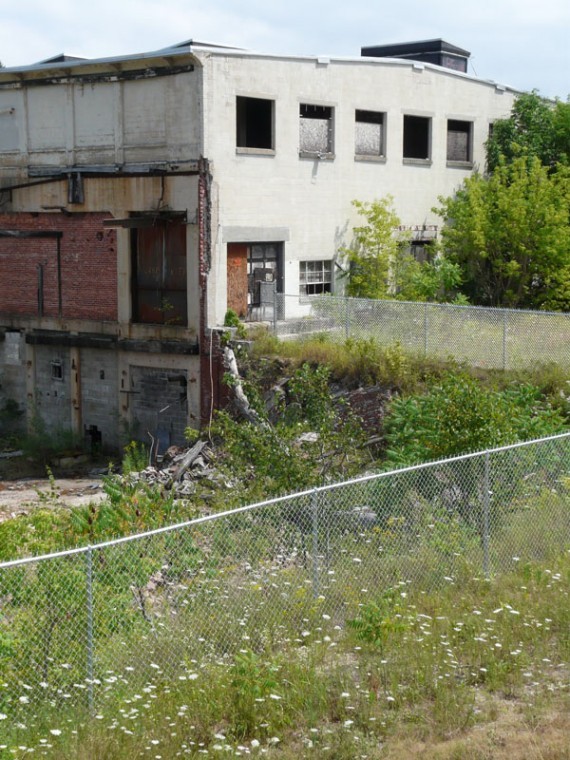 A fence was erected in May to keep people from entering the
Comments are no longer available on this story