
LAKES REGION – Anyone who says Maine somehow dodged the worst of Tropical Storm Irene doesn’t know what they’re talking about – at least according to residents who had trees spear their homes, Central Maine Power and Lucas Tree line workers who have worked 17- hour days since Sunday, and Sebago Lake residents who have resorted to using lake water to flush their toilets.
The evidence that Irene was a major storm, with many lingering effects, still is everywhere around the region, especially right around Sebago Lake, where high winds blew boats off their moorings and pushed docks up onto land.
The range of storm-related stories are minor to severe, with some of the worst including a husband and wife from Raymond, Lewis and Elizabeth Somers, who started a generator in the basement of their home on Musson Road and died as a result of carbon monoxide buildup in the structure.
Another couple, Matthew Fletcher and Crystal Remedis, escaped injury when a falling pine tree cut their camper in two at Nason’s Beach and Campground in the town of Sebago.
But the bulk of the tales are of people who woke Monday to find debris scattered around their yard, food spoiled in their refrigerators and no way to take a much-needed shower.
“I’ve heard a lot of people saying we dodged a bullet with this storm, but I think if you ask people living especially west of I-95, they certainly don’t think we dodged a bullet. There is a tremendous amount of damage especially in western Maine as a result of this storm,” said Central Maine Power spokesman John Carroll.
At the height of the storm, 280,000 customer accounts were without power in Maine, Carroll reports.
“As we say, it was flat, literally 100 percent without power, especially in the towns around Sebago Lake and western areas of the state,” Carroll said.
On Wednesday afternoon, things were back to normal for many customers, but still “flat” for the 44,000 still without electric service.
“This is the second or third largest outage since the ice storm in 1998. We had 284 broken poles, which reflect the fact that it wasn’t just limbs coming down and knocking out power, but whole trees were being uprooted and falling down hard on the power lines, destroying the poles in the process,” Carroll added.
To meet the demand, Carroll said, there were still 285 line crews and 160 tree crews spread through the remaining outage areas dealing with downed trees and unpassable roads in an effort to reconnect homes to the electrical grid. And some towns in the Lakes Region were far from being back online. Carroll said 99 percent of Sebago customers were still without power as of Wednesday afternoon. Other towns were fairing a little better, with 35 percent of Naples accounts restored, 56 percent of Gray restored, 45 percent of Casco restored and 60 percent of Raymond restored. Windham, by comparison, was almost fully restored by Wednesday afternoon.
Daniel Shaw, a resident of Shaw Road on Raymond Cape, had a particularly harrowing tale to tell. While trying to remain upright while walking down to the his Jordan Bay shoreline to check on his sister’s boat, which had been swept from its mooring and had landed on the rocky shore of Jordan Bay, he happened to walk by a large pine tree just as it cracked and smashed to the ground in several chunks.
“I heard a crack, and I ran. That wind was whipping across Jordan Bay probably around 70 mph,” Shaw said. “I’m lucky.”
Shaw, who is a retired middle school teacher and spent time studying meteorology, said the waves were rolling in across the 2-mile wide Jordan Bay and were at about 4 feet when he saw them Sunday afternoon. They were exploding up through the planks of his dock, he said, something he’s rarely seen before. To each side of his dock, large trees were felled by the wind, with long roots exposed, as well.
“This was really bad,” Shaw said. “Look at what it did to the trees, whole root systems were torn out. I don’t understand people who say this was a little storm. I was out there, it was close to hurricane force winds.”
Out of power
While rain was kept to a minimum in the area, the high winds that buffeted the Lakes Region took a toll on lakeside areas especially right around Sebago Lake. The result was downed power lines and cut-off homes.
Boston-area resident Ben Friedman, his wife, their two kids and Friedman’s parents delayed coming to Raymond Cape for their annual vacation until Monday and were welcomed by a power outage. Friedman, like many in the area, was making the best of it and doing what he had to for his family, namely grilling the food they would eat and hauling water from the lake to flush the toilet.
“We come here every year, and while it’d be nice to have a hot shower, I don’t miss the computer or any of that,” he said Wednesday morning on his way to Dunkin’ Donuts in Raymond to get his morning coffee. “And the water is on a pump so we’ve been filling up buckets for the toilet from the lake. That works out well, but no showers.”
A longtime seasonal resident of Raymond Cape, Carol Hall, a nurse from Fall River, Mass., said she survived Hurricane Bob’s resultant power outage in 1991 and she’ll survive Irene’s aftermath. A visitor each summer for the last 54 years, Hall stays at her family’s cottage on Sebago Lake off Murch Landing Road. She’s reading by kerosene lantern and going to bed early, rising with the sun.
“I’ve gone back to the days when there was no power here, lugging water up from the lake, to sponge-bathe in,” Hall said. “So I’m going back to my roots when there wasn’t any electricity out here. It’s like stepping back a century.”
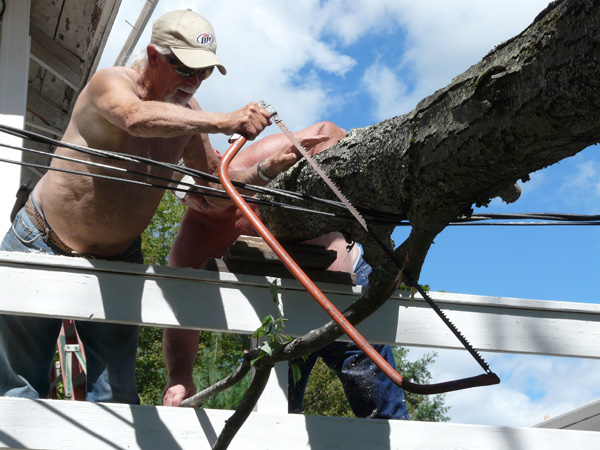 On Monday morning, Bob Genthner was being careful to avoid wires
Comments are no longer available on this story