
WINDHAM – In some ways, the work to re-establish the Mountain Division rail line is going better than ever.
This summer, a crew of laborers from South Portland-based Maine Track Maintenance is laying rail along the 5.25-mile section from Bridge Street in Westbrook almost to the Mallison Falls Road rail overpass in South Windham, near the prison, improving four road crossings along the way.
The $4 million project, which will help turn the Mountain Division line into a “rail-with-trail” as a recreational path is also put in place, was approved by Maine voters as part of a $47.8 million transportation bond package in June 2010. With the backing of state Sen. Bill Diamond, a Windham Democrat, an additional $21 million was to be placed in a bond package to be put before voters this year, funds that would have finished the line, which in total runs 50 miles, from Portland to Fryeburg.
However, Gov. Paul LePage and Republicans in the Legislature, who campaigned on promises to curb government spending and borrowing, nixed any talk of bonds for this year, setting aside a reported 29 bills seeking bonds for a variety of infrastructure projects. The decision puts the Mountain Division project on hold for now, at least once the Westbrook-to-Windham section is complete, and affects both the Western Maine companies pushing for rail access to help their businesses, and the recreational groups seeking a new addition to the state’s trail offerings.
Finding funding
Starting in 1994, the Maine Department of Transportation bought the 50-mile line from Portland to Fryeburg from Guilford Transportation, now Pan Am Railway, with the stated goal that it would eventually reintroduce rail travel. With the national rail-to-trail movement in full swing in the early 1990s, a parallel goal was to build a pathway alongside the rail line to provide for recreational bicycling or walking. The citizen-led Mountain Division Alliance was formed to advocate for and supervise the eventual trail system.
“It has always been the original vision of the Mountain Division Alliance that the rail would come back,” said the group’s president, Dave Kinsman of Fryeburg.
While much of the Mountain Division line already has 85-pound track, much of it is lying on an eroded rail bed. Before freight or passenger rail can be reintroduced, the entire works need to be replaced, especially at road crossings where the rail has for the most part been paved over. In fact, the section being worked on from Westbrook to the prison in South Windham has no track at all.
To pay for the upgrades needed from South Windham out to Fryeburg, Diamond sought the $21 million needed for such upgrades. Those upgrades would have started where the $4 million rehab project is ending this year. However, with the halt to bonding, the package is delayed.
When contacted last week, Diamond said he may propose a pared-down package next session – a request of $8 million – so the rail line can be improved from the end of the current project to Baldwin.
“Three-quarters of the businesses that would benefit from reintroduction of the rail line are in that section (from Portland to Baldwin),” Diamond said. “While I would still push for the $21 million, which is the number we got from (Maine Department of Transportation), if it makes sense to do it incrementally instead, then we’ll look at that.”
While the governor and Legislature can approve putting items out to referendum, any bonding would ultimately need to be approved by Maine voters, Diamond added.
Trail work
With this summer’s work on the section between Westbrook and South Windham, the Sebago to the Sea Trail Coalition, which formed two years ago to advocate for a contiguous recreational walking/biking path from Sebago Lake to Casco Bay, are having to change their plans for the area being upgraded with new track.
According to spokeswoman Tania Neuschafer, the group is hoping to dedicate a new 11-mile section in early November from the Mallison Falls Dam to the Riverton section of Portland, passing through Westbrook. Instead of using the rail line, the group says users can paddle from an access point at the dam to a portage on Lincoln Street before the Presumpscot Falls Dam in Westbrook. From there, the group will unveil a new overland section connecting into the Riverton area of Portland.
“This paddle section is our current strategy to get trail users from South Windham to Westbrook while the Mountain Division Trail is being built,” Neuschafer said.
While recreational use will be impossible on the rail line due to the presence of work crews and the lack of a pathway, soon, the section from Westbrook into Windham could see a trail rivaling the paved path from South Windham to Standish, Neuschafer said. In May, the state Department of Transportation approved a Quality Communities grant in the amount of $150,000, for which the towns of Windham and Westbrook filed jointly.
The grant, obtained through federal highway funding, will pay for the engineering of a trail adjacent to the rail line from the railroad’s crossing of Route 202 in South Windham all the way to the Westbrook/Portland line. Once the engineering is complete, the two towns would then apply for another grant to pay for the actual building of the pathway.
Kinsman, of the Mountain Division Alliance, said an engineering firm should be hired for the design work by early fall. While it has taken years for the recreational path to take shape, he is encouraged to see work being done to improve the trail section of the Mountain Division corridor. Once the design is complete, Kinsman said, he is hopeful the money comes through for building the trail so it can benefit recreational users as well as bicycle commuters wanting an alternative to driving.
“This is a real alternative for commuters,” Kinsman said.
When asked about the safety aspects of a train running next to a pedestrian way, Kinsman said there are 3,000 miles of rail-trails in the country, with 1,100 of those miles alongside active rail lines. He said the engineering schematics will indicate where fencing or other safety features is required. He said the train track won’t run any closer than 10 feet to the trail, with 15 feet the average distance. (The state owns a 66-foot right-of-way through the corridor.) So for bicyclists accustomed to riding on the road, he sees little relative danger.
“Bicyclists are constantly having to avoid vehicles on the road going 30-60 mph passing very close by. The trains, on the other hand, will never go that fast and they never swerve,” he said, adding that there has not been a rail-trail death from a collision with a passing train in America.
Business interests
While railway work has started in Westbrook, work of another type is set to commence in Baldwin at F.E. Wood, maker of wood pellets for industrial applications. Owner Tony Wood is hoping to ship his product via rail, rather than by truck, to Portland to be shipped to spots on the East Coast.
“We were disappointed by the funding delay on the Mountain Division rail, but the timing was certainly difficult for bond funding in general,” Wood said. “We feel confident that the rail revitalization and necessary funding will continue soon, and we look forward to having the link to Portland. It is important for our project, but also for the surrounding region.”
Caroline Paras, a community and business development specialist with Greater Portland Council of Governments, has been working with Wood and other business owners in Standish, Baldwin, and Fryeburg in lobbying for rail reintroduction. In F.E. Wood’s case, she says rail would alleviate thousands of truck trips a year from Baldwin to Portland, trucks that are now using, and taking a toll on, local roads.
Paras said Wood and other business interests met with state lawmakers in May to discuss the rail line.
“A group of business leaders met with the governor to gauge his support, and he definitely seemed to support it,” Paras said.
Track to nowhere?
The contention that the $4 million being used to upgrade track from Westbrook into Windham that voters approved in June 2010 is being spent in vain if voters don’t approve further bonding for the project, is a significant point not lost on opponents of the project.
Windham Town Councilor Tommy Gleason said decision makers are bringing rail in the wrong part of the state, on a track that Guilford closed in the early 1980s because it was a geographically challenging and relatively slower route that bypassed large population centers.
“This money would be much better spent extending rail on the coast, especially in Brunswick, which is where you’re seeing a lot of the major investment coming into this state,” Gleason said. “This track along the Mountain Division, I just don’t understand the reasoning behind it.”
Gleason said the jobs that would be created are too few to pay for the cost of the line, and that subsidies would be required into the future. He sites required subsidies for Amtrak, which are so steep the federal government is considering selling Amtrak’s line in the Northeast Corridor.
“A couple dozen jobs isn’t going to pay for this railroad,” Gleason said referring to operations like F.E. Wood. “Also, what are the real costs and what are the subsidies? No one really knows. There are a lot of unanswered questions. Too many.”
Diamond says the Mountain Division railroad is an investment in the future of western Maine, and that “major players” in government and business are supportive of it. He doesn’t think the $4 million being used to place new track from Westbrook to South Windham should be considered a “track to nowhere” since it requires further funding, mainly because it has broad support.
“What the governor said at this meeting in May, during which the DOT commissioner and business leaders were present, was, ‘We’ve got to do all we can to make this happen,’” Diamond said.
Repeated attempts to solicit comment from Gov. Paul LePage on his views of the project went unanswered by press time.
Regarding Gleason’s contention that the resulting jobs are too few, Diamond said F.E. Wood’s projected 35 jobs is just the tip of the iceberg, and that the railroad could be a boon for all sorts of freight haulers.
Diamond also noted that all public transportation modes cost money to build and maintain.
“There is no transportation mode that is free, and none of it makes money,” said Diamond. “Even the Amtrak Downeaster, which people seem to love, receives significant subsidy.”
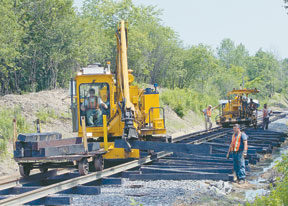 Operator Lee Brown and Dave Swett of Maine Track Maintenance in
Comments are no longer available on this story