
GORHAM – A middle-aged man and a young son paddled up the Presumpscot River and into the Little River on a spring day in May 275 years ago to begin building.
Capt. John Phinney, 43, and Edmund Phinney, 13, were the first to arrive in 1736 in a wilderness that would be carved into civilization – Gorham. Other families, like the McLellans, Moshers, Hamblens and Aldens, would also come to endure early hardships in settling the town.
“They were real pioneers,” the Rev. David Butler, pastor of the First Parish Congregational Church in Gorham, said recently.
From a single log cabin in the wilds, Gorham has grown to 5,789 housing units, according to town statistics, and the population has grown from 432 in 1763 to 16,381 in the 2010 census. Though still rural, the town is home to growing industries. Gorham has recently bolstered its efforts to attract more business to broaden its tax base. With major state highway routes 22, 25, 112 and 114 running through the town, local officials are continuing to seek solutions for its long-standing traffic congestion.
Next week, the town originally known as Narragansett No. 7 celebrates its past and present with a four-day Gorham Founders Festival, Friday, May 27, and continuing through Monday, May 30, with ceremony, tours and amusements.
Town leaders will participate in a ceremony at 9 a.m. on Saturday, May 28, at Narragansett School on Main Street officially opening the festival. TV meteorologist Matt Zidle, a Gorham resident, will deliver the opening remarks and Burleigh Loveitt, a former longtime Gorham councilor, will present a history of the town. Gorham High School Chamber Singers will perform, concluding the ceremony.
A descendent of the Gorham’s first settler, John Phinney, will be recognized in the ceremony as the festival’s honoree.
“We really have a strong weekend planned, and are very pleased with what we have,” Town Councilor Phil Gagnon, who chairs the festival committee, said Tuesday.
Gorham was a land grant as payment to descendants of soldiers who fought in the so-called King Philip’s wars in southern portions of New England against Native Americans. The grandfather of settler John Phinney fought in the war in 1675.
During the French and Indian wars, the entire population in Gorham was ordered into the fort, said Butler, who is pastor at the church began by town founders.
Some Gorham settlers were killed or captured.
Butler said Gorham was the first inland town in this area in Maine. When trouble arose, some settlers vacated for safety of the coastal towns.
The population of the struggling community shrunk from 18 families in 1745 to 10 families in 1746, according to Gorham Historical Society.
“Those who were left were a stalwart group,” Butler said.
Collecting their family’s back pay in land, settlers in Gorham faced starvation, deprivation and disease in those early days. Gorham resident Abbott Mosher, whose forebear, Daniel Mosher, was one of the first, recently told about the rigors of that era.
Abbott Mosher spoke about settlers enduring the winter cold and of settlers wearing leather shoes that soaked up water.
From observing cemetery markers, Mosher said some families had 10 children and only one might have survived to reach teenage years.
As the forest gave way to hard labor, the men and women of Gorham built homes, farms, churches and villages. The Rev. Solomon Lombard was the first settled minister in 1751.
The town was rooted in farming and lumbering. Nearly three centuries later, Gorham is still a largely rural town, but farming has declined in recent decades.
Phinney’s first crop included corn, and some of today’s remaining farmers still carry on the custom.
Descended from Gorham pioneer stock, dairy farmer Bob Parsons of Buck Street recently followed that tradition. He plowed furrows in the rich soil of a 60-acre field 2,000 feet in length in preparation for planting corn.
“My own area hasn’t changed too much,” Parsons, 50, said climbing down from a tractor cab.
Parsons graduated Gorham High School 32 years ago.
“There’s been a lot of changes in town since 1979,” Parsons said. “There were some (farms) on every road,” Parsons said.
While farming has diminished, diversified industry has sprouted. Two well-known families with roots in Gorham agriculture have shifted to the construction field. Both R.J. Grondin & Sons and Shaw Brothers Construction Inc., are among the town’s largest employers and among leading highway contractors statewide.
When the settlers arrived, waterways and Indian trails in the wilderness were its only roads.
“The river was the main artery of transportation,” Abbott Mosher said.
Today, Gorham has 143 miles of road and a modern bypass of Gorham Village, the Bernard P. Rines Highway.
Reactivation of a rail line through Gorham is under consideration in a study aimed at reducing highway traffic. Nearly 150 years ago, a Gorham man, Stephen Stephenson, a cousin of Henry Wadsworth Longfellow, was a civil engineer who helped design the line then called the Portland and Ogdensburg rail. A section of that line, now known as the Mountain Division, opened from Portland to Sebago Lake in 1870, according to the “History of Gorham” by Hugh McLellan.
Preserved in town are multiple historic sites and monuments of the past. The old fort was built on high ground and serves as a park today. The hilltop has a view of the mountains and Mount Washington.
Gorham families have produced a long list of worthy citizens, including two Maine governors – Frederick Robie and Percival Baxter. Last year, a Gorham resident, Shawn Moody, mounted a strong bid as a gubernatorial candidate. And Rodney Quinn, a retired Air Force colonel, is a former Maine secretary of state. An author who wrote a Gorham history, Quinn is an American Journal political columnist.
Gorham also can lay claim to congressmen. Seargent S. Prentiss attended Gorham Academy and had studied law in a Gorham office before moving away. He represented Mississippi in Congress and began serving in 1838. Prentiss gained fame as a great orator. Born on a Gorham farm, Stephen Longfellow, father of the poet Henry Wadsworth Longfellow, was a lawyer and also served in Congress.
Gorham families have produced some notable religious leaders, too. A widely known pastor and author, the Rev. Elijah Kellogg, attended Gorham Academy and wrote the book “Good Old Times,” telling of early farm life in Gorham. Kellogg was the keynote speaker at Gorham’s 150th anniversary in 1886. Ellen Gould White, who was born on Fort Hill in 1827, was a founder of a movement that led to the Seventh-day Adventist Church.
Over the generations, some Gorham teachers earned international reputations. A teacher and principal in 1898 at the Levi Hall School in North Gorham, Donald MacMillan became a Navy rear admiral and gained acclaim as an arctic explorer. More recently, now-retired Gorham High School teacher Bob Crowley earned $1 million when he was named winner of the TV show “Survivor” in 2008.
Butler thinks the founders would be proud of the way the town turned out.
“It has kept a lot of its original character,” Butler said. “It’s a pretty nice town.”
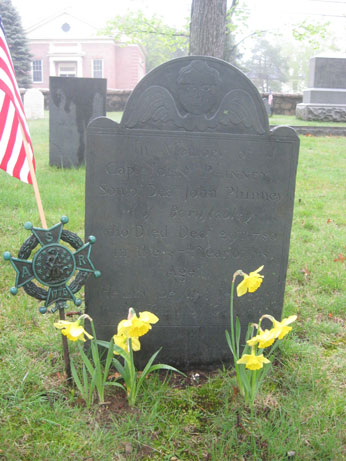 This stone in the Gorham Village Cemetery on South Street marks the grave of Gorham founder John Phinney, who was the first settler in 1736. (Staff photo by Robert Lowell
Comments are no longer available on this story