
WINDHAM – If watching what you eat is one of your New Year’s resolutions, then a new program that directs federal stimulus dollars to the Lakes Region may just be your cup of ginseng.
The Maine Center for Disease Control last year was awarded $4.4 million in funding from the 2009 American Recovery and Reinvestment Act to administer several new nutrition-based programs around the state known as Smart Meals for ME.
The two-year grant, which began last spring and culminates in March 2012, is channeled through local Healthy Maine Partnerships and employs five people in the Lakes Region, an area where 68 percent of the residents are overweight or obese, slightly more than the state average of 64 percent, according to Emily Wolff, who oversees the regional program.
Through the program, the Lakes Region is receiving $1.4 million. The funds are going to local schools, recreation departments and community gardens with the goal of improving the health habits of students and residents. Money is also available to local restaurants that want to create menus that inform diners of the caloric content of their meals.
According to Wolff, nine local adult education and recreation departments around the Lakes Region are sharing $24,000 in funding aimed at increasing physical activity opportunities for residents. Also, $13,700 is going to five area community garden organizations to increase access to healthy food for low-income community members.
Also, several area restaurants, the first of which was the Tiki Bar & Grill in Naples, have already taken advantage of the menu-changing program, and officials are working with several other dining establishments in the area.
Another significant portion of the funding is going toward Windham-Raymond Regional School Unit14 and School Administrative District 61, the Lake Region school district, to improve habits related to nutritional health.
According to Wolff, the fact that nearly seven in 10 Lakes Region residents qualify as obese or overweight is a “serious” statistic precipitating the need for the educational efforts.
“The focus is all about access: how can we increase access to nutritional information to make the healthy choice the easier choice,” Wolff said.
Restaurants
Part of the Lakes Region-focused program, aimed at educating diners at local restaurants, is already up and running. The Tiki Bar & Grill, on Roosevelt Trail near the Causeway in Naples, was the first beneficiary of the program to offer diners a revised menu indicating the calorie count of each item, from appetizers to desserts.
“We’re into our sixth year as a restaurant and each year we’ve tried to expand on our menu,” said Stephen Kirk, the owner. “But I thought it was an awesome idea. Some people don’t care about the calorie count, but more and more people do care, and this is what prompted us to look at our menu.”
Kirk and his head chef, Jeff Daniels, spent last August measuring the ingredients they use in each dish with the aid of registered dietician Stephanie Agne, who is one of the grant team members designated to the Lakes Region.
Agne took the information and tabulated each menu item’s total calorie count. A new menu was then printed and hit the dining tables in November, enabling diners to know exactly how many calories they were ordering. All this was done at no cost to Kirk.
“I’m so glad the grant was there because this is very expensive to do,” Kirk said. “It would have cost $6,000 to $8,000 to do this.”
Agne, who is working with a dozen restaurants in Portland as part of the Healthy Portland grant portion, said a few other restaurants in the area are following the Tiki Bar’s lead, including the Asian cuisine-themed Ginto Restaurant in Windham and the cafe? at the Bridgton Hospital. She’s also meeting with other restaurant owners and is looking for other restaurants to get on board.
“There’s no cost to the restaurant in this,” Agne said. “But we’ve seen that the Lakes Region has been a little slow to jump on board, but maybe after the New Year that’ll change.”
As part of legislation passed in Congress last year, Agne said major chain restaurants will be required to post calorie counts. That would affect North Windham, with its several major chains. McDonald’s already offers calorie counts but only at a customer’s request. Agne said privately owned restaurants should take advantage of the stimulus-sponsored program sooner rather than later.
“In the future, it’s going to be more of a normal thing. The hardest part for the restaurants is gathering the recipes,” Agne said.
Agne is familiar with arguments against the proposal, namely that customers may be turned off from patronizing a restaurant if they know how many calories go into their favorite dish. She says the push to list caloric content is mainly for the benefit of frequent diners, not those who occasionally go to a restaurant for a special meal.
“What I tell restaurant owners who are a little hesitant is that this is an awareness thing, especially for someone who eats out seven days a week,” Agne said. “Someone who eats out once a month probably won’t care, and if they do, maybe they will go ahead and eat a 2,000-calorie meal and the next day eat very little. So it’s really about awareness.”
School efforts
Agne and Wolff are also working at schools in the Lakes Region trying to list calorie counts for cafeteria food, among other efforts. Agne is working with Windham-Raymond RSU 14 and another member of the grant team, Courtney Kennedy, is focused on all the schools in the SAD 61 system in the Naples area.
Kennedy is putting together a District Wellness Policy aimed at all areas of student health, including physical education, health classes and food services. She is even working with individual teachers on trying to set good classroom policy on such things as steering teachers away from using food as a reward. Kennedy said she is leading workshops with teachers on finding other celebrations that take the focus off food.
“We’re trying to review what is good policy, and one you may not automatically think about is using food as a reward in the classroom. Candy, M&Ms, giving kiddos those sorts of rewards creates a bad response,” Kennedy said.
Kennedy is also pursuing a school garden for the district, in order to get more fresh veggies into the kids’ diet.
“It’s really a simple concept: Teach kids how to plant their own food, how to harvest it and how to eat it,” she said.
The point of the school-based efforts, Kennedy said, is focused on obesity prevention but also on “creating an environment so they can learn to the best of their capacity.”
In Windham-Raymond, which already has a school health coordinator, Stephanie Joyce, several things are about to happen because of the federal grant.
Joyce says $4,700 will be used to build walking paths at each of the schools in Windham and Raymond. Another $2,250 will be spent on school gardens for each of the six schools in the district. School fitness equipment, which will be used at recess for younger kids and gym class for older students, will be bought with $7,500 of the grant funding. A total of $50,000 of food service equipment will be bought to preserve vegetables harvested from the new school gardens. Plus another $2,500 will be made available in open-ended funding that school officials can use at their discretion, perhaps to revise the district wellness policy or buy healthy vending machines or water coolers, Joyce said.
“We’re really excited about the possibilities,” Joyce said. “The grant isn’t just taking one approach. They seem to be trying to bring in the schools and the community.”
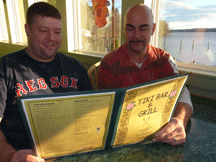 Naples’ Tiki Bar & Grill owner Stephen Kirk, right, and head chef Jeff Daniels check out the restaurant’s new menu listing each item’s total caloric content. Kirk was the first restaurant owner to take advantage of a federal stimulus grant aimed at reducing obesity rates in the Lakes Region. (Staff photo by John Balentine)
Comments are no longer available on this story