
WINDHAM – One of South Windham’s major employers, mWave Industries, is adding to its workforce, acquiring new contracts and busily designing and assembling antennas to be used in the new 4G cell phone market.
The higher the “G,” short for gigahertz, the faster cell phone users can download information to their “smart” phones. To accomplish the higher download speeds, however, more bandwidth is needed. Due to the need for increased bandwidth, companies like mWave Industries are helping cellular communications companies to bolster the infrastructure – namely high-powered antennas – they use to deliver bandwidth to customers.
“When cellular started, what was it? It was a phone. We talked. Now you can do everything,” said Michael Cahill, vice president of sales and business development for mWave Industries. “And people don’t comprehend the infrastructure that a company like Sprint or AT&T Wireless has to put in place to handle all those calls, all that video streaming, all that informational data. And this is one of the solutions.”
The company, located just off Main Street and owned by Windham resident Peter Anania, is one of the few companies in the world which has been able to design and bring to market new antennas capable of handling the higher bandwidth requirements.
Rather than focusing on antennas inside a cell phone, mWave develops tower-based antennas up to several feet in diameter that shoot signals from towers to switches located inside a company’s telecommunications hub. In the lingo of the antenna biz, this part of the communications web is called the “backhaul,” Anania said. The new generation of mWave antenna is capable of delivering 80 gigahertz of “backhaul” bandwidth capability, or about twice what fiber optic cables can transmit. Without an antenna’s ability to shoot huge packets of information quickly, cell phones users would experience severe traffic congestion on the Information Highway.
“It’s the wave of the future,” Cahill said. “There are very, very few people who can do this right now. And it was all designed right here in South Windham. We have our own test range so we were able to test and now we’re selling it.”
Recently, the company received a $2.2 million order from E-Band Communications for 5,000 of the 1-foot and 2-foot diameter 80-gigahertz parabolic (disc-shaped) antennas. Cahill reports the company is in negotiations with two other companies as well.
“It’s not just the United States, this is an international phenomenon,” Cahill said. “We just shipped 30 antennas to Russia that are hopefully being installed this week. We’ve shipped to China as well.”
Anania couldn’t be happier with the progress of the company. Anania, who owns and oversees two other South Windham companies (Maine Cedar Log Homes and Industrial Microwave Oven Services) as well as MEGA Industries in Gorham, has seen employment rise from three people at the founding of mWave in 2004 to a staff of nearly 20 now.
“We’ve come from start-up to doing close to $4 million in sales next year, and they sell all over the world. Every continent has one of our antennas now,” Anania said.
“I’m shooting for every country,” added Cahill.
Military contracts
In addition to the new 4G network antennas, Anania reports several other mWave projects that are keeping his employees busy. The company has several military contracts in addition to the commercial contracts.
In 2009, mWave began fulfilling an order for what is ending up to be 40,000 antennas designed for use by soldiers in the field. As described by Cahill, the soldier can store the foldable antenna in his backpack and then quickly erect it and aim it in the direction of forward operating stations or back toward bases or supply depots.
“There’s a lot of need especially in some of these battles that we’re in to be able to have quick-erect communication systems, and we were able to negotiate with the Army on that,” Cahill said. “And when it’s all said and done it’s probably going to be 40,000 of these units that we’ve made over the last three years, all done here in South Windham.”
The company is also making three different antennas for unmanned aerial vehicles such as the Predator Drone, which are also being used in combat theaters. A drone can have up to 30 different antennas using different frequencies, Anania said, controlling the drone’s various on-board flight, navigation and weapons systems.
In addition to these military and commercial terrestrial applications, Cahill said the company is also working with NASA to deliver a high-performance, buoy-based antenna that transmits to a satellite.
All this activity is drawing attention from Windham economic development officials.
“mWave has been a really great asset to have right in the village,” said Tom Bartell, Windham’s economic development director. “They do good work, produce great products, and we’re really pleased to have them in Windham. It’s great to see some good news, and we wish them continued success.”
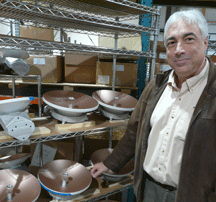 Peter Anania, president of mWave Industries in South Windham, stands in front of a rack of 1-foot diameter parabolic antennas that are part of the new 4G cellular network. The company is slated to do $4 million in business next year and has several military and commercial antenna contracts. (Staff photo by John Balentine)
Comments are no longer available on this story