
Westbrook officials will continue working with Pike Industries and businesses near Pike’s Spring Street quarry in an effort to end a lawsuit regarding the level of activity at the quarry.
The City Council gave preliminary approval Monday to rezone land in and around the Five Star Industrial Park, including Pike’s property, from industrial to manufacturing – a move that would make quarrying illegal in that area.
The rezoning was recommended by the Spring Street Quarry/Industrial Zone Committee, formed in February after the council voted to table the proposed rezoning in favor of finding a compromise that wouldn’t put Pike out of business on Spring Street.
The committee also recommended forming a consent agreement that would allow Pike to continue to operate but would limit the company to blasting eight times a year at the quarry. However, there’s still a major hurdle with that agreement: getting the stakeholders to agree to it.
During the committee’s deliberations, Pike proposed a compromise that would allow the company to blast 20 times per year at the quarry. Idexx Laboratories, a leading opponent of blasting at the quarry, proposed its own compromise, which would allow Pike to blast six times per year at a lower intensity level and put a limit on the amount of rock that could be extracted from the quarry. Idexx has said that, without those restrictions in place, it won’t go through with its plan to build a $50 million headquarters building in Westbrook.
Pike’s attorney Bill Hagedorn of Preti Flaherty, said Monday that the company is still evaluating whether the quarry would be economically viable if it could only blast eight times per year.
“Clearly, we’re disappointed that the number is eight,” he said.
According to Hagedorn, Pike still believes 20 blasts is “the most reasonable proposal” but also that the company is “not rejecting anything” at this point.
Jonathan Ayers, Idexx’s chief executive officer, said his company, which manufactures veterinary products, is sticking to the limits outlined in its compromise proposal. He said the fact that Pike hasn’t rejected the recommendation of the committee shows that it doesn’t need to blast 20 times per year for the quarry to be profitable.
“We always felt there was a compromise position that would keep them in business, and I think we’re beginning to see that that’s the case,” Ayers said.
City Administrator Jerre Bryant said he would continue working toward a compromise among Pike, Idexx, Artel, which manufactures instruments for measuring liquids, and Smiling Hill Farm – the parties to a lawsuit currently in front of Maine Business Court.
If a consent agreement can be reached, Pike would drop its lawsuit against the city, Hagedorn said.
The court is considering Pike’s appeal of the Zoning Board’s ruling that Blue Rock, the company that Pike brought the quarry from, never met certain conditions in its 1968 quarry permit. A judge has already upheld the board’s decision, rendering the permit invalid. However, in a second part of the appeal, Pike argues that it wouldn’t be fair to remove the company’s right to operate a quarry after knowingly allowing it to do so for 40 years.
Though quarrying is currently permitted at Pike’s property, the new zone would make it illegal – meaning Pike would only be able to operate the quarry if a consent agreement is reached or the court rules in its favor.
Hagedorn said the court ruling “would likely be closer to all or nothing for Pike.” So, if the company wins, it would probably be able to operate at a higher level of activity than what Pike proposed in its compromise. However, if Pike loses the court case, and the land is rezoned, a quarry would not be allowed to operate at all.
Still, if a consent agreement is not reached, the court case could go on for years. A hearing on the second part of the appeal should happen this summer, but that decision would likely be appealed, as well.
“Pike offered the compromise because it wants to get this resolved sooner than the court process would allow, because it really does want to be a good neighbor, and because there is always some uncertainty in litigation,” Hagedorn said. “We’ll see where the negotiations go, but even if an agreement is reached, Pike will have far more limitations than it would have if it were successful in the litigation.”
A public hearing on the rezoning will be held on June 7. Bryant said he hopes a proposed consent agreement, which would need the council’s approval, could be reached by then.
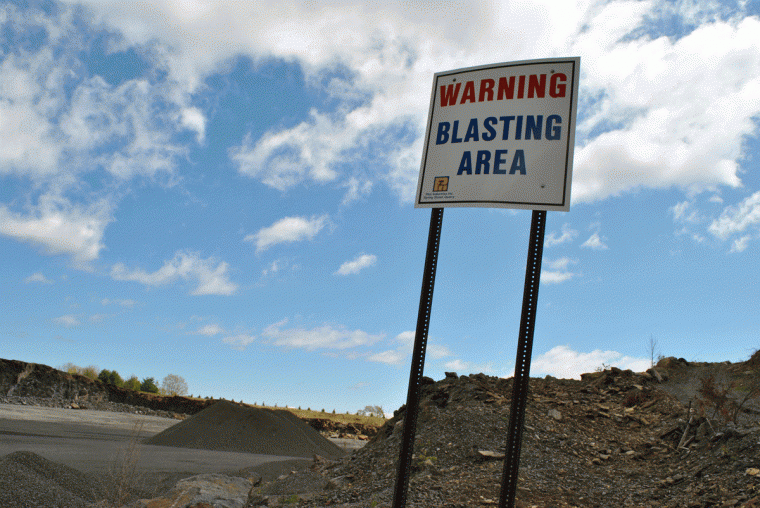 It may be a while before blasting resumes at Pike Industries’ Spring Street quarry. Pike and its neighbors have yet to agree to a compromise regarding the appropriate level of activity at the site. (File photo)
Comments are no longer available on this story