
SOUTH PORTLAND–It is called the Veterans Memorial Bridge, but the 56-year-old span connecting South Portland and Portland never lived up to its name, according to the team designing a new bridge to replace the old one.
“It really had no relation to veterans or a memorial or whatever,” said Mark Johnson, a landscape architect at SMRT in Portland. He is part of a team headed by T.Y. Lin International of Falmouth, the lead design and engineering firm on the $63 million project to rebuild the state-owned bridge.
Now, however, the design of the new bridge calls for the creation of five distinct pavilions to honor veterans of each branch of the armed services, Johnson said at a public informational meeting on the project last week.
Construction on the new bridge, which will be built alongside the old one, is expected to start in May and finish by July 2012.
Much of the basic design is already complete. On the South Portland end, it includes a small public area to be built on top of the old bridge, as well as a bike path to connect the bridge to Lincoln Street.
However, public input on some design elements, such as the memorial pavilions, is still being sought. The meeting on March 11 at South Portland City Hall concentrated on such items. The next meeting will be on March 23 from 5 p.m. to 8 p.m. at a location that had not yet been determined by the Current’s deadline earlier this week.
The veterans’ memorial areas, called pavilions, will be located off a 12-foot-wide walking and biking path that will cross the span on the east side of the bridge. The pavilions will bump out like curved “nodes” from the side of the bridge, Johnson said. He said they also will have rows of arching streetlights rising vertically above them like “reeds” to make them stand out both by day and night, even from a distance.
Each pavilion or node will be a place to celebrate a branch of the service, with room to install benches, informational plaques and even sculptures, Johnson said.
Each pavilion will be unique, he said, even in terms of the paving. “Each area would stand out in terms of a special paving treatment,” he said.
Johnson said at the meeting that the design of the pavilions “is not set in stone,” because the design team has not yet been able to get much feedback from veterans’ groups and the public.
Some of the approximately 40 people attending the meeting voiced criticism of the pavilion design.
Buell Heminway of Portland suggested that memorials for veterans be placed at public spaces planned at each end of the bridge, “rather than these projecting blisters and these reedy things.”
He also said the plan to have so many lights on the bridge to have it make a statement day and night would make it look “Floridian.”
Bobbi Keppel, a senior citizen from Portland who walks and rides the bus because she can no longer drive, complained that the approach to the bridge from the bus stop on St. John Street is too steep to be easily accessible for people with physical disabilities, which many veterans have.
She said, “There’s some real irony to me about designing a bridge to honor veterans when they can’t get up on the bridge.” She suggested having bus stops closer to the bridge entrance.
Alex Jaegerman, Portland’s planning director, said he wondered how five different sculptures at the five different nodes would relate to one another. He said that could be “difficult and challenging to come out really well.”
An overview of the bridge project also was given at the meeting. Jeffrey Andrews of T.Y. Lin International, the design manager for the project, and other members of the design team, gave the presentation.
The Maine Department of Transportation announced last month that Reed & Reed Inc. of Woolwich was chosen as contractor for the project, and that work on the bridge would begin this spring.
The bridge, built in 1954, carries more than 22,000 vehicles per day between South Portland and Portland. However, it will not need to be closed during the 33-month construction period because the new bridge will be built to the west of the current structure.
The new bridge will be the same height as the new bridge but wider.
After the new bridge opens to traffic as expected in July 2012, the old bridge will be removed. Demolition work is expected to finish by December 2012. The lifespan of the new bridge is expected to be 100 years.
In South Portland, a small part of the old bridge will be left near the entrance to the new bridge to become a public space, with flagpoles and plantings.
Also, a bike path is planned eventually to connect the bridge to Lincoln Street, according to Wayne Frankhauser, an assistant project manager with the Maine Department of Transportation. He said more than $1 million has been set aside for that bike path project, the details of which are yet to come.
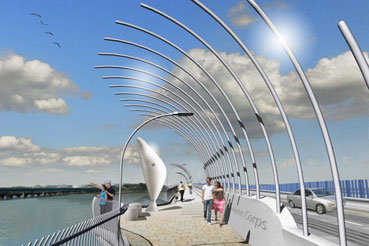 A look at a rendering for the new Veterans’ Memorial Bridge.
Comments are no longer available on this story