
GORHAM – The Gorham Town Council released the First Parish Church Tuesday from responsibility for maintaining the town-owned clock in its steeple ¬- but not before grilling a church spokesman at length.
In a 6-1 vote, with Councilor Phil Csoros opposed, the town assumed responsibility for maintenance of the historic clock, leased to the church for 99 years at $1 a year. The First Parish Congregational Church had agreed in 2007 to terms of the lease, but asked the town this week to be relieved of the maintenance burden.
An annual itemized maintenance by Balzer Family Clock Works in Freeport would have cost the church $800. Mark Faunce, church moderator, told the council Tuesday that paying for maintenance of the clock doesn’t “fit with the church’s Christian mission.”
The clock issue is the latest in a series of controversies in recent years that have strained relations between the church and town leaders.
The clock, a gift to the town from Toppan Robie in 1868, cost $500. It ticked for 138 years in the church steeple until 2006 when it was removed for repair after it stopped. The restored clock was re-installed in November 2008 in the base of the First Parish steeple. The clock works are now in a climate-controlled area in a former organ loft far below its original perch in the steeple, where it was exposed to the elements.
The town owns the clock works, which have been described as priceless, but the church owns the four clock faces, which are part of its steeple.
This week, a member of the church this week questioned the validity of the clock agreement with the town.
“The agreement diverts monies meant for charitable or other religious purposes to pay for maintenance of the town’s clock. In my opinion, that agreement is unconstitutional and thus illegal,” Clyde Grant, a taxpayer since 1955, wrote to the council in a letter that he read in Tuesday’s meeting.
“No one forced anyone to sign any agreement,” said Town Councilor Matt Robinson, who worried about repercussions involving other groups that have leases on town-owned property.
Robinson initially opposed the clock returning to the church, but supported the council’s decision.
“It irks me that it’s back,” Robinson said about the issue.
But, Faunce Tuesday pointed to a meeting attended by town officials in March 2008 at the church. In an e-mail last year to the town, Faunce wrote that the church explained in that meeting before the restored clock was reinstalled that “we were not willing, or more accurately, not financially able to pay for the annual maintenance.”
Town Councilor Burleigh Loveitt said the church had made the agreement in its free will.
“I feel crossed,” he said.
Robinson questioned Faunce about what steps the church had taken to raise the $800 for maintenance.
Citing its revelation in the March 2008 meeting, Faunce said there had not been a specific fundraiser for the annual maintenance.
“There’s been no good-faith attempt to keep your end of the agreement,” Robinson said.
The church claimed it hadn’t defaulted on its responsibility to maintain the clock. Faunce said Grant has voluntarily performed monthly maintenance according to a manual provided by Balzer Family Clock Works, the company that restored the clock. After the meeting, Faunce said the church paid three of its members, who are engineers, $300 to perform the annual maintenance.
Csoros wondered what would happen if the church closed its doors or relocated and the clock had to be moved.
“The town is now the servant of the church,” said Csoros, citing the possible advent of an unforeseen scenario.
Csoros said he favored the town re-claiming its clock or transferring ownership to the church for $1.
“There’ll be discord until one of those things happen,” he said.
Under the lease with the town, First Parish also agreed to insure the clock, but didn’t object to that stipulation this week. The church also agreed to make the clock works available for public view.
The relationship between the church and the town has a unique history. The town had once paid a church sexton $500 a year to climb up stairs inside the steeple each week to wind the town clock.
Before the 2007 agreement was reached with the church, a move to locate the clock in the municipal center on South Street failed.
Also prior to the lease agreement with the church, a controversy developed around separation of church and state. At issue was whether tax money should be used for restoration of the town’s clock to be located in a church.
But, after private donors raised about $60,000 to restore the clock and retrofit the church for its reinstallation, the Town Council signed the lease with the church.
Town Councilor Brenda Caldwell recommended that Town Manager David Cole and Faunce develop a new lease agreement reflecting this week’s council action.
“This mixed relationship won’t work,” Csoros said Wednesday in a telephone interview. “One should not serve the other.”
Relocating the clock to town property would have been an expensive option for the town, but had some sentiment.
“I like it when history is brought down from the mountain top,” said Town Councilor Matt Mattingly.
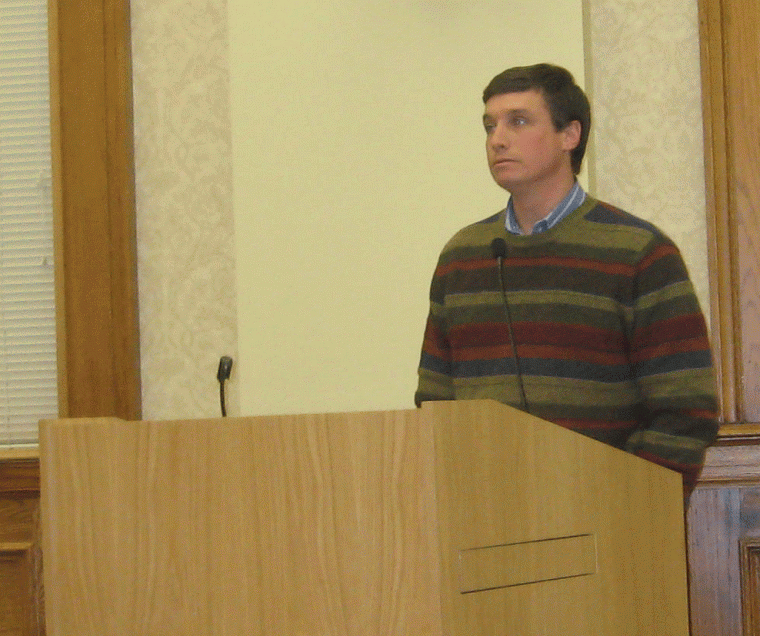 Mark Faunce, moderator of the First Parish Congregational Church in Gorham, faces the Town Council Tuesday. (Staff photo by Robert Lowell)
Comments are no longer available on this story