
Come the Fourth of July, big bunches of brightly colored flowers usually are ready for picking at Norm Jordan’s flower farm.
But this year, cold and rainy weather in June and July delayed the flowers’ blooming at Jordan’s pick-your-own flower business right in the heart of Cape Elizabeth. “The last week in July, I was selling what I normally sell a week after the Fourth,” Jordan said.
Also, he said, the excessive rain promoted diseases, causing some plants at the farm at 359 Ocean House Road to wilt and die.
Still, although Jordan’s flowers have not grown as lushly as usual this summer, a spate of sunny, warm days in August has helped. Now, bright blooms fill his approximately 1-acre flower field, ready for cutting.
And flower lovers can keep on picking them for a month or more, right up until the first killing frost of fall, typically in late September or early October.
The cost per bunch is $5 if you pick your own. The price is $6 if you don’t have time to cut the blooms yourself and just want to grab one of the colorful bouquets that Jordan or his farmhand pick and set out on the farm stand on the edge of his field.
This year has been a difficult one for Maine farmers because of the cold and rainy summer. Cape Elizabeth farmers struggled along with the rest.
For example, Dun-Roamin’ Farm at 1068 Sawyer Road, which specializes in the sale of flowers and Christmas trees, had spring seedlings and flowers. However, the farm owners didn’t plant any flowers for customers to cut this summer because the weather was so bad.
Evelyn Cox, who owns the farm with her husband, James, said, “It’s not been a good summer for any of the farmers really.”
Jordan echoed her words. “It’s been kind of a nasty season from start to finish, actually,” he said. He declined to reveal how much he makes from his flower business each year, but said sales are down 25 percent.
However, although his plants aren’t as tall and bushy as usual, he still has a wide selection of flowers to choose from.
And customers were out picking.
“This place is a gem,” said Jessica Tomlinson of Portland, wandering the field with half a bouquet in her hand while considering what other blooms to add to it.
She said she doesn’t need to plant her own flower garden because Norm Jordan does it for her. “It’s all of the joy and none of the work,” she said.
Jordan, 75, refers to his 2-acre property as The Farm. On his land sits the big white farmhouse, built in the 1880s, where he grew up. Next to it is the greenhouse where his seedlings get their start each year.
There also are raspberry and blackberry bushes and a small number of Christmas trees under way. Customers can pick their own berries and this year, Jordan created a small pick-your-own vegetable plot at the front edge of the flower field. The rain did a number on the vegetables too. For example, Jordan said, his cucumbers were stunted.
But Jordan’s main crop is flowers. Many people in Cape Elizabeth and visitors from out of town think of his business as The Flower Farm.
The farm has been a mainstay of the town center for years. It’s little more than a stone’s throw from Town Hall, the public schools, the police and fire stations and the public library.
Residents can attend to the business of modern life, then step next door to the farm, a place where Cape Elizabeth time seems to have stood still.
Jordan still uses the farm stand at which his parents used to sell fresh farm produce. And customers pay in an old fashioned-way, strictly on the honor system.
The farm stand is self-service so a sign instructs them to push their payment through a mail slot: cash or a check, or even an I.O.U. if they have neither of the first two options on hand.
People from out of town marvel at the honor system, Jordan said. And his farm attracts visitors from people who live way out of town – in other states or other countries as far away as Bolivia and South Africa.
He said a woman from South Africa told him she was amazed at his trusting method of collecting payment.
She told Jordan, “Oh, you wouldn’t do that where I’m from. They’d rob you blind.”
But Jordan, a retired car mechanic who runs the flower business as a hobby, knows from experience that his customers are honest.
Once he found a $20 bill and three one-dollar bills in the mail slot. The note with the money said the $3 was for two boxes of seedlings – and the $20 for flowers picked the summer before but never paid for.
And Jordan said that when he went out recently to eat at a restaurant in town, his waitress handed him $30. It was for flowers she’d picked but hadn’t yet paid for.
Those who want to pick flowers grab a pair of scissors left hanging from a nail and wander into the field of blooms.
If Jordan, who is divorced with four adult children, happens to be out in the field, he enjoys observing his customers and chatting with them.
He said a retired couple arrived together and the husband walked about suggesting they cut a wide variety of colorful flowers. So the woman told Jordan she was going to take her husband home and come back alone because she wanted a bouquet with only very specific colors.
But afterward, Jordan said, “I saw what she picked and she had some of a little bit of everything out there.”
Also, Jordan said. “I have someone once in a while who has never picked any flowers.”
Such customers worry they might kill a plant picking its flowers. They don’t realize, Jordan said, that “the more you cut it, the more it grows.”
Eileen Dunfey, of Cape Elizabeth, said she hadn’t been to pick flowers at Jordan’s much this summer because of the weather, but plans to come weekly now to make up for lost time.
Standing with a handful of blooms in the flower field, Dunfey said she appreciates the reasonable price Jordan charges. “For $5 you get a lot of flowers,” she said.
And Dunfey likes the wide variety of blooms Jordan grows.
His flowers include snapdragons, zinnias, cosmos and sunflowers – which are his own personal favorite. In addition to traditional yellow ones, he grows a black sunflower with striking dark-brown petals.
Because of the rain, the sunflowers are not as tall this year and their leaves are starting to wilt and turn black earlier than usual, Jordan said.
His flowers also include old-fashioned ones with old-fashioned names to match, such as love-lies-bleeding, and kiss-me-over-the-garden-gate. Jordan also grows cleome, or spider flower, a dramatic, tall plant with vividly colored spiky flowers of white, pink or purple. It has thornlike prickles on its stem, and an acrid scent. Cleome is said to have been among flowers grown by Thomas Jefferson in his garden at Monticello.
Jordan maintains his small farm with the aid of a part-time employee. Family and friends also pitch in at times, such as during spring planting and in the fall, when the irrigation hoses are removed and the soil turned over for winter.
Jordan said keeping his farm going is a lot of work, but he likes seeing others enjoy the fruits of his labor. For example, he said that he recently saw a family with two small children pick some raspberries early one evening, then sit on the grass overlooking the flower field to eat a picnic supper along with their berries.
“That’s what I kind of like people to do,” Jordan said.
For more information on Cape Elizabeth farms, visit the Web site of the Cape Farm Alliance at www.capeelizabethfarms.com.
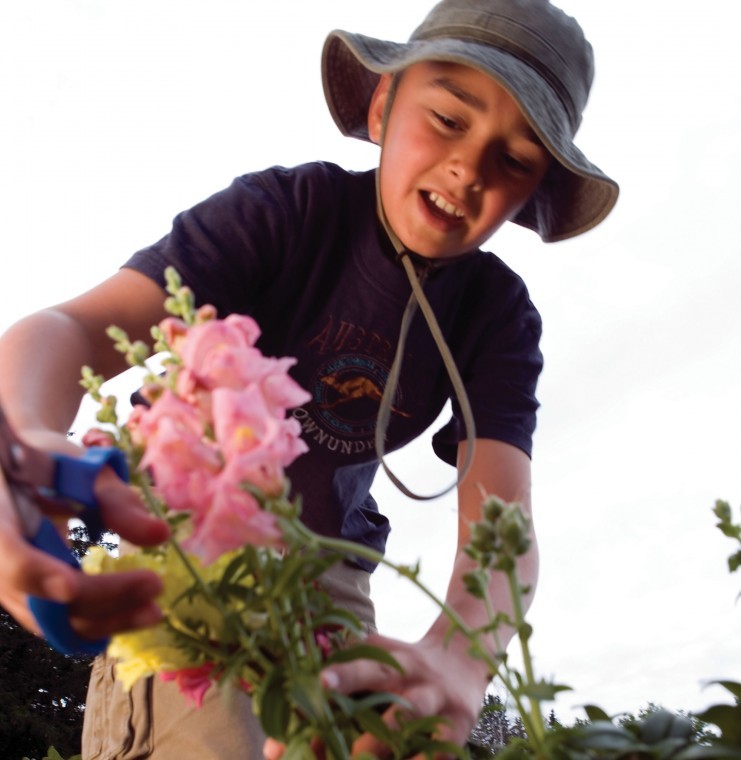 Lars Gundersen of Cape Elizabeth, evidently no stranger to Norm Jordan’s flower garden, wields a practiced pair of scissors as he collects a colorful bouquet destined for the 50th wedding anniversary of his grandparents, Carole and Guy Mainella. (Photo by Rich Obrey)
Comments are no longer available on this story