
Katelyn Estes moved to South Portland a year ago to forge ahead with her plans of becoming a funeral director.
The 23-year-old North New Portland native admits her chosen career path has disconcerted some family members and prompted questions from friends. But, she says, it’s been worth it, now that she’s only a few months away from completing her apprenticeship with Hobbs Funeral Home in South Portland.
She said Hobbs is a great place for learning. Becoming a funeral director might seem to some people an odd choice, but it can be a lucrative field, Estes said. She cites Hobbs’ recent expansion to Scarborough as one tell-tale sign that the funeral home business is a smart career option.
Estes is still in school, working full-time at the funeral home and paying her dues, she said, but she is excited about working in a field that few women have chosen.
She recently sat down with the Current to discuss why she wants to become a funeral director, her duties as an apprentice and her career expectations.
Q: What made you decide to get into this industry?
A: I didn’t really think about it until I had taken a theater course at the University College in Bangor. When I was there we were comparing life events that were kind of like theater and we got to talking about funerals. I’d always liked helping people and working in the health care fields, so it just made sense. The more I looked into it, the more I was interested. I didn’t want to go to school until I worked in the industry a little bit and knew I would be into it. It took me a year and a half to two years to get a job in a funeral home and that finally happened up in Skowhegan at Smart and Edwards Funeral Home. I have been doing it since January 2008 as an apprentice and attending mortuary school down in Massachusetts one day a week.
Q: What is mortuary school like?
A: Because I’m so interested in it, it comes easily to me. Ever since I’ve been there I’ve been on the dean’s list every quarter. It’s basically sciences and social sciences for the most part.
Q: Why social sciences?
A: Basically psychology of grief, sociology, business classes, history of embalming or funeral profession in general.
Q: What is it like to deal with the dead?
A: That part wasn’t as big of a deal or as hard with me to work with as opposed to learning how to work with families and people who are grieving. That was harder for me, because you never quite know what’s right to say. If someone’s upset, you never know what’s really appropriate to console them, so it was a little bit harder for me to learn that aspect of it. Working with the dead is something that’s a part of the job. You just need to have respect for them. And use extreme caution in everything you do or say.
Q: What is your role as the apprentice?
A: As an apprentice, my job is to basically learn everything that the funeral director does. I can do anything that the funeral director can do, but under the supervision of a funeral director. I do a lot of paperwork, help meet with families, I help in the prep room, I help with arrangements, cosmetics. I do transfers and basically every job you can think of in the funeral home, including maintenance and cutting grass.
Q: Have you ever seen “Six Feet Under,” the HBO series about a family with a funeral business?
A: Yes.
Q: In reality, minus the drama for the show’s context, how close to reality is it?
A: I would say it’s pretty accurate, but they don’t touch on all of the aspects. You don’t see people getting the phone calls at 3 a.m. and having to go and basically work for about an hour and then go home and get some sleep. They don’t show all of the cleanliness. There is a certain amount of sanitation we need to uphold in all aspects of the vehicles (and) in the prep room when we’re setting things up. There is a lot more that goes into it than the show reveals. It’s a great show and it portrays it well; it just doesn’t cover all of the aspects.
Q: Where do you go from here?
A: Basically, for the state of Maine we have to have 2,000 hours of an apprenticeship and it’s divided up into different sections like embalming, meeting with families, casketing, cleaning, doing maintenance, and we also have to have an associate’s degree in funeral science and we have to pass the national board exams as well as our state board exams. The nationals are pretty much a really long multiple-choice test that takes all day. Once you pass it, you’re done. The state you have to renew each year. I’m pretty much done with my apprenticeship, but I have about a year of school left. I would be continuing as an apprentice until I passed all of my boards. By the fall of next year I will be a licensed funeral director. What I do after I’m licensed is still up in the air. I hope to stay here, because the Hobbses have been great people to work for. One day I would like to maybe own my own funeral home, where I would work there and live there.
Q: Is it nice knowing that you will be a part of this business when there aren’t a lot of women working in the industry?
A: It’s getting more diverse. How I got into the business – I actually met a female funeral director. She was at a cooking class with another funeral director and it was through them that I got an interview within a week. There were two female funeral directors I worked with. In school, there are quite a few women.
Q: What do your friends and family think?
A: My friends still get a little creeped out by it, some people more so than others. My mom still thinks it’s great; my dad gets creeped out by it, though.
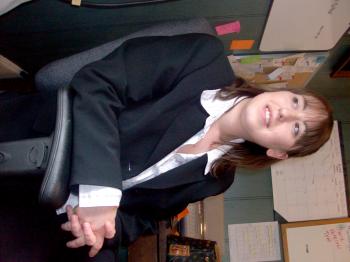 Katelyn Estes has been an apprentice with Hobbs Funeral Home in South Portland for a little more than a year. She is close to completing her apprenticeship and hopes to someday own a funeral home.
Comments are no longer available on this story