
Economic and Community Development Director Alan S. Manoian wants Bridgton to be ready for the end of the recession.
“During times like these, communities have time to start putting together new strategic initiatives,” Manoian said. “Those communities that can demonstrate they’re looking for good public-private partnerships, those are the ones that are going to benefit first when the good times come back.”
In order to create a plan for future development, Manoian solicited the thoughts of more than 50 residents last weekend during brainstorming sessions about the future of the area around Depot Street, which makes a short loop leaving Main Street between Reny’s and the Magic Lantern Theater and reconnecting between Ricky’s Diner and the Chapter 11 store. The street also connects to Frances Bell Drive, which leads to Stevens Brook Elementary School.
The town’s Economic Development Committee has been looking at the Depot Street area for around five years, said Chairman Peter Lowell.
“One of our main interests was in downtown revitalization,” Lowell said. “Depot Street is a fertile crescent in the middle of town…We were really kind of fascinated by the potential it had.”
In 2007 the town received a community development block grant to pave the parking lot between the Bridgton Community Center and the Magic Lantern Theater. That same year, the Reny’s store doubled in size and the theater opened after being built partially over the footprint of the old Magic Lantern Theater that had been condemned and torn down in 2006.
It was, in part, support from the town in setting up economic incentives that encouraged owner Frank Howell to invest in the Magic Lantern Theater and the adjacent engineering and design facility, Down East Inc.
“To get such a vote of confidence from the town was certainly important,” Howell has said.
Manoian is hoping that if residents come together and create a vision for what kinds of development they want in the Depot Street district, it will draw future investors.
Plans for Depot Street depend on private investment, as well as on the availability of state and federal money for infrastructure, Manoian said, adding that developers are more likely to invest money where there is stability and predictability. They want to know their projects will be seen as valuable to the community, he said.
Funding for downtown development such as sidewalks and public parks would have to come from a variety of sources, Manoian said, including grants. He said he is pursuing a grant from the Maine Department of Transportation for sidewalks to connect downtown residents to Stevens Brook Elementary School.
On March 6 residents of all ages gathered at the Bridgton Community Center to set priorities for Depot Street. Manoian split them into six groups and gave each group a set of 52 cards with photos of different kinds of development.
Two of the cards were blank and open for residents to add anything they wanted. The remaining cards included photos of waterfront cafes, public art, pedestrian-oriented streets, downtown hotels, artist studios, wetlands protection and other downtown elements. Each group had to choose 15 cards that were most important to them.
Manoian tried to get residents to think about how to create a street where they would want to spend time, as opposed to looking at what specific types of development to bring to the district.
Janet Montgomery, owner of the art supply store Art Attack, volunteered to create artistic renditions of residents’ suggestions early the next morning, and she presented two watercolor paintings to more than 35 people March 7.
In her sixth year in the town, Montgomery said she got involved in the project to support the town, and ultimately her own business.
“Certainly any improvement in the town, any growth, will affect my business as well,” Montgomery said.
All six design groups had some overlap in their 15 priorities for Depot Street. These universal features included a Bridgton narrow gauge railroad museum, ample sidewalks, small buildings, a waterfront park with performances, pedestrian-oriented streets and a public square.
“They’re looking for a traditional new England street,” Manoian said.
The next step, Manoian said, is to develop a more detailed plan based on the priorities residents expressed. This plan, as well as Montgomery’s paintings, will be displayed in various locations around town.
Eventually, Manoian plans to propose an optional and parallel process to the site plan reviews developers now complete with the planning board before building.
Developers would have the option to choose a site plan review or the new form-based code, which would require some of the elements residents agreed would improve their downtown. The new code would place more requirements on developers, but could include some incentives as well, Manoian said. This alternative set of rules would have to be first approved by voters.
Ultimately, Manoian hoped that when the economy turns around, Bridgton would be at the leading edge with a plan, ready for an upsurge in investment.
“What I can do now is get Bridgton in a highly competitive position,” Manoian said. “That’s all a good economic development director can do in times like this.”
 Artist Janet Montgomery’s interpretation of residents’ ideas for the future of Depot Street in Bridgton.
 Artist Janet Montgomery’s interpretation of residents’ ideas for the future of Depot Street in Bridgton.
 After choosing 15 elements they think should be a part of Depot Street, attendees of the community design event sketched out a possible design for the street and presented it to the group.
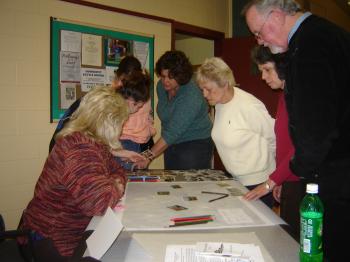 Bridgton residents discuss their priorities and visions for the Depot Street district. More than 50 people gathered to give their input March 6.
Comments are no longer available on this story