
Treasure hunter Bill Peters goes to Jim Rivard’s auction in Bridgton once a month to look for anything he can make a profit on by reselling on the Internet.
Peters and other online sellers, who often take up the hobby after retirement or to supplement income from another source, dominated Rivard’s auction last month. They said sales have slowed because of the economy and they have to be more selective about what they buy.
“It’s getting tough now, because of the economy,” Peters said, adding that he makes less of a profit.
In these challenging times, even auctions – normally considered recession proof – are feeling the pinch. Rivard, 66, said it’s harder to find full estates now, because individuals are selling off the best items themselves before turning the rest over to auctioneers. And individuals and Internet sellers have replaced many of the antique dealers who used to dominate Rivard’s auctions.
When there were 100 antique shops in the area, dealers would show up to an auction with a van and $10,000 in their pockets, Rivard said. The individuals who come now don’t buy as much as the dealers. And as the individuals who now largely support Rivard’s auctions curtail their spending, it’s unclear if he will continue to make money.
Bonnie Rolfe of Otisfield said she has noticed some of the regulars spending less. She comes to every auction with her friend, Janice Davis, who said she spends less than she used to – around $50 instead of $100 at each auction.
Cheryl Robitaille was at Rivard’s Feb. 24 auction to buy things to resell. A former Connecticut antiques dealer, she has been selling mostly costume jewelry on Ebay for around five years. Robitaille said she has seen the impact of the recession on e-Bay.
“People are tight with their money. There’s not the bidding wars there used to be,” Robitaille said. “You have to be more selective about what you do buy.”
After 17 years in the business, Rivard hopes to pass off more of his workload to Christopher Grant, an auctioneer who works for him. Terri Rivard, Jim’s daughter, also shoulders some of the workload. She has a shop connected to the auction house on Route 302 where she sells furniture, jewelry and collectibles.
Grant, both Rivards and Terry Denning worked together Feb. 24 to put on their bi-monthly tailgate auction, which combines goods they’ve acquired from estates or abandoned storage compartments with items brought by bidders.
Fifty-five bidders showed up, which Terri Rivard said is typical for a winter tailgate auction. Up to 150 bidders can show up to larger auctions during the summer.
The auction was filled with regulars, and many people knew each other. They were a group of “dealers, collectors and just curiosity seekers,” according to Grant. For the people who regularly attend the auction, it seemed to be for the experience as much as for their purchases.
Wearing a cowboy hat, Grover Cleveland Fisher talked fast and bid impulsively. Fisher, who lives in Effingham, N.H., said he travels to auctions within a 50-mile radius of his home two or three days a week. Usually he spends between $200 and $400.
He sells most of what he buys on the Internet to supplement his income from hog farming and seasonal construction work.
“I shouldn’t be buying for myself, but a lot you can’t resist,” Fisher said.
Most bidders had a story of their best find, usually when they unexpectedly made a big profit. Fisher said he once bought a box of bird models for $3 and sold them for close to $1,500.
“You have to know what you’re buying,” Fisher said.
Rolfe said she bought a bed at an auction the previous week for $2 and found a gold wedding band in it. Though this doesn’t happen often, “you never can tell,” Rolfe said.
And Bridgton resident Bill Peters said he once bought an old toy gun for $20, without knowing the history of it. The man who bought it from him paid $500 for it because it once belonged to Gabby Hayes, a comic cowboy actor who died in 1969.
In quick succession, Jim Rivard asked for bids for tools, decorations, toys, books, papers, postcards, furniture and other collectibles and oddities. Most items or boxes of items sold for under $20. There was even a plastic box that Rivard couldn’t open.
“I can’t get it open. It could be full of gold bullion,” Rivard said, selling the unknown box for $10.
He joked with bidders and they laughed easily. They raised their pink cards to indicate bids and sometimes crossed the room to buy food or smoke in a designated room with large windows in the back.
Rivard sold a dog and ball wind-up toy, still in it’s original box, for $7.50 and a group of rifle butts and stocks for $12.50. He quickly auctioned off a medicine cabinet and an album full of post cards and tourist information. A set of three bird prints went for $13.
“Here’s a golden opportunity for somebody,” Rivard said. “It’s a high school diploma.” The diploma sold for $17.50.
Rivard said he got into the auction business by default. He was a truck driver, but he wanted to be home with his children more. He started his own trucking business and hired drivers, but the drivers stole from him, and he was nearing bankruptcy.
He needed a business that was recession proof, Rivard said, and in 1990 he got into the auction business, which was quite lucrative and helped him pay off his debts.
Auctions traditionally have done well during recessions, Rivard said, because people are looking for deals. But individuals looking for deals don’t buy in the same quantity as dealers looking to fill their stores.
Though many items were bought for their potential re-sale value, some were clearly bought for sentimental or personal reasons.
“This is rocks and minerals,” Rivard said, opening a cardboard box. “Some of them look like they should have labels on them. Some look like they should be in the driveway.”
James and Patricia Dickens bought the box of rocks for their grandchildren. They come to the tailgate auctions twice a month looking mostly for postcards, which they collect, but also looking for items for a store they run out of their home in Naples.
Patricia Dickens said the store contains mostly collectibles, maps and postcards. It also contains their collection of more than 90,000 postcards from all over the world.
“It’s fun and you don’t know what you’re going to get,” Dickens said of the auctions.
 Christopher Grant marks down the winning bids on items Jim Rivard auctions off Feb. 24. Grant said most of the bidders were regular attendees of the bimonthly auction.
 James Dickens and his wife Patricia watch the bidding at the Rivard auction house Tuesday. The couple sells collectibles out of their home in Naples and online. “It’s fun and you don’t know what you’re going to get,” Patricia Dickens said of the auction, which they attend regularly.
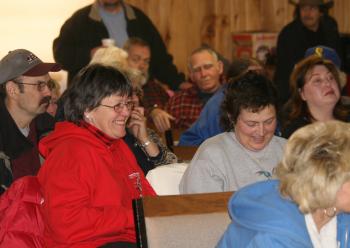 Bonnie Rolfe and Janice Davis share a laugh at the Rivard auction Feb. 24. The two women frequently come to the auction together looking for bargains.
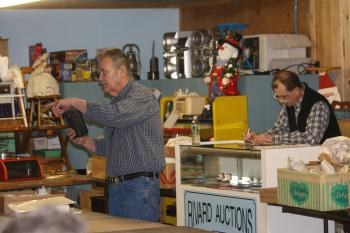 Jim Rivard auctions off items at his bimonthly tailgate auction, while Christopher Grant keeps records. Rivard said his auctions have changed over the years, with less antiques dealers now and more individuals buying for themselves or to sell over the Internet.
Comments are no longer available on this story