
Once one of the most rapidly growing communities in the state, Scarborough is showing signs that the national economy has taken a toll on the pace of residential and commercial development.
With an abundance of undeveloped land and easy access to Portland, the Maine Turnpike and the Maine Mall, Scarborough has long been considered a prime location for new business development, and new businesses were seen as key to balancing a surge in residential growth over the last two decades.
While much of the robust growth remains in evidence, Scarborough officials say they have seen a marked decline in development in recent months, with projects being pulled, Planning Board meetings being canceled and the vacancy rate for businesses sitting at an all-time high.
A national company, Harvest Development, recently halted plans to build a retirement community on 65 acres on Elmwood Avenue. The development company behind bringing a Cabela’s outdoor outfitter to Scarborough, New England Expedition LLC, has struggled to attract tenants to small retail spaces nearby and generate property taxes. Scarborough even canceled a Nov. 17 Planning Board meeting because no items were on the agenda.
“I’ve talked to people who have been around here for a long time, and they have never seen a Planning Board meeting canceled because there weren’t any items on the agenda,” Assistant Town Planner Jay Chace said. “We really don’t have a lot of people proposing projects right now, and I think it’s because of the economy.”
The slowdown isn’t unique to Scarborough. Commercial real estate brokers say it is consistent with what is happening through the Greater Portland market. It is more visible, though, in a community where new developments were not just welcomed, but expected.
In fiscal year 2006-2007, the Planning Board approved 34 development projects. That number dropped to 24 in 2007-2008.
Harvest Development in December withdrew its plan to develop a retirement community in Scarborough, citing difficult economic times. The development group from Oregon informed Scarborough officials on Dec. 1 through a letter from Westbrook engineering firm Sebago Technics that it was pulling the project after nearly a year of planning.
“Current economic and market conditions have caused Harvest Development to carefully re-evaluate each of their pending projects,” wrote Sebago Technics project manager Owens McCullough in the letter to Scarborough. “As a result, the applicant has made a business decision to not pursue the Scarborough project.”
The decision came two days before town councilors were to listen to a second round of public hearings regarding the proposed 65-acre project on Elmwood Avenue. The proposal included 118 apartments in the main building, which would have been built in the initial phase, and 10 cottages to be built in a second phase. The project would have offered assisted-living services and full health care.
“They are a national company and they indicated to us that they are not moving forward with half or more of their national projects,” Scarborough Town Planner Dan Bacon said.
Bacon also said that McDonald’s, which the town considered a substantial project, withdrew its plans to open a restaurant in the Scarborough Gallery development.
Scarborough is also seeing a drop in small retail and small office developments, said Harvey Rosenfeld, Scarborough Economic Development Corp. president.
“That seems to be the case right now,” Rosenfeld said. “I think what’s happening is a lot of people who were going to possibly enlarge their businesses are holding off and waiting to see what’s going to happen with the economy next.”
Tom Moulton, a commercial real estate agent with The Dunham Group, said Scarborough’s issues are consistent with other towns in the area.
A lot of property owners are having problems finding tenants to lease office space, Moulton said.
“I’d say development in the private sector has for the most part stalled,” Moulton said. “There are some niche players out there, but it is substantially less than it was a year and a half ago.”
Moulton said that an online search for office space in Greater Portland, between 3,000 and 12,000 square would turn up about 120 to 130 listings. In previous years, that number would have been between 50-60.
“I’ve never seen that before,” he said.
South Portland is also seeing a drop in development, said Planning Director Tex Haeuser. South Portland watched its building permits drop from 825 in 2007 to 761 in 2008. That includes all permits for single-family housing and commercial construction.
“We still have projects, and people are coming in for permits and coming to the Planning Board meetings for approvals,” Haeuser said. “It is definitely a bit slower than before.”
Not knowing that there’s money to borrow is part of the problem, said Bob Nadeau, vice president and commercial lender at Gorham Savings Bank in Scarborough.
The national media is reporting that lenders are freezing loans and that there isn’t money available after the sub-prime mortgage collapse, but that’s not true in Maine, Nadeau said.
“The banks in Maine do not have a liquidity problem and are actively lending,” Nadeau said. “If people are listening to the national news, they are hearing that lenders are freezing credit, but we have money to lend out. I know our competitors have money to lend out and there is still money to be had.”
In Scarborough, Norman Berube & Builders Inc. is moving forward with its proposal of a subdivision of single-family homes on West Beech Ridge Road in Scarborough.
The builders hope to create 31 lots on 65 acres of land known as the Waterhouse property.
“Berube Builders is the only company proposing a significant subdivision project,” Bacon said. “We’ve had a few land swaps, but really nothing too significant.”
Gene Beaudoin, developer with New England Expedition from Connecticut – the driving force behind bringing Cabela’s to Scarborough – said his company has noticed a drop in new project proposals.
That could be because consumer spending is down, he said.
The latest figures from the Federal Reserve indicate that consumers are borrowing and spending much less as they work their way through the recession.
According to the Federal Reserve, consumer borrowing fell by $8 billion in November, or 3.7 percent. At the same time, credit card borrowing was down by 3.4 percent, while other borrowing, such as auto loans, was down 2.1 percent, or $5.2 billion.
“Whether you’re in the lending community or are a retailer, everybody is watching the consumer and how soon the consumer steps back into the national economy,” Beaudoin said. “When the consumer is not spending, everybody is much more cautious.”
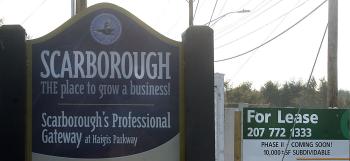 Slow going
Comments are no longer available on this story