
Val Schurman, former state president of the Maine Federation of Business and Professional Women, has made the most of her 88 years. She campaigned for women’s rights, owned her own restaurant and raised three children. Schurman’s current hurdle is an Alzheimer’s diagnosis. Schurman, who grew up in Scarborough and now lives in Westbrook, sat down with Maine Women to talk about her career, her politics and her diagnosis.
Q: Where did you grow up?
A: I was born in Portland, but moved immediately to Scarborough and lived there until seventh grade. From Scarborough, I moved back to Portland, after the Great Depression. I’ve been here at Longfellow Place in Westbrook for eight years, and I love it. It’s a great place to live.
Q: How have you made a living during your life?
A: I started in the food business. The Gorham Fair was the first of the fairs of the year. I sold orange juice and hot dogs, and, at the end of that week, I met a man who owned a cook house and had it for sale for $50. So, I bought the business and worked the fairs for three years. I was 17 and had already had three children, though my baby boy died. I wound up in the food business for 30 some-odd years, including owning my own restaurant on Forest Avenue called Val’s Lunch.
Q: How did you get involved in the Maine Federation of Business and Professional Women?
A: I had a friend who had been involved for many years. I was managing the snack bar at Chapman Arcade, at the corner of Preble and Congress streets, and she owned a restaurant upstairs. Her name’s Cora Brown. She’s been very active in the Republican party for many years. She asked me to join and I did and became very involved. I went to my first convention in Denver, Colo. This was at the time of the Equal Rights Amendment. I had been a staunch Republican for many years. Then, I heard the stories of all the women. There was one whose son was injured in an automobile accident that cost her a lot of money, but she couldn’t sue because her husband was dead and women weren’t allowed to sue. A woman couldn’t buy a house. We fought with the newspapers, because you couldn’t use your own name on the byline. If you were married, you had to be Mrs. John Brown. Women were secondary citizens. So, I got very involved and tried to make women’s lives and their workplaces better. That’s what Business and Professional Women is all about.
Q: You said you had been a Republican. Did you switch parties?
A: I changed probably in ’74, when the Republicans dropped the Equal Rights Amendment from their platform. I called my friend Mary, who was a senator for Portland, and said, ‘How would you like a new Democrat?’ I didn’t get too involved until my husband died in the ’80s, and then I became involved in politics in Buxton. I was the secretary of the Buxton Democratic Committee and the York County Democratic Committee. I worked on various campaigns for anyone who was running – Tom Allen, Bill Clinton. I do the absentee voting here (at Longfellow Place) for the residents. The town clerk will let me know the day they’re going to set it up, and they come here for the people in the building, and I organize that.
Q: What’s important to you in the upcoming election?
A: The very important thing is that I got half my ticket at least. I wanted Hillary/Biden. I wanted to see a woman president in my lifetime because of my work to prove that a woman can do the job. To say that they can’t because they have their period? That’s crazy.
Q: What led to your diagnosis of Alzheimer’s?
A: We have a tenants’ council here. The president moved away, and there was no one to become president, but you can’t have beano unless you have a council. I don’t play beano, but I offered to do it. So, I started learning people’s names. I got to know everybody, and I was president for three years.
One June, my oldest son died. He was only 67, and within 21 days, there were six deaths that were close to me. That was a lot of trauma. In September, when I started a meeting, I looked out and I didn’t remember some people’s names. I started losing my place on the agenda. I became very disorganized. So, I resigned. That’s the part of me that I’ve lost that’s hard to take. When I was in school, I never took a book home to study. I had hundreds of telephone numbers in my head. But I go on from day to day and live and let people know, so they don’t think I’m acting weird because I don’t remember their names.
Q: Are there any other changes you’ve noticed?
A: I can slowly see myself becoming more and more forgetful and more confused. I can still take care of myself, but I have to rely on notes, notes, notes everywhere. If I’m going to call my daughter, I write down lists of what to tell her. I lose track in the middle of conversations. Up until three years ago, I could have told you word-for-word my valedictory address from eighth grade. I won the spelling bees. Now, I do crossword puzzles, and I get the e’s and i’s messed up, and I really have to do some erasing. It’s little things like that.
Q: What kind of emotional impact have those changes had on you?
A: I cuss at myself for the stupid things I do. I rang my own doorbell the other day, and I’ll have the milk in my hand and open the microwave door. I watch myself more and more, and when I feel I could be dangerous, I’ll let my family know, but I’m not depressed by it. I’m 88. How many years do I have to live with it? Hopefully, not very many. When a person that’s close to me comes to my door, and I don’t know who they are – I hope that never happens. I’m too independent.
Q: Has anyone in your family had Alzheimer’s?
A: Not that I know of, but I really have no family history. My mother came from Scotland and she died when I was 8. My father died when I was 18, and I was too young to be thinking about family health history.
Q: Have you ever known anyone who has had Alzheimer’s?
A: Oh, yes. I’ve known several. There was one woman, who wasn’t really related to me, but we used to call each other cousins. Every year, I’d go to the Maine Women’s Hall of Fame, but I hadn’t been in a few years. I saw her and grabbed her and hugged her, as usual. She looked at me vaguely. I thought she didn’t remember me, so I asked others, and they told me she had Alzheimer’s.
Q: How have you learned to deal with people who have Alzheimer’s?
A: You have to take them day by day, and be very calm, and understand – see, this is how it’s affecting me. I used to be able to get up and talk for hours. I can’t put my thoughts together very well. I can’t express my feelings. You see that blankness there, and it’s not pleasant. It’s just not pleasant.
Q: What are your plans if you do feel like you are at a point where you can’t take care of yourself?
A: I love my children, but I wouldn’t want to be a burden on them. I say, put me in assisted living. I’ve told them that. But, hopefully, I’ll be gone before then.
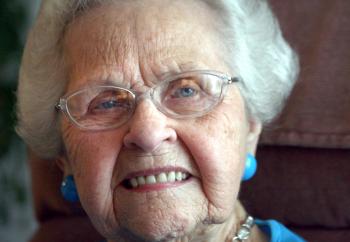 Q&A with Val Schurman – Facing Alzheimer’s, but not slowing down
Comments are no longer available on this story