
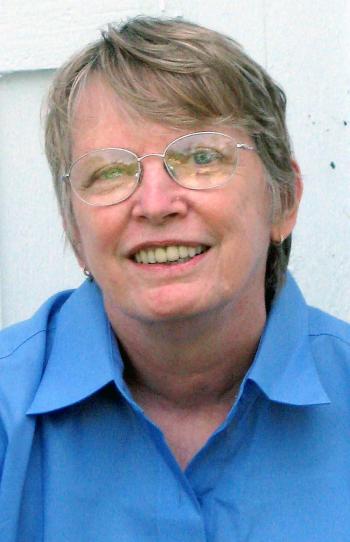
Author Lois Lowry, 71, has written more than 30 children’s books. She has received two Newberry awards for her books “The Giver,” and “Number the Stars.” She splits her time between her home in Cambridge, Mass., and a large farmhouse in Bridgton. Her newest book, “The Willoughbys,” came out this spring.
Q: Tell me about your newest book, “The Willoughbys.”
A: It’s different than my other books. It’s really a satire on classic children’s literature, with all the stock characters that are in those old books that I read as a child and my mother read as a child-orphans and benefactors and nannies and all of that.
It’s kind of darkly humorous. It’s about four children who have terrible parents and decide they would be better off as orphans. They plot about how to get rid of their parents, not realizing that their parents are secretly plotting how to get rid of the children. And of course the children triumph and the parents are dead in the end, in a comic way.
Q: Tell me about how you got started writing.
A: I majored in writing at Brown University. I went there when I was 17 years old, many years ago. I always wanted to be a writer but I married young and had four children very young so that postponed my aspirations. I had not finished college when I married.
When my children went to school, by then I lived in the Portland area, I went back to the University of Southern Maine and finished my degree and went to graduate school. I still wanted to be a writer and I began doing a lot of journalism. I had studied photography in graduate school so I combined that with writing. I did a lot of stuff in those years for Down East magazine, as well as other magazines and newspapers. But I really wanted to write fiction.
In 1975 or ’76 I published a short story for adults in a magazine. It was about myself as a child, written in the first person but written as fiction. A children’s book editor at Houghton Mifflin read it and asked me to write a children’s book. So I did and they published it and they have gone on to publish 35 of my books since then. I stopped writing for adults and turned my attention entirely to writing for kids. It was more satisfying, actually. I don’t know why I never thought of it myself.
Q: Do a lot of your books have some aspect of autobiography?
A: Not a lot, but several. My first book, back in 1977, called “A Summer to Die” was autobiographical. It was about the death of my older sister when we were both young – about the effect on a family of the death of a teenage girl, told from the point of view of a younger sister. But I changed a lot of things.
In 1980 I published a book called “Autumn Street,” which remains one of my favorite books. The setting is the small town where I lived as a small child in Pennsylvania. In the voice of a woman remembering her early childhood, it deals with the murder of a childhood friend in this small Pennsylvania town. But I think every bit of fiction one writes draws on your own experience, your memory of emotions you’ve had surrounding events.
Q: Where do you start when writing a book, with a message or a story?
A: I hate the word message in books for kids because I think that makes them sound didactic and saccharine almost. I don’t start with any message and I think any theme that’s involved in anything I write arises intrinsically out of the plot.
“The Giver” started really with my own fascination with memory. At the time my father was in a nursing home and losing his memory and so I was thinking a lot about the role that memory plays in our lives.
In the last couple years of his life, my father no longer remembered my older sister, his first child, who had died young. When I realized that I thought, oh wouldn’t that be comfortable to forget a tragedy in your life. And then of course when I thought about it I thought what a loss to forget something, even tragic. In essence I began a book in which people had somehow found a way to repress or relinquish or lose anything that made them feel unhappy.
Q: How does the theme of fear of the other play into “The Giver” and other books?
A: That’s a pronounced theme in “The Messenger” and “The Giver.” In my own experience, and I drew on that for both books, I went to live in Tokyo not long after World War II when I was 11 years old.
My parents chose to live in this walled compound in which a fake American village had been created with American style houses and a movie theater and grocery store. It was, I think, because my parents were fearful of foreigners. I was not. I spent a lot of time in those years from 11 to 14 on my bike riding around the streets of Tokyo, without my parents knowing.
I’ve always been fascinated by people and places. It was my curiosity, I suppose, and my interest in other cultures, my adventuresome side combined with my painful shyness. I always liked being on my own, even when I was little, and I still do.
Q: Tell me about the controversy that has surrounded “The Giver.”
A: Sometimes people accuse the book of something that it doesn’t do. More often, it’s just because they think the book is scary and they don’t want their kids to read anything scary.
There was one newspaper in Florida that quoted someone as saying children should only read uplifting things. Well that would be nice if we all only read uplifting things. The problem is, in my opinion, that children have to go out and deal with the world as they grow, and the world is very difficult and complicated.
One way they prepare themselves for that is with fiction. When you read a story, if you identify with the main character, you weigh the choices that character makes and how you would react and what you would choose. It’s kind of a rehearsal for life.
If they read only uplifting stories, as this one parent felt they should, then they will be plunged into a world that is not always uplifting and happy and cheerful. I think it’s far better to learn about difficult topics in the comfort and safety of your own school, with a teacher, with a librarian, or with a parent there to talk about things. That’s my take on it, but there are many parents out there who don’t agree.
Q: Why did you choose to buy a house in Bridgton?
A: I have kids and grandkids in Maine. I think it was six years ago I bought this old farmhouse, which I’ve been renovating ever since. It allows me to spend more time with my grandchildren. I put in a Google search for antique real estate in southern Maine and this house came up. I probably didn’t perceive the amount of work that it needed, but took it on anyway.
Q: What do you like about it?
A: I love it here all year but the winter is particularly nice in terms of the solitude. In the summer there’s always something to do. To keep myself in that chair in front of the computer is sometimes hard in the summertime. Old houses have always appealed to me-the history and the things you can make up about them and speculate about the families that lived here.
Q: Do you plan to keep writing indefinitely?
A: Yes, as long as my brain works and my computer works. It’s what I love best. I think the luckiest people in the world are the ones who make their living doing what they love doing.
Q: What do you love about it?
A: Mostly I just love sitting there in that room and looking at the words on a page and rearranging them, listening to how they sound and trying to assess how best to say what I’m trying to say. The act of writing is what I love best. Once it’s finished and it goes out there in published form, then it’s out of my hands-I don’t think about it any longer, except when I answer mail or go speak at a teachers’ convention or something. That part is fine, but what I really love is sitting in that room all by myself.
 Lakes Q & A: Lois Lowry
Comments are no longer available on this story