
On a hot July Saturday Diana and Gregg Alexis of Waterford were browsing tables of seedlings and vegetables on their first visit to the Bridgton Farmers Market.
The couple said they want to support local business and eat fresh, safe food. Pointing to the recent case of large-scale contamination of tomatoes with salmonella, Diana Alexis said, “that kind of makes you start thinking a little more local.” Sheadded they would be back to the market.
The Alexises aren’t the only ones looking to locally-grown food as a safe, healthy and tasty alternative to the grocery store. Helen Ramsdell, a farmer in Denmark and organizer of the markets in Bridgton and Naples, said both markets have seen increased traffic.
“We see more and more people coming,” Ramsdell said of the Bridgton market. The increase in visitors is combined with the addition of three new vendors to make a total of 15 in Bridgton and two new vendors in Naples to make a total of seven.
The vendors at Saturday’s market were selling everything from baked goods to greens, from various kinds of meat to zucchini. Later in the summer farmers will be busy selling tomatoes and corn, Ramsdell said. Vendors also sell honey, apples and maple syrup.
Bruce Fournier of Meadowsweet Lamb & Herb Farm in Denmark was selling meat and herbs at Saturday’s market. Fournier said he has seen a remarkable increase in customers in the four years he has been with the Bridgton Farmers Market. “The foot traffic is just phenomenal,” Fournier said of this season.
Fournier, who has been farming for 20 years, largely attributed the growth to the expansion and back entrance at Reny’s, the paved parking lot adjacent to the market and the proactive work of the community center.
“Everybody’s on the eat local kick,” Fournier added, agreeing with the Alexises that he thinks people are concerned about food safety and freshness.
“I think they love dealing with the local farmers,” Fournier said. “People are looking for good quality, healthy food.”
The new Lakes Region Farmers Market in Windham is also seeing increased customers this summer, according to Scott Libby, treasurer and webmaster for the market. Libby said the number of customers is up 150-200 percent from last season and attributes the growth to promotion of the market’s second year.
“We’ve had just an excellent, excellent year,” Libby said.
Growth in the Lakes Region mirrors state trends, according to deputy commissioner of the Maine Department of Agriculture Ned Porter. Porter said he has heard of increased traffic at farmers’ markets statewide.
“I think Maine consumers believe strongly in the health benefits of buying food locally,” Porter said. “I think they understand that it’s not only good for them but good for the economy.”
Organic marketing coordinator for the Maine Organic Farming and Gardening Association Melissa White said the number of farmers’ markets in the state is steadily increasing. She said there are 75 active markets in Maine this year, up from 65 in 2006 and 55 in 2003.
“Without the farmers’ markets there would be a huge gap in supply and demand,” White said.
White said the association’s two farmer training programs have also seen a big increase in applications. The journeyperson program, which provides aspiring farmers with mentors and training, has doubled in the past two or three years and the number of applicants to the apprenticeship program has grown by 15-20 percent each year, according to White. Fifteen journeypersons and over 100 apprentices are placed at farms this season.
“There does appear to be renewed interest in people getting in to farming,” Porter said, adding that many new farms are diversified and scaled for sale at markets and community supported agriculture.
John Sayles was one new farmer selling vegetables at the Bridgton market for the first time this summer. Sayles and his wife, Sonya Theriault, started Summit Springs Farm in Poland in 2007. For their first season they have 30 community supported agriculture members and travel to markets in Bridgton and Portland.
Community supported agriculture is a way for farmers to get money in the spring, when they need it, and know they will sell their product. Members purchase a share and receive farm fresh food each week throughout the growing season.
Sayles said he has always been interested in local business, food issues and food history and described farming as a “good way to focus my time and energy towards helping the community.”
He and his wife, who are expecting a baby, entered farming partially because they love to cook and eat.
“It’s tiring but it never gets boring,” Sayles said.
Ramsdell was selling her own cheese and meat at Saturday’s market. She makes chevre, feta, mozzarella, parmesan, camembert and cheddar with milk from her herd of Nubian goats.
On Tuesday, Ramsdell, 67, was at her farm in Denmark packaging cheese and pasteurizing milk. With 37 goats to care for, 12 goats to milk and 10 gallons of milk to process, Ramsdell is busy. She said she typically works 12 hour days seven days a week and on market days she works even more.
Ramsdell moved to Denmark from Massachusetts with her husband 35 years ago to buy a farm. Though her husband has since passed away, Ramsdell continues to raise goats and sheep dogs and grow vegetables with the help of family and 4-H students.
Her arthritis is a challenge, Ramsdell said, as well as high feed costs. A few years ago Ramsdell spent $60 per week to feed her goats, but now she spends $100 a week. With rising costs, Ramsdell said she might raise the price of her cheese next year. “Even my containers have gone up,” Ramsdell said.
Ramsdell also shows her purebred goats at agricultural fairs. “These are some of the best bloodlines in the country,” Ramsdell said.
Organizing the farmers markets, Ramsdell said, can be fun and a pain. She said balance is important to ensure that everyone makes money at the market. Though the Bridgton market has grown to allow business for three bakers, Ramsdell used to allow only one.
“It’s important to make sure the people who’ve been there for years are making money,” Ramsdell said.
“I sell everything I make,” Ramsdell said. Even as she makes cheese every day and increased the quantity and variety of her cheeses, she still can’t manage to keep her freezer full.
“I believe in direct selling,” Ramsdell said. “I’m dealing directly with the customer and I am proud of my product.”
Ursula Flaherty tasted Ramsdell’s new camembert and cheddar cheeses at Saturday’s market. With a second home in Bridgton, Flaherty said she comes to the farmers market whenever she can. Flaherty, originally from Germany, said she is used to buying her food at markets and enjoys the flavor, safety and support she can give to local farmers.
Area farmers and greenhouses also reported an increase in the number of people looking to grow their own food.
“There was a huge increase in the amount of vegetable seedlings we sold,” said Libby, who owns Libby’s Landscaping and Greenhouse in Raymond. “There’s a movement towards gardening when vegetable prices move so high.”
White said she has heard of the same trend from farmers across the state.
Julee Applegarth, farm manager of Rippling Waters Farm in Standish agreed. “My seedling sales keep going up and my flower sales keep going down,” Applegarth said Saturday.
Rippling Waters Farm participates in four farmers markets each week – two in Portland and the ones in Naples and Bridgton.
Betz Golon of Common Folk Farm Herbs of Naples, who teaches classes in the basics of organic growing and food preservation, said she has seen more interest in growing and preserving food.
“People are becoming more aware of the fact that their food source won’t always be in the grocery store,” Golon said.
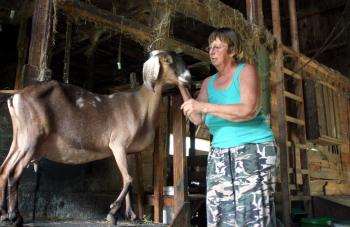 Denmark resident Helen Ramsdell has been
 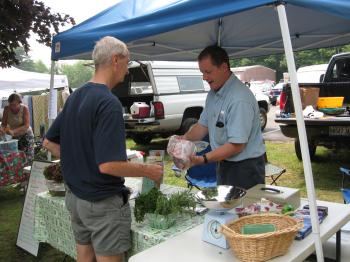 Bruce Fournier of Bittersweet in Denmark attributed the increase in visitors to the Bridgton Farmers Market to improvmetns in the site and consumer worries about food safety.
  Grow it and they will come
Comments are no longer available on this story