
The 132-year-old Pennell Institute holds a special place in Gray’s history. Regardless of what the town decides to do with the property, it is certain to play a crucial role in its future.
Town officials are now in the midst of gathering information on the cost of renovating the main Pennell building and its 1950-era additions, located on a seven-acre site near the center of town.
The result of that research is likely to go a long way toward deciding where the town will place its municipal offices and meeting areas in the future. It is a decision that will be made both with the cold figures of dollars and cents, and a warm sense of nostalgia.
The Gray Town Council has asked the volunteer community economic development committee to determine both the best method for altering or restoring the Pennell building, and the cost of building a new town hall from scratch.
A September deadline has been set for the study, and information will be used to help residents decide how they want to proceed through a question on the November ballot.
The Pennell Institute was built in 1876, and opened as a four-year high school a decade later.
With such an important decision looming, the council wants to make sure residents are heard on the matter.
“I want them to feel free to reach into the community,” said Peter Gellerson, council chairman, of the directive to the committee. “I really want everyone to toss in their ideas.”
In deciding the future direction, the town should look 20 years into the future, to make sure the proper questions are asked and the most pressing problems solved, said Town Councilor Mark Grover.
“I’m not in a rush to make a decision on Pennell,” he said.
Once residents decide what the town should do with the Pennell Institute, they will have to look at other town properties.
The former post office is now vacant. Stimson Hall may be closed for the winter to save on heating costs, and may be too large and too old to serve as a meeting hall much into the future. If the town offices are moved to Pennell, the current municipal building will have to be dealt with in some manner.
Town building administrator Doug Webster said he will soon begin putting together “packages” that are different sets of options for the town properties. It will show town officials and residents the different scenarios under which they can proceed in relation to the town buildings.
“The town has a tough decision to make,” he said. “The town, at this point, probably owns too many buildings.”
Last week, councilors, town officials and interested residents toured the main Pennell building, some for the first time. Part of the building is being used by the Gray Historical Society, and the remainder is either vacant or used for storage.
But the tour participants found the old building in great shape, its bricks firm and steady, its iconic clock chiming on the hour. Even after years of relative inactivity, the Pennell Institute inspired awe.
“Right now, this building is in great shape,” said Ted Googins, a Gray resident who gets an inside view of the building each month when he services the clock’s immaculate gears. “If this place was a modern building and had been neglected, it wouldn’t be here.”
At the tour, resident Peggy Brown remembered playing on the ballfields on the Pennell property, which includes the Institute, Newbegin Gym, the Anderson Lab and municipal ballfields. Brown said the kids would welcome the regular chiming from the clock tower.
“You don’t see them like this anymore,” Brown said. “I just think it’s so important to keep it maintained. It’s just a treasure.”
A town survey conducted in March shows much of Gray feels the same way. Of the 330 residents who responded, 292 said it was important to preserve the Pennell buildings, and 207 said the buildings should be renovated and used as the municipal offices.
There’s no doubt that the Pennell Institute carries a worth that cannot be measured in pure dollars, said Jeanne Carpentier, chairwoman of the Gray Economic Development Committee. But once the renovation figures are reached, townspeople will have to decide if it makes sense to fix the building.
“You can’t build anything like that today,” said Carpentier. “We’ll have to see what that is worth.”
The Pennell Institute is not without problems. The flashing on the roof is getting thin, and the building has bad ventilation. The bathrooms and two staircase are not compliant with standards outlined in the Americans with Disabilities Act.
A recent report submitted by Webster, town building administrator, put the cost of properly improving the entire Pennell building at $1.5 million, with $1.1 million going to the portion constructed in 1876. Those estimates, Webster said, were based on earlier studies and are in 2004 dollars.
The town may be restricted by the building’s placement on the Historic National Register, Webster said. The implications of that designation are unclear at this time, but will have to included as part of any proposal, he said.
Once the new figures are calculated, the true discussion can begin, Webster said.
“It’ll probably come down to dollars and cents” he said. “I think there will be some spirited discussions.”
He may be right. During the tour, Jean Bibber, whose father, Eliot Small, was the principal at Pennell Institute in the early ’50s, said she loved the building. But she didn’t know if should be renovated.
“At this point, until I hear a dollar figure, I’m not sure,” she said.
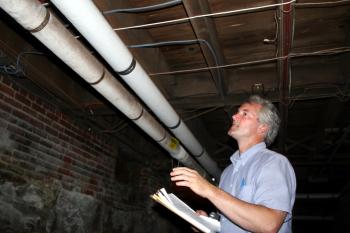 Doug Webster, Gray town building administrator tours the basement of the Pennell Institute July 10. Webster is at work on a plan to present options on what can be done with the 132-year-old building and other town properties.
 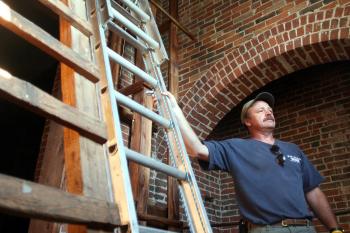 Ted Googins, of Gray, talks about maintaing the clock at the Pennell Institute Thursday evening during a public tour.
Comments are no longer available on this story