
It was around mid-morning at the Maine Wildlife Park in Gray, and Park Superintendent Curtis Johnson was heading toward the bird exhibit, a bucket of dead mice in tow. It was lunch time for the park’s young bald eagle, who sat high on his perch, inspecting his visitors with an intense glare.
A few steps away, Pam Richardson, an assistant game keeper, was working with a great horned owl, an unusually friendly bird rescued from a nearby nest. Soon, she’ll be hosing down the park’s moose, giving the bull a welcomed cold shower on a humid July day.
It’s another day in the life of the popular attraction, where over 100,000 visitors came last year to see the bear, deer, birds and other native wildlife that call the park home. Johnson and his staff keep the animals healthy and happy, and in some cases, prepare them for release back into the wild. As they go, they walk a fine line, providing these animals with hands-on care while respecting their primal nature.
(Click here to see a photo slideshow of animals from the park.)
“They are wild animals. They don’t make good pets,” said Richardson, who began her animal rehabilitation career by helping a small mouse at age 6. “They’re cute when they are babies. They’re fun. But they are not going to be babies forever. When I rehab them, I rehab them with the idea that they are going to be released, with as little human touch as possible.”
Where the wild things are
While most of the park’s animals are injured or otherwise dependent on human care, the game keepers try whenever possible to put the wildlife in their care back in the wild, Johnson said.
“If they are suitable for release, we don’t hold on to them,” he said.
After the bald eagle finished its meal, Johnson headed inside, stopping near a woodchip covered pen. As he left to gather a set of small bottles filled with warm goat’s milk, four deer fawns entered through a small door. Wide-eyed and unstable on their long, thin legs, the fawns stumbled in, ready for their meal.
The fawns that find their way to Gray have usually been plucked from the wild with the best of intentions by people who find them nestled in the woods.
“They assume that the fawn has been abandoned because they can’t see the mother,” said Johnson. “They think they are doing the right thing. A lot of times the mother is right there, but it doesn’t want to intervene. In most cases, it’s best just to leave wild animals where they are. “
After spending summer and fall at the park, the fawns will then go to an animal rehabilitation center before being released into the wild.
“They’re allowed to roam with the other deer for the winter, and then they are ready to go,” said Johnson.
As the deer approach their departure date, the keepers start to wean them off human contact, feeding them remotely rather than by hand.
“You need to do it in a way so they are not so attached,” Richardson said.
While deer and other mammals can be returned to the wild after lasting contact with humans, birds like owls and hawks are not as fortunate, Johnson said. The raptors, he said, are easily “imprinted” and develop an irreversible relationship with their human handlers.
“If they are cared for by humans at an early age, that’s it,” said Johnson.
Sometimes, however, the imprinting is unavoidable, and is necessary for the animal’s survival.
This spring, a visitor to the park found a great horned owl chick on the ground underneath a pine tree.
“We took it in and debated whether or not to put it back there,” said Johnson. “Often times it’s a sibling or the parents themselves that kick a runt out of the nest, and we didn’t think his chances of survival were very good.”
They decided to hold on to the owlet until its parents went off to hunt, then place it back in the nest.
“When we returned to do that, the parents were gone, the chicks were gone, and the nest was gone,” said Richardson.
“Sure enough, the other chick died and the nest failed,” said Johnson.
A closer examination of the owl found that its ear was infested with maggots, and its hearing badly damaged.
“I think it’s just vibration that he can hear,” said Richardson, who began to care for the bird, forming an unusually close bond. When Richardson was in the owl’s enclosure, it went without much trouble, to rest on her hand. The owl softly leaned its head against Richardson, and wrapped itself around her neck.
“They usually have an attitude,” she said. “He’ll snuggle and play and preen my hair. He hasn’t got to that nippy point, and I don’t think he will.”
Because the owl is so comfortable with Richardson, it will likely be used as a teaching tool for park visitors, Johnson said.
“It has become very attached to her, so we think it’s going to be a good display bird,” he said. “We can bring it out on someone’s fist and educate people about great horned owls.”
But even when they are at their cutest and cuddliest, the animals can pose a danger.
When Johnson entered the three-acre deer area, all the animals scattered, their white tails bouncing to the far side of the pen. All that remained of the herd was a 6-year-old buck, who sits calmly, all 250 pounds of him, under a tree near the fence. The imposing buck barely moved as Johnson approached, and allowed him to rub his nose and antlers, still covered in the early season velvet fuzz.
“He’s unlike any deer I’ve ever seen,” said Johnson. “He’s like the family dog.”
Still, this gentle giant has his wild instincts. The animals at the park are infertile, but the buck still has his hormones, and they kick in every fall. Last year, one buck killed another during a mating season fight.
“During the rut, we don’t go anywhere near them,” he said.
In the beginning
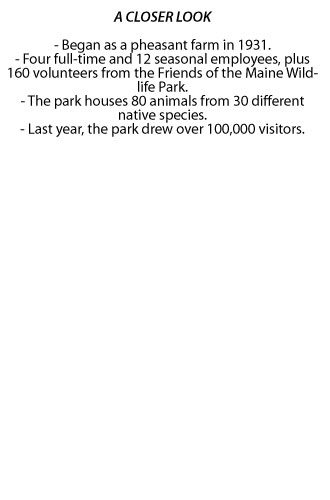
The Maine Wildlife Park began as a pheasant farm in 1931, and thousands of pheasants were raised there for the enjoyment of Maine hunters. In the early 1980s, the area became a game farm, and began its slow transformation into the attraction seen today.
“Over the years, wardens would bring injured animals here,” said Johnson. “It wasn’t a paid admission. People would just drive up and check it out.”
In 1992, the Legislature mandated that the game farm become financially self-sufficient, and now the park’s expenses are covered by revenue generated at the park as well as through donations. In 1998, the name was officially changed to the Maine Wildlife Park.
The park has become a popular attraction for Mainers and tourists alike, drawing over 100,000 people last year. The park employs four full-time workers and 12 seasonal employees. Besides showing off the 30 species of Maine wildlife, the park also offers weekly educational events where visitors can meet a live bald eagle or learn about Maine’s Native American tribes.
In addition, around 160 volunteers from the Friends of the Maine Wildlife Park, a nonprofit organization, help pitch in by working at the park or on fundraising projects.
One of the volunteers, Earl Meyrick, an 80-year-old New Mexico native who summers in Lewiston, is at the park Monday mornings, when he lectures visitors near the bear exhibit on one of the state’s signature species.
“Black bears are a part of us,” he said later.
A mathematician by trade, Meyrick, who also works at the Rio Grande Zoo while home in New Mexico, uses his time at the park to satisfy one of his lifelong dreams.
“I always wanted to be a veterinarian,” he said.
It takes the effort of all the staff and volunteers to make the park reach its goal, said Johnson.
“Our primary purpose is to educate the public,” said Johnson. “We are not a zoo, because we don’t have exotic species. We only have Maine species. These animals live in Maine and fill these different niches in Maine’s ecosystem.”
Everybody who comes to Maine wants to see a moose, Johnson said. If they can’t find one in the wild, they can certainly stop by the park, which has a four-year-old bull, an orphan found abandoned near the St. John River in northern Maine.
“This is definitely our flagship animal,” said Johnson. “They don’t want to leave Maine without seeing a moose.”
While the park is a big draw to visitors from outside the state, workers at the park said Mainers should come and learn more about the animals that live in their backyards. A long trip is not necessary to see amazing examples of wildlife, Meyrick said.
“I don’t think the people of Maine know what they have here,” he said.
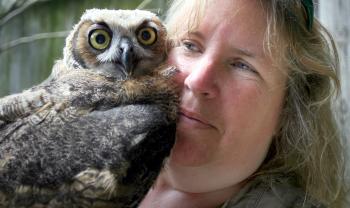 Maine Wildlife Park assistant game keeper Pam Richardson pauses for a moment with a 10-week-old great horned owl at the park in Gray Monday. Found abandoned, the owl will likely remain at the park instead of getting returned to the wild.
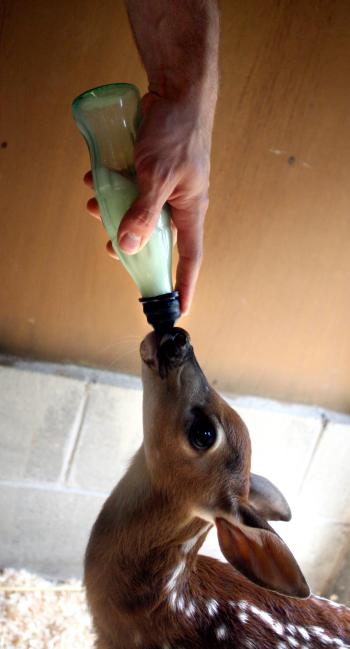 A 4-week-old fawn is fed Monday at the Maine Wildlife Park in Gray. Fawns are often brought to the park by people thinking them abandoned when a doe is actually nearby. After time at a rehabilitation center, the fawn will be released into the wild in the fall.
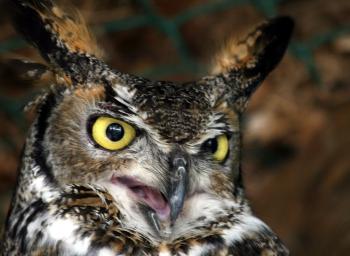 The steely glare of the great horned owl is one of the highlights of the raptor exhibit at the Maine Wildlife Park in Gray.
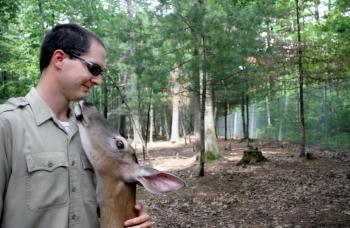 Curtis Johnson, a manager at the Maine Wildlife Park, greets a doe while feeding animals Monday afternoon in Gray.
  It’s a wild life in Gray (photo slideshow)
Comments are no longer available on this story