
What was it like in the olden days?
There were just three channels on the black-and-white TV – if your family had one – and they weren’t Nickelodeon, Disney and MTV. Ten cents an hour was a pretty good wage, drive-in movies were all the rage and the bathroom was out back – and didn’t flush.
Scarborough children walked to school, walked to church on Sundays, wore their hair in beehives and obeyed milked cows every morning and evening.
And there wasn’t a Wal-Mart anywhere.
For sixth-graders at Scarborough Middle School, a class project of interviewing some of the town’s older residents this spring became an opportunity to journey into the past.
Run by teachers Diane Saito, Tom Griffin, Kelli Crosby, Jen Simard and Carrie Murphy, the interview project brought together pre-teen boys and girls with senior citizens ranging in age from 65 to 106. After learning interview techniques and listing questions, groups of four to five students were paired with an older resident, whom they interviewed and then wrote a poem about.
The interviews turned the skeptical pre-teens into avid listeners with a new respect for older generations, they said.
“There is a lot you learn,” said Alicia Beckwith, 12, who interviewed 106-year-old Blanche Small Cook. “They have experienced a lot more than we have.”
Her group’s poem describes Cook’s life in matter-of-fact terms that are eloquent in their simplicity. Cook was the oldest of five children of a “Jack of all trades,” went to school in a one-room schoolhouse heated by a wood stove and walked home for lunch.
She married a printer named John during the Great Depression and worked in a sardine factory to help support her family, but “still wishes she could go back to high school.” Today, she is the only one of her siblings left, still “can’t carry a tune if she tried,” lives with her daughter and two cats to keep her company, and “calls herself a ‘tough cookie’ to make it to 106 years old.”
“Did I enjoy it? Very much,” said 84-year-old Marion Macmillan, who grew up in Massachusetts but summered in Maine with her family as child. “They were a good group of kids. They were really interested in what we did … We had kind of a good time. They didn’t know John Wayne – they didn’t know who he was. They didn’t know what a trolley car was.”
Michael Prichard, 12, said he was most impressed that his interview subject, Theresa Defosses, was driving at age 12 and got her license at age 14.
“She made 10 cents an hour. She said that for washing windows, you could make 1 cent per window,” he said. “(She) said there was only one policeman in town and everyone in town knew him and if you got in trouble they’d bring you to your parents’ house and you’d be very sorry.”
Roger Beeley, 64, said he was not entirely comfortable being classed as a “senior citizen” for the project, but said he enjoyed working with the children nonetheless.
“I thought the kids did a good job working together and I thought they did a good job putting (the poems) together,” he said. “They did a terrific job.”
The students say they have a new appreciation for senior citizens as a result of the project.
“A lot of people think old people are boring,” said Erin Quirk, 12, “but when you ask them questions, you can learn a lot.”
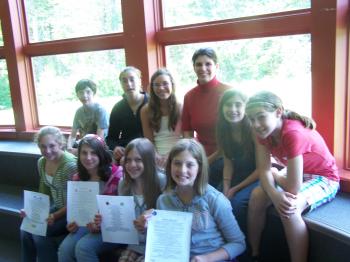 Kids learn seniors have much to teach
Comments are no longer available on this story