
A legendary artist
What better way to spend a cold and cheerless wintry afternoon than to view the excellent exhibit of paintings by Dahlov Ipcar now being shown in the old white farmhouse in Freeport that is the home of the Frost Gully Gallery?
Her glowing, iridescent colors, especially her yellows, oranges, golds and greens, are enough to brighten any dull, gray, leaden skies. It is difficult to believe that Ipcar is 90 years old and that these 20 or so paintings were all done in the last two years. Ipcar herself is surprised at her output and has told friends that cataract surgery has allowed her to perceive more brilliant colors, and reasonably good health has allowed her to work for a few hours every morning.
The first painting to catch my eye was entitled “The Ark of the Lord.” Dark clouds and teeming rain hover on either side of the picture and in the background stands the enormous ark with a white-bearded Noah, clutching his staff, standing in the bow. In the foreground, orderly lines of animals twist and turn, two by two, approaching the ark – giraffes, elephants, camels, zebras, pigs, sheep, anteaters, weasels, foxes, snakes, peacocks, flamingos, bats, swans, a rooster and hen, on and on they come, each pair more colorful than the last.
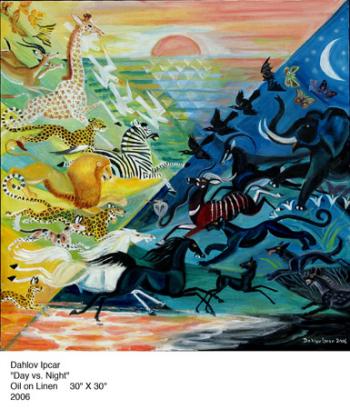
Another wonderful work, “Day vs. Night” has a sharp diagonal from top left to bottom right, dividing radiant light from menacing dark. On the one side, a rising sun reflects off water and shines on a golden giraffe, lions, leopards, zebras and butterflies, while on the other side, a crescent moon glows eerily over deep blue elephants, a cobra and wolf, bats and crows. “Cats on a Garden Path” is intriguing. Four cats (or maybe more – it’s hard to tell the way they are intertwined – but I think I counted four tails) sit on a gray stone path bordered by exotic green plants. Their yellow, tan, black and white coats shine in a vivid golden light and their long, curving tails are wondrous to behold. The month-long exhibit closed Dec. 28.
Ipcar is also a well-known illustrator of children’s books. Next year, Maine-based Islandport Press will reissue two of her books – her first, “The Little Fisherman,” published in 1945 and written by Margaret Wise Brown (“Goodnight Moon”), and her last, “My Wonderful Christmas Tree,” published in 1986. That is a great tribute to a legendary Maine artist and something for the literary world to look forward to.
A legendary home
The Tate House celebrated Christmas this year by reaching back some 230 years to Dec. 25, 1770, when Col. George Tate and wife, Mary, hosted the marriage of their son, Robert Tate, to Martha Slemons, the daughter of William and Catherine Slemons, also of Stroudwater, Casco Bay. We were greeted at the door by an elderly gentlemen in a gray wig, handsomely attired in a long brown coat with gold buttons, knee britches, white knit stockings and buckle shoes. Most striking of all was his vest, a golden brocade weskit decorated with pink and blue flowers, really quite elegant.
He introduced us to the house and explained that the actual wedding might have taken place at the home of the bride. However, since that house was quite small and since the reception after the wedding would have been quite large, the curators felt that it might, indeed, have taken place at the home of the groom. At any rate, our docent went on to say that the bride’s house no longer existed and so, if we of the present day were to enjoy the preparations for the wedding, it would have to be there in the Tate House.
We learned that weddings were often held on Christmas Day or on Twelfth Night (Jan. 6) as these were popular holidays when everyone who could make the trip would already be gathered at the family home. Decorations were sparse, but we admired the sprigs of boxwood hanging in all nine panes of the 18-pane window, and the trims of holly, representing the crown of thorns and the red blood of Jesus. Also on view were a bundling board and a bundling bag, It seems that when the prospective groom came to court, he could spend the night as long as the girl was safely ensconced in the bag and the board separated the two while in bed.
The docent in the front room had on a beautiful purple satin gown with pleats in back from shoulder to floor. Two petticoats, hip pads, stays, a stomacher that could be removed from the front of the dress and washed if it became soiled, white knit stockings with clocking and a white bonnet completed her costume. At that time, brides did not have a wedding dress, but instead wore their “best dress” often trimmed with little bows that they presented to the guests after the wedding. Instead of a veil, they adorned their hair with silk flowers. Also on display was an original “best” dress dating from 1754. Partially restored, it was of glorious yellow silk, with a woven floral pattern and was last viewed by the public during the 250th anniversary of the Tate House.
Finally, in the kitchen we met the serving girl. Her clothes were far different from the stylish costumes we had seen previously. She wore a long black skirt and a gray blouse made from linen and wool, covered by a blue checked apron of cotton – very practical, but not very pretty. We were told that all the costumes we had seen were made especially for this exhibit, sewn by hand and conforming to 18th-century requirements. Our serving maid went on to read a delightful poem said to have been written by Sir Fleetwood Fletcher in 1744 – “A Receipt for All Young Ladies That Are Going to be Married To Make a Sack-Posset.” Much like the eggnog of today, the “posset” consisted of sugar, sherry, nutmeg, eggs and milk and was bound to please the wedding guests.
We ended our visit at the Means House, across the street from the Tate House, Built in 1797, it now serves as the gift shop for the museum and also provides a lovely room with splendidly carved woodwork where we would find refreshments. We partook of an excellent “Bride Cake” with almond icing, and enjoyed reading the recipe for what we would now call a fruitcake. The ingredients for the frosting were particularly interesting, calling for a blending of egg whites, Jordan almonds, sugar and rosewater, to be applied to the cake while it was still hot and then returned to the oven “to brown.” The original recipe was published in London in 1770 and attributed to “an ingenious Foreigner, now head Confectioner to the Spanish Ambassador in England.”
 Current Affairs – Exhibits add something special to season
Comments are no longer available on this story