
More than 30 years since starting the Foundation for Blood Research in Scarborough, physician and scientist Dr. Robert Ritchie, 77, of Freeport, retired last month. On Nov. 5, he received the Hanley Leadership Award at a ceremony held at the Marriott in South Portland. The award, named for Dr. Dan Hanley, honors health-care professionals whose work benefits the people of Maine and who demonstrate courage, innovation, and vision. Last week, Ritchie sat down with The Current to talk about the work done at the foundation, the growth of biotechnology in Scarborough and the closest he’s come to an out-of-body experience.
Q: Why did you start the Foundation for Blood Research?
A: I was at Maine Medical Center. We started the research project there. It grew and totally changed the way we did testing. It went from taking days to minutes and then seconds. There wasn’t enough room for us. Out of it came the clinical application, which was taking these tests and making real diagnoses for treating human disease. We started to apply computer technology, which marries the tests with the demographics of a patient.
Q: What kinds of diseases could you diagnose with the computer program?
A: Rheumatoid arthritis, lupus and all the allied conditions, like infection, cancer of many types, heart disease of many types. When you look at someone who seems healthy but has dropped 10 pounds in the past month, sometimes you can’t tell what it is. The computer can narrow it down to something much more specific. We had to justify these tests to the insurance companies. We looked at 1,000 cases of people coming in with typical complaints, like ‘I’m tired’ or ‘I’m depressed,’ and we found that about 30 percent of them had real diseases that hadn’t manifested yet.
Q: So, the computer program allows for a much earlier diagnosis?
A: Which presents a problem: do you want to know if you have a disease that’s going to crop up three years from now?
Q: Where is the research from the foundation being used and applied?
A: The research is used all over the world. The interpretive program is relatively local.
Q: So, if the interpretive computer program can make diagnoses, will there someday be no use for doctors?
A: It’s up to the physician to agree or not agree with the diagnosis. That’s going to happen someday, but not in that sense, just like any profession. Physicians will play a different role. The picture will change, just as it’s changed from 1950 to today. There’s such a flood of information, you can’t expect anybody to handle it all.
Q: After starting the foundation, how were you still heavily involved with the work being done there, or were you more of an overseer?
A: The computer program was my baby, totally. I wrote it. It took 20 years, and I’m still debugging it. Getting the tests going was more than 20 years ago. Other people at the lab have taken it and refined it. The people at the lab have been what’s made the engine go.
Q: Have you had any personal encounters, diagnosing patients?
A: Countless. But it’s a two-edge sword. When you are the bearer of bad news, you don’t often see people happy about what you did. We know that we’ve done a great deal for people, and some have been very grateful, but the number is relatively small.
Q: Why do you think Scarborough became a hub for biotechnology?
A: We were the first one. We spun off the first for-profit research group, which was Atlantic Antibodies. People from both have gone off on their own, and others have come in because of the base of trained people. And it’s a very compliant population. If you need a study group, the Maine people have always been extremely enthusiastic about taking part, which is completely opposite from Boston or New York. No one has told me here, ‘I don’t want to be involved because I don’t want to be a guinea pig.’ We’ve had patients drive down from Fort Kent to get their blood drawn because of the reputation.
Q: How did it feel to receive the Hanley Leadership Award?
A: If I’ve ever had an out-of-body experience, it was that evening. I wasn’t expecting it. When the time came for me to go up, I was dimly aware that there were people standing around me, but I got there and there was this army of people. I felt like I was an observer – quite a moving experience.
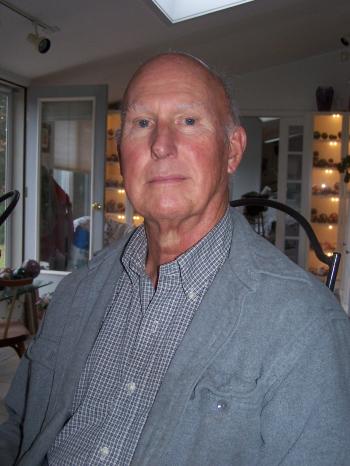 Q&A with Dr. Robert Ritchie – Retiring doctor brought biotech to Scarborough
Comments are no longer available on this story