
It lacks a taste and smell and can take years to adversely affect a drinker’s health, but uranium has proved to be quite good at punching small holes into budgets.
The naturally occurring element, which can concentrate in water supplies through the dissolution of other minerals, has been found in high concentrations in the water supplies for Naples municipal buildings and Songo Locks Elementary School.
The cost and design of treatment options for uranium in the water was the subject of a meeting Wednesday between Naples Town Manager Derik Goodine and Andy Madura, maintenance supervisor for School Administrative District 61.
Goodine is still searching for the proper method to remove the uranium from water in the town office, fire station and other buildings on the Naples Village Green. He expects to update Naples selectmen on the options and costs at the board of selectmen’s meeting Monday, Sept. 24.
At a Sept. 10 meeting of the Naples Board of Selectmen, Goodine said he was quoted prices of $18,000 to filter water at town hall and other buildings, plus an additional $4,000 for the fire station. He later declined to name the company quoting the figures.
Goodine hopes Madura, who earned state approval Aug. 22 for a filtration system at the elementary school, can help him sort out and compare the apples from the oranges as they look at the treatment system to be installed soon. Students at the school are now drinking water from dispensers installed before the school year began.
An anion system to filter uranium from the water using electronically charged particles to attract uranium molecules to a resin surface will cost SAD 61 about $3,500 to install and another $3,500 per year for use and disposal. Filtration tanks will be exchanged each year so the school faces no worries about disposing of trapped uranium.
While referring questions about water treatment to Madura, Songo Lakes Principal June Conley did say parents were notified of the situation before school began and have been calm. “They know we are doing what we need to do,” said Conley.
Madura said the heightened levels of uranium were first noticed at Songo Locks Elementary School last fall, but tests done at that and other district schools usually show dissipated levels when tested again.
The state, which administers the federal Safe Drinking Water Act for the U. S. Environmental Protection Agency, performs tests for uranium in water in public and private water sources. The EPA standard for safe levels of uranium is 30 parts per billion in a liter of water.
The school water was tested again in the spring, and when uranium levels proved consistent at above 100 parts per billion, Madura decided to consult Air & Water Quality Inc., a Freeport company that designs containment systems for water contaminants.
Uranium concentrations are not as high at the buildings in Naples, where the heightened levels were discovered about eight months ago.
“The issue of uranium is not about radioactivity, it is about heavy metal poisoning,” said Eric Wilson, a senior sales engineer at the company.
The EPA does not require treatment systems to be installed in schools or churches given that the rate of water consumption at these places falls well below levels that can cause health hazards, specifically to the kidneys or from carcinogens.
According to David Braley, a geologist with the Maine Department of Health and Human Services, the standard used by the federal EPA is based on the idea that an average person can safely drink up to two liters of water a day with 30 parts per billion or less of uranium for 70 years.
Braley did caution that estimate was a statistical average, likening it to the fact that many people know smokers who may smoke for decades and avoid the known health hazards and consequences.
Eric Fromberg, a state toxicologist, added that heightened uranium levels would not necessarily accelerate kidney damage or cause irreversible harm.
Madura said he was told a person would have to drink two or three quarts of water a day over decades to encounter potential health risks from uranium at the level seen at Songo Locks Elementary School.
The presence of uranium in water is a newer concern in both public and private water supplies, and the state suggests homeowners with wells drilled into bedrock have their water tested for uranium and other contaminants such as arsenic.
Perhaps 5 percent of private wells have elevated levels of uranium, but Wilson believes the figure is higher. He estimated the company has performed 200 tests for uranium this year with as many as 10 percent showing levels above the EPA standard. Fromberg and Wilson confirmed high levels of uranium in water have been found in specific areas in Gray, New Gloucester, Poland and Raymond Cape.
With at least one private well in 20 showing elevated levels of uranium, Fromberg recommends homeowners have their wells comprehensively tested. He added to specify uranium as part of the test because it is not automatically included in tests done by some private labs.
Air & Water Quality offers a variety of tests, with one specifically for uranium for around $20. A more sophisticated test used by real estate agents to check for organic and inorganic contaminants like arsenic can cost $50 to $70.
At Katahdin Analytical Services in Scarborough, lab manager Debbie Nadeau said the company does not usually test water for private homeowners, and does not offer treatment programs and equipment for water.
However, the company has seen more walk-in customers, even if measured anecdotally, in the last couple of years. Nadeau and George Brewer, who manages the lab testing for inorganic materials, did say requests for testing for uranium had increased, but as a part of general concerns for water quality.
Air & Water Quality also offers treatment options for homeowners. A basic reverse osmosis filtering method that filters uranium by trapping the molecules on a membrane as the water passes through will cost between $1,500 and $1,800 to install. The comapny also pays for an independent test of the water after instasllation to ensure the system works properly.
Unlike the anion systems used for larger water supplies, the reverse osmosis method returns the uranium to the ground source, alleviating the need to dispose of the membrane as hazardous waste.
Filter cartridges cost $35 to $40 each and need yearly replacement, while the membranes may need replacement after about four years.
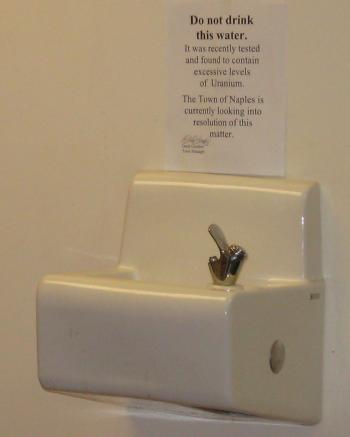 The resolution referred to in this sign at the Naples Town Hall was initially expected to cost more than $22,000, but Naples Town Manager Derik Goodine is still considering options to remove high levels of uranium from the water supply.
Comments are no longer available on this story