
Retired high school science teacher and Bowdoin graduate Dick Brown said his small business really started at his family’s cabin in Wayne, Maine.
“My grandmother and mother always had a puzzle going on the table,” said Brown. He lives in Windham with his wife Delanne.
Now Brown, 70, who has a Ph.D. in chemistry, makes wooden jigsaw puzzles with his small business, Otodoworks, that he runs from his basement. He named it after his family’s cabin. A mason had just finished building the chimney and was asked to help name the cabin.
“He said, ‘that ought to do,’ and it just stuck,” said Brown. His puzzles are often sold to collectors, or as birthday or wedding gifts. He makes most of his sales in the summer and around Christmas time, and he has been in the trade since 2001.
“I’m up to over a hundred a year, Brown estimated. He said he can make five puzzles in a busy week.
Each puzzle starts as a rectangle of five-ply mahogany plywood sprayed with adhesive and topped with an image printed from his computer on high-quality paper.
“That was the hard part when I started out,” said Brown. His puzzles feature a mix of old images with expired copyrights and new ones.
Some of the images are paintings by local artists like Thomas K. Merriam, of Windham, or R.N. Cohen, who has a gallery in Portland. Brown also takes scenic photographs and Photoshops them to make the colors brighter and higher in contrast.
“People like to have that strength and vibrancy in their puzzles,” he said. He also will make special puzzles from images the customer provides.
After the image is carefully glued on and the air bubbles are taken out with a roller, Brown trims the side of the board to make sure the picture is as squared away as possible.
“I’m never perfectly straight,” he said. He then sands the edges and applies a UV-protective, non-yellowing matte spray to protect the image.
Then comes the cutting.
Brown said he spent a lot of time trying out different blades before he found the right one. It needed to be thin and able to cut a straight line without veering off.
“It’s eight-thousandths of an inch wide, so the pieces go together tightly,” said Brown. To keep a sharp cutting edge, he goes through eight to 12 blades each puzzle.
Each puzzlemaker has his own cutting style, according to Brown. He desribes his as “random and knobby,” making quick, fluted cuts resulting in irregular locking pieces. His cuts look more fluid and layered when compared to the pieces of a mass-produced die-cut puzzle where all the pieces fit neatly onto a grid.
All of his cuts are spontaneous and off the cuff. He has to stay focused to avoid making acute-angle cuts, which would result in a peeling image, and peg-shaped pieces that have no locking contacts with neighboring pieces.
“If I start to lose track, I ruin a puzzle every time,” he said. He sells those puzzles for about half price.
He also likes to make color line cuts, which are cut along color divisions, like a dark roof next to a bright sky, to make the puzzle harder for his customers.
“I like the challenge of trying to make a quality product that people will enjoy putting together,” he said.
After talking to other Maine puzzle makers, Brown said he learned a few tricks of the trade.
“I don’t touch the edges when I cut,” he said. Constant finger contact can cause the image to loosen so Brown now moves the uncut board under the saw by pressing down on the board and gliding it under the blade.
While he cuts pieces out, Brown sets them to the side in the original formation. When cutting is complete, Brown flips the solved puzzle over.
“You can pick these puzzles up by one piece,” said Brown while dangling a complete puzzle from a single corner piece.
He then takes sandpaper to the bottom of the puzzle to smooth the cut edges and anchors the pieces with a special tool, a wire mesh set in a wooden frame, and vacuums the sawdust away.
The last step is to count the number of pieces and box them. Brown said his standard puzzle size is 11 by 17 inches, and about 340 pieces.
Brown charges 53 cents per piece, so the retail price hovers around $150 for a puzzle.
“Most puzzle cutters sell them for a dollar a piece or more,” said Brown. Some fancy puzzles can go up to $6 a piece.
“Dick does a wonderful job,” said Bob Havenstein, who owns the I’m Puzzled retail store in Nobleboro which has about 1,700 puzzles on its shelves.
“The puzzles I have from Dick feature points of Maine interests, like Fort Edgecomb, Portland Headlight, and a wood full of birch trees,” said Havenstein. He said Otodoworks puzzles sell very well at his store.
Otodoworks puzzles are also sold at Puzzles & Games Etc. in the Portland Old Port and Board Silly in Old Orchard Beach, as well as from Brown directly.
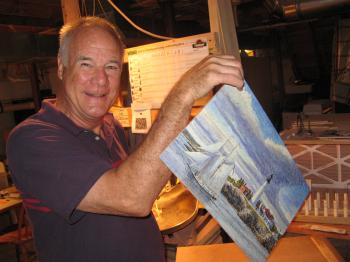
 Puzzles1: Dick Brown, __, of Windham holds an uncut jigsaw puzzle in his basement workshop on Nash Road. Brown is a retired chemistry teacher and now runs Otodoworks puzzle company in his spare time.
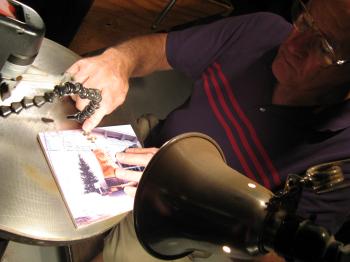
 Puzzles2: Dick Brown, __, of Windham holds a wooden jigsaw puzzle by a single corner piece in his basement workshop on Nash Road. Brown is a retired chemistry teacher and now runs Otodoworks puzzle company in his spare time.
  Puzzles3-6 Brown uses a blade 8/1000 of an inch wide to cut his puzzles. All of his cuts are spontaneous and quick. The black segmented device next to the blade blows air to remove the sawdust from fresh cuts.
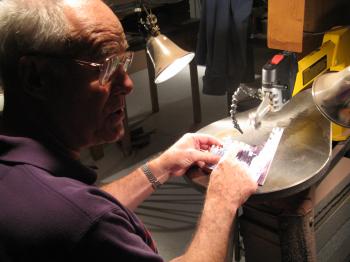 Puzzles3-6 Brown uses a blade 8/1000 of an inch wide to cut his puzzles. All of his cuts are spontaneous and quick. The black segmented device next to the blade blows air to remove the sawdust from fresh cuts.
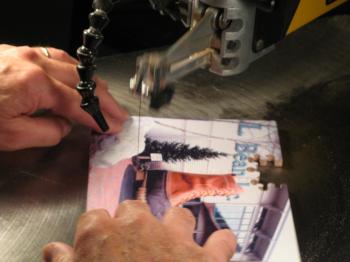 Puzzles3-6 Brown uses a blade 8/1000 of an inch wide to cut his puzzles. All of his cuts are spontaneous and quick. The black segmented device next to the blade blows air to remove the sawdust from fresh cuts.
Comments are no longer available on this story