
More info:
The Menu Foods Web site lists all pet food involved in the company’s recall. The addresses are:
http://www.menufoods.com/recall/product_cat.html
http://www.menufoods.com/recall/product_dog.html
Marie Aikins said she first heard about a pet food recall March 16 from a feline message board she sees online.
She said she checked her family’s cupboards and didn’t find any of the listed food.
“I thought I was in the clear,” she said.
Then last week, she checked to see if the recall list had been updated. It had, and some of the Iams foil pouches in her cupboard were now on it. Aikins said three of her four cats ate the tainted food, and two cats, Nala and Roo, showed signs of toxicity.
Aikins, who lives in Portland, is one of thousands of people whose pets have been affected by the tainted pet food. Throughout the area, veterinarians are fielding calls from worried owners and treating pets suffering kidney damage.
On March 16, the Ontario-based pet food production company Menu Foods announced a voluntary recall on some of its “cuts and gravy” style wet food. It is believed that traces of rat poison made its way into some varieties of food after the company switched its supplier of the protein and binding agent wheat gluten. Menu Foods produces a number of large name-brand and retailer-specific pet foods, including Iams, Paws, Wal-Mart and Hannaford.
The suspected poison, aminopterin, is used as a rat poison and a cancer treatment. It causes renal failure, which means that the kidneys stop filtering out most waste products from the blood stream. Certain varieties of canned pet food and foil pouches produced between Dec. 3 of last year and March 6 were taken off shelves this month and customers who had already purchased them were asked to return the food.
On March 24, Menu Foods said all cans and pouches of the tainted varieties, not just the ones produced during the toxic period, were being taken off shelves to protect consumers from getting the production dates mixed up. The recall has not been extended to other types of wet food and no dry food bags have been recalled.
“A lot of pets…have no symptoms,” said Renee Brezovsky, head technician at the Lake Region Animal Hospital in North Windham. She said many pets have been brought to her veterinary clinic for blood tests and the majority of those exposed to the toxin had no symptoms, but did show increased renal values.
Brezovsky said that the few animals that do show signs of poisoning drink large amounts of water and, as a result, urinate more. Vomiting and a lack of appetite are also symptoms, she said.
Cats are at a higher risk to the poisoning, according to Brezovsky, because of their smaller bodies. She encourages anyone with an exposed pet to have its blood tested.
“If gone untreated, it can be fatal,” she said.
“Every day, there’s someone in here asking questions,” said Jess Smith, assistant manager at the Blue Seal animal feed and supply store in South Windham. She said customers have been buying more pet food made from smaller companies.
Dr. Kristine Hoyt, from Cats on Call in Scarborough, a clinic just for cats, said that most of her patients were not exposed to the tainted food.
“It’s a very minor number,” she said of the cats that were brought in to be tested.
Hoyt said that many of the cats who ate the tainted food vomited and felt sick afterwards, which discouraged them from eating it again and kept the number of poisoning victims down.
While the numbers may be low, Hoyt said she feels her patient pool has been affected. A cat that visited her clinic died under mysterious circumstances just before the recall was declared.
“I suspect highly that that cat may have come under (poisoning from the pet food),” she said. The body was cremated before news of the recall came out, preventing her from knowing for sure.
“We’re talking millions and millions of cans,” said Dr. S. Eric Riddell of Jordan Bay Animal Hospital in Raymond. He said he’s heard through the grapevine that most veterinary clinics have seen one or two cases.
Riddell said a young cat was brought in to the Raymond clinic about a week before the recall was announced on March 16. Riddell said the cat was suffering from the latter stages of renal failure and had to be put to sleep. He said the cat had been exclusively eating one of the recalled varieties.
Another cat that visits his clinic is currently being treated for poisoning, and he expects it to make a full recovery. It is being fed supplements and a low-protein diet to take strain off the kidneys as well as the water treatment.
“Water is the elixir of life,” said Riddell.
Standish Veterinary Hospital reported no cases of renal failure.
On Monday, Gloria Hardy of the Animal Refuge League of Greater Portland stopped by Aikins’ home to show her how to treat Nala and Roo.
Water is injected into the loose skin at the nape of the cat’s or dog’s neck and forms a small hump. It is absorbed into the flesh, and Aikins said it flushes out the system.
Aikins, who is also a volunteer with the Westbrook-based Animal Refuge League, said the treatment must be done every day for two weeks. She estimated it would cost about $1,200 to have the treatment done by a veterinarian. She said she believes her cats will recover.
“My heart goes out to those who can’t afford to treat their cats,” she said.
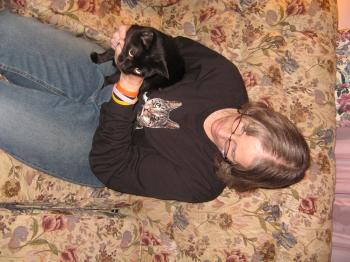 petrecallNala1 & petrecallNala2: Marie Aikins of Portland hold hers cat, Nala, who tested positive for kidney failure as a result of eating tainted pet food. Aikins owns four cats and is treating two of them by injecting water into the nape of their to flush out the system. Cats and dogs from all over North America have been affected by the poisoned food from numerous major brand names that share a manufacturer.
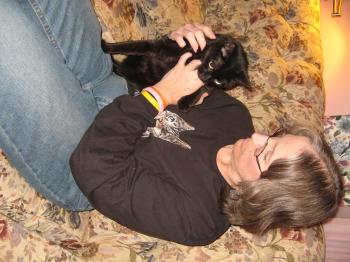 petrecallNala1 & petrecallNala2: Marie Aikins of Portland hold hers cat, Nala, who tested positive for kidney failure as a result of eating tainted pet food. Aikins owns four cats and is treating two of them by injecting water into the nape of their to flush out the system. Cats and dogs from all over North America have been affected by the poisoned food from numerous major brand names that share a manufacturer.
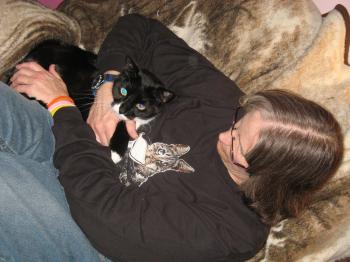 petrecallRoo1 & petrecallRoo2: Marie Aikins of Portland hold hers cat, Roo, who tested positive for kidney failure as a result of eating tainted pet food. Aikins owns four cats and is treating two of them by injecting water into the nape of their to flush out the system. Cats and dogs from all over North America have been affected by the poisoned food from numerous major brand names that share a manufacturer.
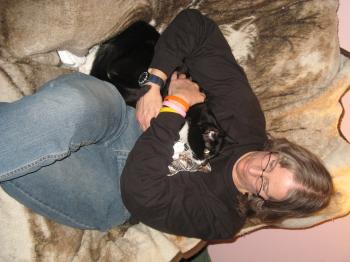 petrecallRoo1 & petrecallRoo2: Marie Aikins of Portland hold hers cat, Roo, who tested positive for kidney failure as a result of eating tainted pet food. Aikins owns four cats and is treating two of them by injecting water into the nape of their to flush out the system. Cats and dogs from all over North America have been affected by the poisoned food from numerous major brand names that share a manufacturer.
Comments are no longer available on this story