
After last week’s announcement that the Sensata manufacturing plant will lay off the vast majority of its employees, many employees are wondering what they’re going to do next.
“I’m still shocked about it,” said Sharon Ridgedale of Cornish. “They’ve sold it six times since I’ve been here, but never closed the doors.”
Ridgedale has worked at the plant for 35 years. Ridgedale said she used to work as a mechanic when the plant produced thermal protectors, devices in engines and electronics that shut things off when they reach unsafe temperatures. Sometime when the plant changed hands Ridgedale’s mechanic job was cut but she managed to stay on as a custodian.
Sensata Technologies, located on Route 35 near Sebago Lake Village, is Standish’s largest private employer with about 200 employees. It produces sensors used in automobiles and consumer products. The jobs will be moved to a plant in the Dominican Republic. It was purchased from Honeywell less than a month ago on Dec. 19.
Although the closing was announced on Jan. 10, three weeks after it was purchased, Sensata spokeswoman Linda Megathlin said the decision to close the plant was not made until after it was purchased.
“As part of the process, we looked at the integration [of Honeywell and Sensata],” Megathlin said.
Megathlin said the plant will lay off workers in phases over the next 18 months. She said Sensata will keep 25 to 35 employees for a smaller research and development center. The location of the center will be in Standish or a surrounding town, Megathlin said, but a location has not been chosen at this time.
Ridgedale believes the workers who do survive the lay-offs might not be around very long.
“I can almost bet when they learn all they can from the engineers, they’ll be let go, too,” said Ridgedale.
“This is just part of a pattern,” said Sensata employee Robert Bradstreet of Standish. Bradstreet, now in his mid-50s, said this is the fourth time he has lost a job in Maine because operations were moved out of the country.
“I’m kind of sick of it at my age,” said Bradstreet. His previous jobs were in producing shoes, poultry and casting metals.
Standish Assessor Peter Arnemann said the plant has a yearly tax burden of $114,807. Arnemann said that the value of the land, building and personal property (business equipment) of the plant is worth almost $11.8 million and about $6 million of it is in property that he expects Sensata will remove. This means that if a new company bought the plant, its taxes would be reduced to $58,600 because of the removed equipment.
State Rep. Gary Moore, R-Standish and other government leaders say they are most concerned about the effect the closing will have on the workers and families, many of whom live in Standish, who will lose their jobs.
“I’ve discovered people who have worked there for over 20 years, and not just a few of them,” said Moore.
Moore has petitioned for the federal Trade Adjustment Act to be applied to the Standish workers. If approved by the U.S. Department of Labor, the act will give the displaced workers “enhanced unemployment benefits” and access to retraining, Moore said.
The Trade Adjustment Act is open for workers whose jobs have been relocated out of the country. Moore said Maine Senators Susan Collins and Olympia Snowe have become involved in the application.
“They’ve been very helpful,” Moore said.
Marty Perlmutter, the rapid response coordinator for Cumberland and York counties, met with Sensata officials last week. His office meets with laid-off workers and informs them of unemployment benefits, options for health care and services available at the 22 career centers located throughout the state.
“I’m hopeful that in an appropriate time we’ll be invited in to meet with Sensata employees,” said Perlmutter. He is employed by the Maine Department of Labor.
Megathlin said that the 180 or so production workers scheduled to be let go will receive a severance package equivalent to four weeks’ pay, plus a week’s pay for every year they have worked at the plant. Health insurance coverage would end three months after an employee’s separation date. In order to receive severance pay, employees need to stay employed at the plant until their lay-off date, which is unknown. Employees who quit or are fired will not receive anything.
This same severance pay plan will also be used for the executives of the company that are being laid off, according to Megathlin.
Moore said while the severance package does give money to workers who need it, “it’s also a way of holding onto people and keeping them dangling.”
Ridgedale said she’s concerned a large portion of her severance pay will be taken out in taxes.
“They’re closing the plant, taking our jobs, and then [the government is] taking our money,” she said.
Sandy Lynd of the Maine Revenue Service said she in unaware of how much the federal government can tax the workers on their severance pay, but that the maximum the state of Maine can take is 8.5 percent.
Workers who wish to know how much of their severance pay will be taxed by the state can reach her at (207) 624-7855.
The Standish plant began as a Sylvania operation several decades ago. Until recently, it was known as Control Devices, an offshoot of Honeywell. Sensata, a $1.5-billion company with nine technology and manufacturing centers in eight countries, grew out of Texas Instruments. It was acquired by the investment firm Bain Capital LLC last April.
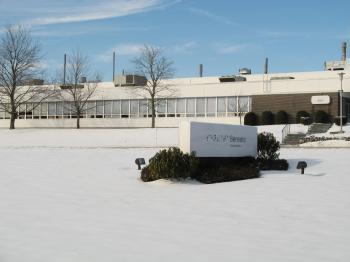 Sensata1 and Sensata2: Sensata Technologies, located on Route 35 near Sebago Lake Village, is Standish
 Sensata1 and Sensata2: Sensata Technologies, located on Route 35 near Sebago Lake Village, is Standish
Comments are no longer available on this story