
The Cape Elizabeth Town Council is losing its longest-serving member.
Known for her defense of the environment and support of land conservation, Carol Fritz decided not to run for re-election this fall after serving a little more than nine years – three terms – as a town councilor. She attended her final meeting last week.
“It’s been a real distinctive pleasure to serve as a Cape councilor,” Carol Fritz told her colleagues in her brief farewell speech at the meeting.
Although she plans to spend more time on her rhododendrons and traveling, Fritz doesn’t plan to end her years of work volunteering in the community. At 63 years old, she is turning her attention toward raising money for Fort Williams Park, after being one of the most outspoken opponents of charging a fee to visitors there.
Fritz was recently nominated to serve on the Fort Williams Charitable Foundation’s board of directors. She expects to hear confirmation from the group in a couple of weeks.
Fritz has made a habit of public service since she moved to town from Michigan in 1974 with her husband, Ron, who died in 1995. Her husband’s work as a physician allowed her to devote much of her time to volunteering. Before she was a town councilor, Fritz served on the planning board for seven years.
Town Councilor Paul McKenney said she was a leading advocate for open space as a founding member of the Cape Elizabeth Land Trust in 1985, and a member of the trust board for 11 years. He said she fought hard for historic preservation, both as town councilor and as a member of the Spurwink Church Renovation Study Committee.
McKenney, who was recently nominated as council chairman, said that during his two years on the council, he sat next to Fritz, whom he called a powerful promoter of the environment, fiscal conservatism and historical preservation.
“Carol was particularly effective working with EcoMaine and promoting recycling in the town,” he said. EcoMaine is a nonprofit waste management company owned and operated by 21 municipalities in Southern Maine.
In her farewell speech at last week’s meeting, Fritz expressed delight at the outcome of the recent referendum vote, which rejected fees at Fort Williams. She expressed regret that the town had not taken advantage of more opportunities to preserve land with open-space easements at Fort Williams, the Jordan Farm and the Town Farm. She also expressed regret at the loss of the keeper’s quarters at Two Lights.
In an interview Friday at her Stirrup Road home, Fritz said she was disappointed councilors had not voted in favor of an easement protecting a portion of Fort Williams. She said that and the possibility that fees could be assessed to park visitors had been obstacles for the Fort Williams Charitable Foundation, which was created about six years ago, as it has tried to raise money for the park.
While most of the park is protected because of federal grants for the fort, a portion is unprotected town property. She said protecting that portion with an easement would have guaranteed to donors that the park would remain in public hands.
Fritz said she was also disappointed with the loss of the historical keeper’s quarters at Two Lights. She called it one of her biggest disappointments as town councilor.
In 1998, the owners of the property removed the original structure and built a new one in similar fashion, but in a larger, more modern style. She said it is hard to see these buildings go because they help people remember the history of the town in a very physical way.
In pursuit of historical preservation, Fritz asked state Sen. Jane Amero to sponsor a bill in 1999 that gave tax-break incentives to people who own historic buildings. The bill was passed and eventually voted in as an amendment to the state constitution.
Fritz was instrumental in the vision for Gull Crest Field, a 110-acre property the town purchased in 1998. It is now the site of multiple-purpose fields, hiking trials, Nordic ski trails and a community garden with nearly 40, 12-foot-by-12-foot garden plots for residents.
“The purchase of Gull Crest Field was a really good decision,” said Fritz, who said it was a highlight of her time on the council.
The 50-year easement for the Town Farm property, which includes a portion of the Spurwink Marsh, was also a big accomplishment for Fritz. She said the council worked with the Cape Elizabeth Land Trust to create the easement, which she would like to see continue in perpetuity.
“I’ve always been concerned about growth,” said Fritz. “I’m worried we are going to lose some of our farms in the future,” she said.
Fritz said she is also concerned development pressures might weaken current wetland ordinances. “I worry people will forget all the work and scientific knowledge that went into creating it,” she said.
Councilor David Backer said Fritz has consistently been the strongest voice for preserving land and the rural character of Cape. He said she was also a strong proponent of recycling in town. He said he hoped councilors would continue to echo her views.
“I will miss her voice, and I think the whole town will miss her voice,” said Backer.
Other fellow councilors also spoke highly of Fritz and her work on the council. “It’s been great working with her. She is a wealth of knowledge,” said Anne Swift-Kayatta, the now senior member of the council, with over seven years’ experience.
While she plans to continue her work in the community, Fritz does expect to have more time for herself now that she’s no longer a town councilor. She’s already beginning to think about some of the places she might travel to – Machu Picchu, the Galapogos Islands, Greece, Chili, or just about any place she hasn’t been, she said.
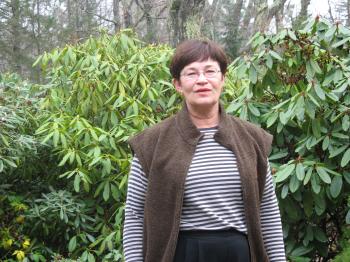 2048 – Carol Fritz talked on Friday about her three terms on the town council and her rhododendrons.
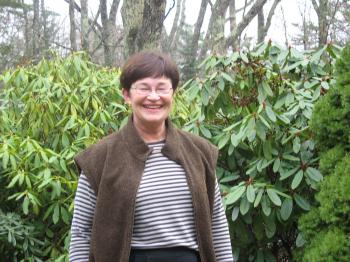 2049 – Carol Fritz shares a laugh while talking about her work with the town of Cape Elizabeth.
Comments are no longer available on this story