
Since the first farmers in Scarborough started altering the land, the saltwater marsh has been drained, blocked, filled and marred by ditches in various attempts to gain better farm land and build better roads.
For the next two weeks, a restoration plan six years in the making will try to reverse some of the harm done to the marsh in the Libby River watershed by adding two culverts underneath Black Point Road.
As a result, Black Point Road will be closed from now until Friday, Nov. 10, and possibly into Saturday, Nov. 11. Traffic will be detoured onto Highland Avenue to Pleasant Hill Road to Route 77, about a 4.8-mile loop.
The culvert replacement is a $236,000 project designed to increase the tidal flow and levels of saltwater in the Libby River tidal marsh in an attempt to restore about 93 of the 3,100-acre Scarborough Marsh. With two extra culverts, more salt water can reach the marsh and excess fresh water from storms and runoff can leave. With a more natural tide flow and higher salinity levels up stream, it will be hard for phragmites, a highly invasive species of reed, to survive in the marsh.
“The very first goal is to control and hopefully eradicate the 27 acres of phragmites,” said Wayne Munroe, the district conservationist for the Natural Resources Conservation Service.
The two new culverts are made of aluminum to prevent rust and corrosion and together cost about $56,000. They are not entirely round, but more oval shaped, with about a 6-foot 4-inch rise and 8-foot 10-inch span.
This latest restoration of the marsh will be completed at no cost to Scarborough. The Wildlife Habitat Improvement Program provided 75 percent of the money and the Federal Highway Administration and the Maine Department of Transportation gave 25 percent.
The project, which should be finished in about two weeks, is a joint effort with the Maine Department of Transportation, the Natural Resources Conservation Service, the Scarborough Sanitary District, the Maine Department of Inland Fisheries and Wildlife, Maine Audubon, the Friends of the Scarborough Marsh and other Maine environmental groups.
The large number of local, state and federal groups helped make the project successful, said C.D. Armstrong, president of the friends of the Scarborough Marsh. “It’s the best way to get the right outcome,” he said. “Each of the agencies and organizations that have been involved brought something different to the table.”
While the concept of adding two culverts appears simple, finding the right way to add them was a complex and lengthy process.
“There is a long history with this project,” said Ryan Hodgman, the environmental coordinator for the Maine Department of Transportation. When the existing culvert was installed under the road in 1992, said Hodgman, a wastewater pipe was punctured, causing clam flats to close. The pipe and culvert were then encased in cement.
“That really put a lot of constraints on what we can do,” said Hodgman.
Added to the modern problems of wastewater lines and cement, said Munroe, are changes that were made to the marsh a few hundred years ago. By looking at aerial photographs, said Munroe, they can see what was done to alter the marsh by early farmers. All of that has to be taken into consideration before a successful plan can be implemented. No one fix can be applied to all sections of the marsh.
Part of the solution, said Hodgman, is to actually widen the channel by removing about 4,000 square feet of marsh. Weighed against the eventual positive impact of adding the two culverts, said Hodgman, this impact on the marsh is relatively small.
The goal, said Charles Hebson, the hydrology supervisor for the Maine Department of Transportation, is to make sure the marsh floods at high tide without rising too high. Currently, water only floods the banks once or twice a year during spring tides. With the extra culverts, the hope is that this will occur around 30 or 40 times a year.
“The immediate indicator of success will be when you look out over the beautiful marsh you don’t see 20-foot tall phragmites,” said Munroe. “That should be seen within one year. Next fall at this time, a large portion of phragmites will be reduced.”
Though the eradication of phragmites is easily visible, the restoration project will be carefully monitored for water levels and wildlife. The real success indicator, said Munroe, is when the marsh once again has a wide variety of plants, fish, invertebrates, shorebirds, wading birds and water fowl.
The Libby River restoration is part of a bigger plan to one day restore the whole marsh, said Munroe. Once two current projects still in the planning stages are completed, he estimated that about 50 percent of the marsh will have been restored.
“We’d really like to see a post-restoration marsh in the next three to five years,” said Munroe. In that time, he added, the marsh could once again function as it did 200 years ago.
Though he hopes the marsh will be restored in the next few years, there is always the potential of new problems, said Munroe.
“We hope that phragmites will be the worst invasive species,” said Munroe. “There’s always more stuff coming in and probably some that aren’t even mapped out yet.”
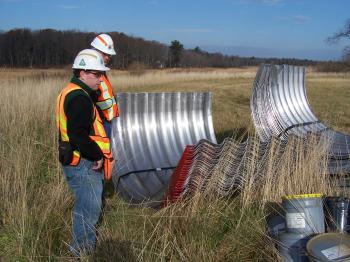 Charles Hebson, the chief hydrologist for the Maine Department of Transportationh.
 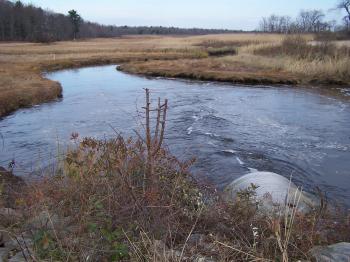 To restore tidal flow, about 4,000 square feet of marsh will be removed to widen the channel and two new culverts will be added.
Comments are no longer available on this story