
On any given summer day, Route 302 is clogged with traffic heading north and south through the Lakes Region.
For tourists visiting the region and commuters driving to work, there’s no way to avoid the heavy traffic and no other option but to drive the main road since all forms of alternative transportation were suspended long ago.
Since transportation officials continue to focus on road improvements and highway expansions to solve the problem of traffic congestion throughout southern Maine, reviving the state’s railroad network remains on the back burner.
But with the price of fuel sparking interest in railroad passenger service and freight, old railroads like the Mountain Division Rail are once again being looked at for the future of transportation.
The Maine Department of Transportation is currently pursuing purchase of the abandoned rail line from Route 202 in Windham to the SAPPI Fine Paper mill in Westbrook from Guilford Railroad. This is part of an ongoing effort to preserve vital rail corridors in the state for future passenger and freight use. The state already owns the rail tracks from Windham to the New Hampshire border in Fryeburg.
While revival of the passenger service on the old Mountain Division railroad may be far off in the future, renewed interest in the rail at least gives hope to people like Barbara Clark, director of the Sebago Lakes Chamber of Commerce, who constantly talks with state legislators and transportation officials about finding a solution to the congested Route 302 corridor.
“Knowing that transportation officials are looking to work on that extension is really good news and I’d like to get our legislators more involved in that,” Clark said.
Sen. Bill Diamond, D-Cumberland, chairman of the state Transportation Committee, has already held several discussions on the possibility of reusing the Mountain Division tracks with transportation officials, other state legislators and business owners interested in using the tracks to ship freight.
“Eventually, we hope for commercial reasons to have a line to the New Hampshire border,” Diamond said. “There’s good potential in the Mountain Division Rail and it’s a great opportunity.”
Mechanics and cost of renewing the tracks
If the Mountain Division rail line were to be renewed for passenger rail, most of the track would have to be replaced to bring it up to Amtrak standards, said Ron Roy, director of the state Office of Passenger Transportation.
After new railroad ties are put in place, welded steel would be laid in quarter-mile strips to ensure a smooth ride. The cost per mile hovers around $1 million per mile with additional money needed for guarded crossings and train station platforms.
In terms of speed, the rail line would need to be on par or above road traffic, averaging between 40 to 60 miles per hour.
“You want to be competitive with the automobile which would be easy in the east/west corridor,” Roy said.
The renewal of rail service from Portland to Boston on the Downeaster train cost a total of $70 million including new train stations and guard crossings on the 78-mile stretch.
Roy considers the possibility of renewing the rail line “well out into the horizon,” but the state does recognize “the opportunity that the Mountain Division Rail may be able to provide to the transportation corridor.”
Renewal of freight lines
Though no commuter service pays for itself, the use of freight on a rail line makes renewed passenger service more viable.
On freight lines owned by the state, the state leases use of the rail to freight companies shipping goods by train. While this doesn’t create surplus revenue for the state, it does help to subsidize the cost of passenger rail.
“We’re not going to get rich off them and we understand that,” said Nate Moulton, director of the state Office of Freight Transportation. “It’s like any other public transportation infrastructure. You just try to make it better for the public.”
For companies, it’s most profitable to ship heavy commodities such as concrete and lumber by train. One cement railroad car can haul what three tractor-trailers can haul of cement, he said.
“If you’re moving a heavy product any distance, it can really pay for itself because it costs significantly less moving it by rail,” Moulton said.
Portland Water District, however, is apprehensive about renewed freight on the Mountain Division because the old rail line skirts by Sebago Lake as it heads north to Fryeburg.
“We don’t have any concerns with passenger service,” said Michelle Clements, public relations director for Portland Water District. “But it’s really a different thing when the train could be carrying chemicals.”
To protect the valuable source of drinking water in Sebago Lake, the Portland Water District has asked, if rail is renewed, that no station would be created in close vicinity where the Portland Water District extracts water to supply to thousands of customers in southern Maine.
Vision of “The Crown”
As transportation officials focus on possible commuter service and freight service to the Lakes Region, some rail advocates have a greater vision of the Mountain Division Rail.
Jack Sutton, of Belgrade, set forth one such vision in a report called “The Crown of New England.” The report suggested Maine, New Hampshire and Vermont work together to renew the Mountain Division Rail from Portland to North Conway and across to White River Junction where it could connect with Vermont rail lines heading north and south.
“The Crown of New England concept offers three northern New England states an unparalleled opportunity to utilize the full length of the Mountain Division,” for stimulating local tourist economies while restraining traffic congestion, the report read.
Sutton presented this report to the New Hampshire Railroad Association in 2001 where it received interest, but little sign of commitment.
Conway Scenic Railroad already runs summer tourist trains from the border town up to Crawford Notch and, if the Mountain Division Rail in Maine were to be revived and connected with this rail service, the entire Mountain Division rail line would become more economically viable, Sutton said.
“There’s economic reality involved in this, too,” Sutton said. “It’s a reasonable avenue to pursue, but it requires investments by the states.”
The North Conway tourist train pays for itself since the state leases the rail line to the privately owned scenic railroad company, said Christopher Morgan, head of the New Hampshire Bureau of Rail and Transit.
The stance on reviving the railroads in New Hampshire is much the same as it is in Maine.
“There’s a renewed interest, but not much activity besides to preserve these corridors,” Morgan said.
People continue to talk about the possibility of reconnecting with Mountain Division line in Maine, but the obstacle remains that the state of Maine doesn’t own the final link in the track from Windham to Portland, a section of which the state is now attempting the purchase from Guilford Railroad.
If Maine were able to obtain this missing link of track to complete the stretch from Portland to Fryeburg, New Hampshire transportation officials would take a closer look at the possible collaboration, Morgan said.
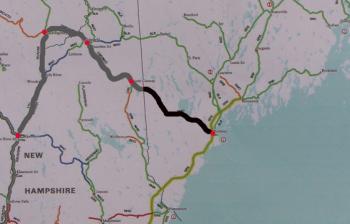 This railroad map from the Maine Department of Transportation shows the various railroad routes both in service and abandoned. The black route outlines the Mountain Division Rail from Portland to the New Hampshire border in Fryeburg. The gray route outlines the Mountain Division Rail as it continues through to North Conway, across to St. Johnsbury, VT and down to White River Junction where it meets with Amtrak service to north Burlington and south into Massachusetts. State transportation officials are now negiotating to buy a missing link of the Mountain Division Rail from Windham into Westbrook. The state already owns the rail line north to Fryeburg and is interested in renewing freight and commuter service on the Mountain Division Rail in the future.
Comments are no longer available on this story