
Graph:
Chart
State percentage of jobs from microbusinesses
Maine 21.3
Massachusetts 17.5
New Hampshire 19.6
Vermont 22.5
Connecticut 17.7
Rhode Island 18.3
United States 17.9
Source: U.S. Department of Commerce
Infobox: For help building a home-based business, contact Colleen Myers at cmyers@maine.rr.com or 799-4706 for more information about the Cape Entrepreneurs, a local group of home-based business operators.
After 10 years eating late night meals out of Chinese take-out containers, Colleen Myers was spent. Her work as a lawyer had invaded nearly every facet of her life. She longed for balance. So in 1991 she and her husband Paul, fled New York City for the peaceful respite of Maine. They hoped to shift out of fifth gear into a lifestyle a little less taxing. This was Myers’ first step towards recreating her career.
In 2003, a friend introduced Myers, a Cape resident, to a Japanese company called Nikken. Myers bought into their “wellness home technologies,” and began selling the company’s air and water filtration systems, line of supplements and sleep care products. Similar to the business model of Pampered Chef or Tupperware , Nikken relies on its home-based sales agents. Now Myers works from home and said she doesn’t miss the 9 to 5 grind.
“If I needed to go back to work, I could, but I just can’t imagine doing it,” said Myers, who relishes the flexibility of her schedule often times trading her computer for soil and gloves, taking a break from her business to work in the garden. Now Myers enjoys attending to her family’s needs. Her work no longer pushes her personal life into the corner.
Like more and more people statewide, Myers is taking advantage of the technology at her disposal and rejecting a conventional corporate atmosphere. In lieu of the office, she works on her laptop in her sun-filled back deck, dressed in casual attire, slippers, athletic shorts and loose-fitting tee shirt.
Business experts say more people are trading in their pumps and briefcases to work from home, especially in Maine, and though their work is not as visible it is just as vital to the economy as the grocery stores, retail shops, or restaurants. It’s the businesses located off the main drag, very often operating out of people’s homes that are helping boost Maine’s economy.
Jim McConnon, University of Maine Cooperative Extension associate professor and business and economics specialist, said the economic importance of microbusinesses – businesses with five people or fewer – is growing in the Maine economy and the culture in Cape Elizabeth and surrounding areas is indicative of that growth.
McConnon has tracked the growth of microbusinesses and discovered that one in every five jobs in the Maine economy is created by a microbusiness with half of those jobs created by home-based entrepreneurs.
All new businesses in Cape Elizabeth must get a permit from Code Enforcement Officer Bruce Smith before opening. Smith said about 21 to 24 new home-based companies sprout up in Cape yearly, compared to only about 10 to 12 storefront businesses that have opened in town in the last five years.
Though Smith said home-based business growth has been steady in his nine years as code enforcement officer, those registering as home-based occupations, which don’t service customers or have employees, have doubled in three years over the prior three years.
South Portland Licensing Administrator Jen Scholz has seen a similar trend. In her seven years working with the city, she has seen the number of home-based businesses in the city grow. Mostly she’s seen growth in certain areas, like consulting, landscaping and cleaning businesses, she said. “I don’t know what they’re consulting about, but it’s big business,” she said.
Smith theorizes that regulations imposed on banks after Sept. 11, 2001 have driven people to register with his office. “I’m not sure there’s more home occupations,” he said, but added he felt that banks were requiring better documentation from those small businesses.
Scholz said though that may be one factor, her numbers of newly registered small businesses were increasing before Sept. 11, 2001. From 1997 to 2006, Scholz has registered 450 new small businesses in South Portland, and she estimates that 90 percent of those are home-based. In 1997, 29 new small businesses registered and by 2005, that number had more than doubled to 62.
The number of new registered home businesses in Cape Elizabeth jumped from just four in 2001 to 14 in 2002. The numbers increased again in 2003 to 17, but then dropped down to six in 2005. Both Scholz and Smith many home-based businesses don’t bother to register with the government.
McConnon conceded that his own statistics regarding microbusinesses are probably an understatement of the actual market, because people are also working from their homes without registering the business.
People are choosing to work from home for many reasons, including cost efficiency, technological advances, lack of better opportunity and to spend more time with their families.
Myers finally stopped commuting to work when her family obligations demanded it, though she had stepped back from corporate life incrementally over the years.
In 1993, Myers adopted her son Leo and cut back to part-time at Tom’s of Maine, where she was as a vice president. In 1996, Myers adopted her daughter Clara. With two children and a mother to care for in Minnesota, Myers decided “it was time to bail out of these high profile jobs…I wanted to have energy available for my family,” she said.
For the first time since she was a child, when she worked on a farm in Minnesota, Myers’ work revolved solely around family. She was a mother and a daughter first. “I stopped saying ‘I’m taking time off from work’,” said Myers.
Mike Vaillancourt, president of the South Portland/Cape Elizabeth Community Chamber, said home-based businesses are a growing market. Though the chamber is an advocate of home-based businesses, Vaillancourt concedes they very often go unnoticed.
“The funny thing about it is you don’t hear much about them, oftentimes you don’t even know they’re there,” he said.
Kathryn Sheehan, who runs a $30,000 a year business selling hand-made fairy doll kits and accessories, rarely advertises. She works from her basement in Cape, where she has a storage room full of her stock.
There is no shop out of her home and customers don’t stop by to browse. Most of her business, which is primarily out of state and out of the country, is generated through her online connections. She uses Ebay as well as Web rings and blogs, which connect her to similar interest sites and generate word of mouth business.
Sheehan, like Myers, stopped working full-time to devote more time to her family. With her and her husband’s family in Oklahoma and Illinois and no day care centers in Cape Elizabeth at the time, Sheehan said it was difficult securing reliable childcare for her daughter.
“It was just us. I was it. When she was sick, I didn’t have grandma to call,” she said.
It was the constraints of a traditional work schedule that encouraged her to seek alternative forms of employment.
In addition to a flexible schedule, people are bailing out of the traditional job market because of cost considerations, said McConnon. Scholz said in South Portland, she has noticed many massage therapists and other alternative healing therapists working from home, where they can set up their massage chair in a back room and not pay for office space.
Cape resident Ann Kilby’s work lends itself to a home environment. Her office on St. John Street in Portland bears little resemblance to the polite reserved atmosphere of traditional healthcare offices. A rocking chair on one wall sits beside a fireplace where an imitation fire flickers in the grate.
Kilby said the energy she used creating a welcoming atmosphere could be better spent in her home, at less cost. “It just really makes more sense,” she said.
For 53-year-old Kilby, relocating her holistic healing practice, from Portland to her home in Cape, will save her about $7,200 a year.
McConnon said that statewide, particularly in more rural areas, where traditional blue-collar manufacturing jobs are disappearing, microbusinesses are especially important for economic growth.
Whether people already live in these areas or move there by choice, they are being forced to think more creatively about building a career. “In remote places, people tend to cobble together a living. It’s more of a survival, these people are figuring out a way to survive where they live,” said McConnon.
Cape Elizabeth Tax Assessor Matt Sturgis theorizes that the lack of more traditional job offerings in Cape could be contributing to the growth of home-based businesses, at least in Cape Elizabeth.
“The job opportunities may not be there in a conventional sense, but you can create opportunity…it’s an independent streak we have,” said Sturgis.
In Cumberland County alone, microbusinesses comprise 18 percent of the total job market and half of those are home-based jobs, said McConnon.
In eight years, Sheehan’s business, The Silver Penny, which originated from informal classes teaching neighborhood kids to build fairy dolls, has evolved into a legitimate home-based business growing 25 to 40 percent yearly.
Sharing her secrets, Sheehan concluded that finding success requires finding a niche. Sheehan found her niche as “the Tooth Fairy,” selling her customized fairy products and books. Though working from home can be isolating, it doesn’t deter Sheehan, who said she likes being the Tooth Fairy.
 Cape resident Ann Kilby uses sound therapy to help heal patients at her office in Portland. Kilby was recently granted a permit from Cape Elizabeth to practice her holistic healing techniques from her home. When she moves her practice to her home in Cape, Kilby will save over $7200 a year in rent.
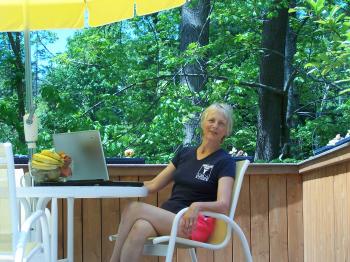 For Cape resident Colleen Myers, her back deck serves as her office. Myers runs her business from her home.
Comments are no longer available on this story