
Cape resident Bob Neely has an unusual hobby. He likes to re-enact American wars.
Neely, a former Marine, is fascinated by the life of the foot soldier. Donned in the traditional redcoat attire, he expounded recently upon the details of daily life, explaining everything from the structure of a British company down to the shoes the Brits wore.
This past Monday night, about 25 people gathered at the Thomas Memorial Library in Cape Elizabeth to hear Neely’s history lesson on the Revolutionary War, told from the British soldier’s perspective. Sponsored by the Cape Elizabeth Historical Society, this was the last in a series of lectures. The Historical Society will resume their monthly lectures this coming November.
Neely, a self-proclaimed history buff, who majored in floristry at Syracuse University, first joined the Marines in the 1960s. Neely fought in Vietnam, finished up his term and then went to college. One day on campus, he bumped into the military recruiter and signed on for a second tour of duty.
“It was something special, and I was good at it,” said Neely, who served as a squad leader.
Now a shipbuilder at Bath Iron Works, Neely hasn’t abandoned his military days. As a war re-enactor, he travels to Connecticut and Massachusetts for staged battles. When he goes, he brings his props: hatchet, canteen, haversack, musket, bullet bag, hat and the red coat.
Why the red coat? Asked an audience member. “It’s still a mystery,” said Neely. One audience member shared his own theory, “probably some general had a controlling interest in red dye.”
Though the red coats might have been superfluous, the rest of the gear was not. Hatchets were necessary, said Neely, because America was a virgin land and soldiers often found themselves in thick shrubby brush. The only way to get out was to cut through it.
The haversack was large enough to carry four days worth of food, though oftentimes soldiers subsisted on sauerkraut and other preserved foods. Because there was little to no building infrastructure, there was no easy food source. Food shipped over from Britain by sea was often moldy or sour by its arrival.
“Everything was in pretty bad shape,” said Neely.
America’s first civil war – that’s how Neely described the Revolution. One-third of the colonists, the Loyalists, fought for and supported the British, while one-third, the Yankees, supported the American Revolution and one-third were neutral.
Many who fought for Britain were recruited from surrounding countries. In the basic British Army, Neely said only about 11 percent were British. About 80 percent were Scottish and Irish. Neely is of Irish heritage.
Many soldiers were lured into service by the up-front salary. Recruiters traveled from city to city offering a shilling and a crown to most any man who would sign up, though they tried to avoid enlisting married men.
The shilling was to pay for the outfit, and the crown was to drink to the king’s health. After too many drinks, “a man would wake up with a shilling in his pocket and boom, he’s in the army,” said Neely. As a result, desertion was a problem as well as drunkenness and gambling.
Despite this though, Neely claims men were mostly loyal to the crown and at the close of the war many returned to Great Britain.
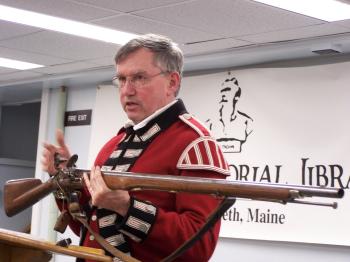 Cape resident Bob Neely demonstrates how to load a 75-caliber smooth board musket. The musket was the favored weapon of British troops during the American Revolution.
Comments are no longer available on this story