
Kylie Tanabe and Colleen Whitcomb knew that Hawaii was an American state, but they didn’t know how or why, until they entered the statewide National History Day competition last September.
After seven months of research and compiling more than 50 sources, there is no doubt in Tanabe’s mind how Hawaii became part of America. “The U.S. basically illegally took Hawaii…evidence shows that it was an overthrow,” she said.
Tanabe, Whitcomb and 11 other Cape Elizabeth eighth-graders will present projects on taking a stand in history at Maine’s National History Day competition April 6 in Augusta.
Project topics range from the more commonly known story of Rosa Parks and the flappers, to the less obvious founding of Georgia. Project formats range from performances to documentaries, to a paper and an exhibit.
Peter Brigham decided the founding of Georgia fit the “taking a stand” in history theme because it was founded by the English government as a utopia for people imprisoned for not paying their debt. “They were there because they were poor,” he said. The colony was founded essentially to relieve poverty, he said.
Social Studies teacher Sarah Welch, faculty adviser, offered this opportunity because it was something she benefited from as a student in Connecticut. The students, she said, learn transferable skills, like forming an argument, identifying resources and researching and organizing information.
“They’re making connections they otherwise wouldn’t in the classroom,” she said.
Cidney Mayes said her mother is a “bit of a feminist,” which inspired her to study Susan B. Anthony, a forerunner of the women’s movement. Mayes is confident that her project, a position paper, is ready for competition. With nearly 70 sources under her belt, Mayes has decided that Anthony is a great inspiration.
“We should continue to uphold her beliefs,” she said. Now, she knows why her mother is a feminist, she said.
Welch said one of the most important aspects of the project is source collection. She urged her students to find 130 sources by competition. Internet sources were capped at about 30. To assist her students in filling the quota, Welch brought them on fieldtrips to the Portland and Augusta libraries. However, in order to meet their goals, students reached their tentacles beyond the obvious routes. One student crossed the United States for sources.
Tanabe, born in Hawaii, was immediately excited about her project when she chose the annexation of Hawaii. She knew her family would visit Hawaii during her research period so she and her parents visited the Iolani Palace in Honolulu, where the last Queen of Hawaii, Queen Liliuokalani was surrounded by Americans and forced to sign the annexation treaty in 1893, which ceded possession of Hawaii to the United States.
Grant Backer used the Baseball Hall of Fame, which wound up being a gold mine for his and partner Will Pierce’s project on Jackie Robinson, the first black baseball player to bridge the race divide in professional baseball.
Robinson fit the theme because he entered the league knowing there would be consequences, said Backer. Other players slid their spikes into him on base, people sent him death threats, and he was booed at games, said Backer and Pierce.
“He inspired other blacks to play,” said Backer.
Most of the students said they’ve worked on their projects nearly every day and have surrendered precious weekend hours to collecting sources. Now, they’re putting the finishing touches on their projects.
For Whitcomb and Tanabe, that means memorizing lines and practicing their performance.
At this point, the girls aren’t worried about collecting sources or building an argument. Their biggest stressor now is the upcoming performance. The final hurdle of the seven month project will be getting through their lines.
“We’re afraid we’re gonna mess,” said Tanabe, or worst yet, “trip,” said Whitcomb as her eyes widened in anxiety.
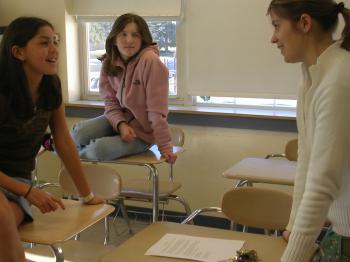 Kylie Tanabe (front) recites her lines to National History Day adviser Sarah Welch while partner Colleen Whitcomb looks on. Tanabe and Whitcomb will act out the annexation of Hawaii at the state competition on April 6
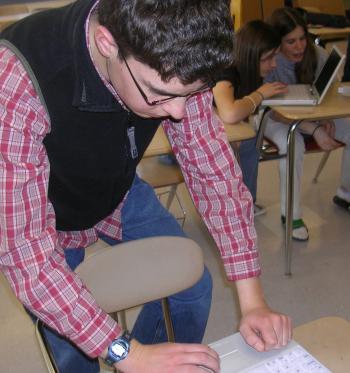 Peter Brigham works on his documentary on the founding of Georgia while Macauley Cliffe and Kristin Kerney work on their project about flappers for the upcoming National History Day competition.
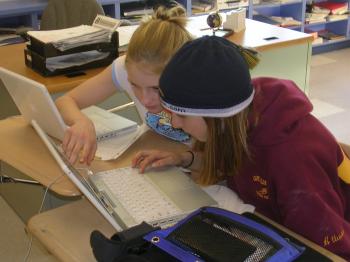 Cape Elizabeth eighth graders Meredith Riker, left and Emily Attwood pore over their documentary “Why move when you can start a movement” about Rosa Parks for the National History Day competition.
Comments are no longer available on this story