
The number of students participating in Cape Elizabeth’s student rescue program has reached its lowest level since the program began nearly 20 years ago.
Only one student now participates in the program. In past years, the program has been filled to capacity – eight students.
Some people involved in Cape Elizabeth public safety speculate that the student shortage could just be part of a natural cycle, while others believe state mandates limiting student activity could be to blame, and still others think students could instead be choosing to train as firefighters.
Cape, like some neighboring towns, has two programs recruiting and training students for public safety work. The student rescue and student firefighter programs recruit students to bulk up their volunteer forces.
Though the programs share some similarities, they are dissimilar in many ways. For one, the firefighter program isn’t experiencing waning interest.
“This has never happened before,” said Evelyn Cox, captain of the rescue program. Cox said there is competition for students in the programs and she suspects she is losing students to the firefighter program, where there are fewer restrictions on what trainees can do.
Both Cox and Cape Elizabeth Fire Chief Phillip McGouldrick not only encourage their students to recruit, but rely heavily on the students to sell the programs to their peers. “When you’ve got just one student recruiting, it’s more difficult,” said McGouldrick.
The student firefighters said Eric Wellman, a rescue program graduate, have “missold” the rescue program, telling their friends it is not as valuable as it really is. Student firefighter Brad Pearson said this is probably true. Student firefighters do flaunt that they do more than the rescue students. “It’s partially a bragging rights thing,” he said.
McGouldrick has heard this too, but said interest in one area of public safety does not necessarily translate into interest in another area of public safety. “I’ve never had any interest in being a cop,” he said. McGouldrick partially credits the training programs offered through the student firefighting program for student retention.
There are weekly truck checks, monthly company trainings, and the firefighter 101 course offered through the department. This is in addition to the calls students respond to.
“If we didn’t have any training, it would be more difficult to keep their interest,” said McGouldrick.
Though there are currently no meetings or trainings specific to student rescue, Cox said that when the program is full, there are monthly meetings addressing such topics as blood-born pathogens, moving a patient, and use of stretchers. As Pearson is the only student, he is invited to attend the regular rescue meetings.
Training for student rescue involves obtaining a basic EMT license, which is not offered through the rescue program but through a class taught at Southern Maine Community College.
Wellman, a dispatcher at the Cape Elizabeth Police Department who also teaches at Southern Maine Community College, said he thinks interest in the program is waning because of restrictions on student activity.
The rescue program is mandated by the state, and students are allowed to perform only certain tasks. Students cannot respond to possible suicides, overdoses, peer injuries, or a call that may be physically or psychologically injurious to them, said Evelyn Cox, student rescue caption.
Despite these restrictions, she said there are few calls that students are prohibited from going on.
Student firefighter programs are regulated by the Occupational Safety and Health Administration, rather than the state, and have far fewer restrictions. Under OSHA regulation, student firefighters can respond to all calls, and are prohibited only from entering a burning building.
McGouldrick has said there are more opportunities for students to get hands-on experience in the firefighter program because there are more jobs to do at a scene. When there’s a grass fire or woods fire said McGouldrick, “it’s a man-power intensive thing.”
McGouldrick concedes that the majority of tasks given the students in the firefighter program are “grunt-work.” “That’s how they learn-doing the grunt-work,” he said.
With a rescue call, there is usually only one patient, and therefore less work to do. Cox said the rescue program is designed initially as an observer program for kids to decide whether they want to pursue the medical profession. “Once licensed, they can work with the patients under the supervision of a licensed rescue member,” she said.
Another wet towel thrown over the rescue program is the rotational on-call schedule. Students only work one week out of the month when enrollment is its maximum of eight students. The rescue program caps participation at eight students because of space limitations. In addition, there is a limit of two students per call.
“The back of an ambulance only has so much space,” said Wellman.
For Pearson, this meant three weeks out of the month he was not going on calls. “Sometimes it would bug me because it wasn’t my week,” he said.
This year, as the only student on the rescue, he said, though he misses the camaraderie, fewer students in the program means he can go on more calls. Last year, as a junior, he shared calls with seven seniors on the rescue team.
Student firefighters don’t worry about such limitations. There are no restrictions limiting the number of kids who can respond to calls, though McGouldrick says he tries to maintain enrollment in the program at about 10 so there is adequate supervision.
Student firefighter Brad Pearson said he responds to calls his brother is prohibited from, like car accidents. If there is a car accident, he said, “I get people out of the car, take the car apart” while “my brother can’t go out” on the call.
Despite the current obstacles, Cox is confident the program will swing upwards soon. “I would like to see eight kids next year, she said. “I don’t think we’re going to stay in this cycle.”
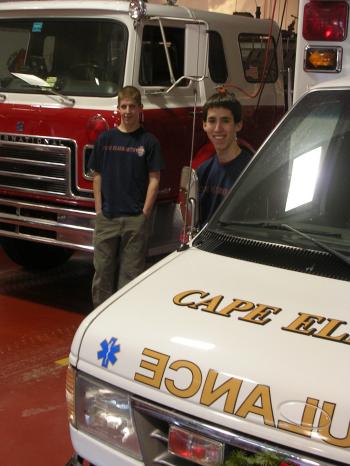 Casey (front) and brother Brad Pearson volunteer for public safety in Cape Elizabeth. Casey Pearson is the only student in the student rescue program while brother Brad Pearson is one of 10 student firefighters.
Comments are no longer available on this story