
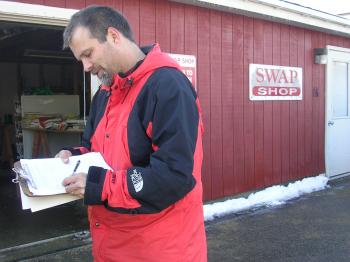
Diana Sterne spent her Saturday afternoon at the Cape Elizabeth dump, where she resolved to stay until she collected enough signatures to fill her petition sheet.
Sterne and other members of the Neighbors for Sensible Development made a final push to gather enough signatures for a petition to change zoning ordinances. They hoped to submit the petition to the town clerk for approval before the Dec. 20 public hearing for the Spurwink Woods development project.
Sterne’s home is on the corner of Mitchell and Columbus roads, and she said she is collecting signatures to help her neighbors, even though she wouldn’t be directly affected by the development.
“It’s a very quiet neighborhood,” she said. “It’s a shame to have to change the nature.”
The proposed zoning change would prevent the creation of short-cut streets in Cape Elizabeth, which the citizen group considers a threat to their way of life.
The Spurwink Woods subdivision is a proposed 42-unit development on 26 acres located between Spurwink Avenue and Mitchell Road. The neighbors are primarily opposing the creation of what they describe as a short-cut road, linking Dermot Drive and Killdeer Road, which are currently dead-end roads.
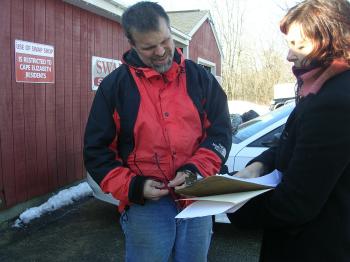
Ray Haversat of Lydon Lane initially refused Sterne’s request to sign the petition, thinking that supporting the petition could endanger his neighborhood. “I live in the other neighborhood that they’re going to go through if they don’t go through hers,” he said.
After listening to Sterne explain that the zoning change would protect all neighborhoods from “short-cut” streets, he signed willingly, though he was skeptical about its potential effectiveness.
Cape resident Nancy Wentworth wrote in an e-mail to Maureen O’Meara that developer Jim McFarlane was using “scare tactics” with “threats” to develop other neighborhoods if the Spurwink Woods project were blocked.
McFarlane said he never threatened anybody. “Why would I risk all that I’ve done so far to do something like that?” he asked.
“Anywhere you do a project like this,” he said, “the not-in-my-backyard contingent is big.” McFarlane thinks the citizen group’s petition aims to prevent his development.
Richard Bryant, a Spurwink Avenue resident and the lawyer who drafted the proposed ordinance change, contends that is not the case. “It’s not a sledge hammer trying to stop all development,” he said. “If you avoid cut-throughs, it’s fine to connect developments.”
Although the proposal has been accepted by the Planning Board as complete and is on its way to approval under current zoning ordinances, the Neighbors for Sensible Development could still stymie the project.
The petitioners have collected more than 750 signatures. They need only 767 before submitting it to the town clerk for acceptance.
Bryant calls the petition-filing day the “magic date.” If filed prior to final acceptance of the Spurwink proposal, the proposed zoning change is no longer subject to time constraints, said Bryant. Even if the development proposal gains final acceptance the day after the petition is filed, the new zoning, potentially adopted months later still applies to the project because it did not have final approval at the petition filing date.
The Spurwink Woods proposal was accepted as complete at the Planning Board’s November meeting, but final approval could be three months or more down the road, said O’Meara. Bryant said the petition will be completed and filed well before the developers obtain final acceptance.
The neighbors maintain that the connector road will transform their neighborhoods with little traffic into through-ways for the entire town.
“Connectivity may be a good theory for a town,” said Stephen Osborne in an e-mail to O’Meara, “but to the residents of long-standing neighborhoods, it is the end of our way of life.” Osborne has lived on Columbus Road since 1977.
Osborne’s sentiments are echoed by many who live in those neighborhoods. However, the planning boards actions are governed by ordinances, said O’Meara, and the current ordinances require two entrance and exit points for safety purposes and to maintain traffic flow.
Last month the planning board commissioned a peer review of the original traffic study provided by the developers, said O’Meara. The review as well as the original study, according to O’Meara, did not indicate that the disputed “short-cut” road is unsafe as the citizens group claims.
Bryant said the peer review as well as the original traffic study is insufficient. Peer reviews don’t bring new data to the table, he said, they only review data produced by the original study.
Bryant claims the traffic study did not adequately analyze the possibility of increased local traffic because it measured only distances from Mitchell and Columbus in Cape Elizabeth to Broadway and Ocean in South Portland. “It ignores the fact that people don’t just travel from Mitchell and Columbus,” he said.
He claims that Cape commuters can save more than a mile traveling from the east to the west side of town and vice versa.
McFarlane concedes that though people living in the area would use the new road to travel across town, he maintains that the 15 mph speed limits would deter most cut-through traffic.
He also stressed that connectivity helps redistribute traffic away from the main roads. “You can’t keep shoving all traffic on major arterials,” he said. O’Meara has said in the past that connectivity is part of the long-term plan for the town, and the adoption of the zoning change would be a step backwards.
Bryant also argued that the citizens initiative group is concerned about protecting vernal pools on the property, which he says should be protected as wetlands.
O’Meara said the vernal pools Bryant refers to do not exist. The development team was required to hire an expert to evaluate the wetlands on the property.
“He did not find vernal pools. The abutters, who are not experts, say there are vernal pools,” she said.
However, wetlands will be filled for this project, said O’Meara. A total of 10,111 square feet of RP2 wetlands, will be altered. RP2 wetlands are categorized as less fragile and wet than RP1 wetlands. Some wetlands will be filled to construct a road for the subdivision, while others will be altered to expand the Greenbelt trail system.
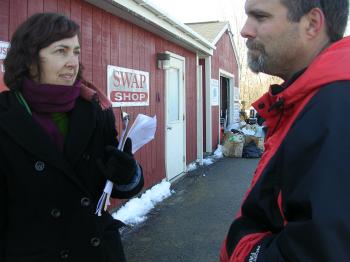 petition Ray Haversat ponders whether or not to sign the Neighbors for Sensible Development petition to change zoning laws. The zone change would prohibit the creation of “short-cut” streets connecting existing neighborhoods. Diana Sterne, solicitied signatures for the zoning change at the Cape Elizabeth dump Saturday afternoon.
 Ray Haversat
 Neighbors take Spurwink fight to dump
Comments are no longer available on this story