
Because of the state’s $1 increase in cigarette tax, Chris Tucker of Windham has just made a change to his lifestyle. No, the new “health tax” has not caused him to quit smoking. Instead of cigarettes, he now buys cartons of King Edward’s Menthol little cigars for his smoking pleasure.
“It’s just not in the budget,” Tucker said of the price hike. “So it’s either quit or scale down.”
And the savings is dramatic. A carton of King Edward’s menthols goes for around $10 while a carton of his old brand, Basic Menthol, now goes for around $40 because of the tax increase. The full revenue price for name-brand cigarettes has increased from $4.85 per pack before the law went into effect Sept. 17 to $5.85 now.
Stanley Colburn, manager of Cigaret Shopper in North Windham, said many smokers are turning to cheaper tobacco alternatives, like roll-your-owns or mini cigars, to avoid paying the tax. Where once smokers used to stick to a brand, now there is no loyalty, Colburn said, with many smokers opting for cheaper generic cigarettes at $37.99 for a carton (more than $4 a pack) as opposed to premium cigarettes like Marlboro and Camel which range from $48.69 to $56.39 a carton (over $5 a pack).
Because people are choosing tobacco alternatives, and buying cigarettes online or in New Hampshire, Colburn believes the purpose of the tax will be defeated and the state won’t get as much revenue as they had anticipated.
The state does expect a 12 percent decrease in cigarette sales. But the overall increase in revenues should balance the budget as hoped, said Speaker of the House Rep. John Richardson (D – Brunswick).
“No one likes taxes and no politician likes raising taxes,” Richardson said. “It’s a last resort.”
The reason for the tax increase, Richardson said, is because the Maine Legislature decided against borrowing $250 million in bonds to balance the budget. And so they made cuts to the budget, Richardson said, and resolved to raise the cigarette tax by $1 in hopes of gaining $125 million in new revenue.
Their only other option, Richardson said, would have been to cut eligibility for Dirigo Health and MaineCare, state-sponsored health insurance programs, by 40,000 people.
“We felt that was taking a step back,” Richardson said. “We thought it would hurt small business.”
Bureau of Health statistics state that 2,100 adults will die each year from smoking. And for every pack of cigarettes sold, $8 are incurred in health care costs. And the current $2 cigarette tax is not enough to pay for the total health care cost listed at $585 million.
“I think it is a very important public health intervention,” said Dr. Dora Ann Mills, state public health director. “We know that whenever the prices goes up, it saves lives.”
Mills said this cost burden caused by smoking is one taken on by everyone with health insurance, not just smokers, because it raises premiums.
Though business has still been “pretty good” at Cigaret Shopper, Colburn says the tax is unfair.
“I don’t see a problem with any tax,” Colburn said. “But I do see a problem when it gets ridiculous.”
Colburn questions why the Legislature didn’t raise the alcohol tax instead, which he believes poses more of a health risk than cigarettes.
“I personally don’t feel that cigarette smoking is as bad as alcohol,” Colburn said. “Smoking only kills an individual. But drinking can kill a lot of people.”
A former firefighter in Jacksonville, Florida, Colburn said he saw firsthand the damage alcohol can cause: car accidents, domestic abuse by intoxicated spouses as well as personal effects like brain damage and cirrhosis of the liver.
“We lose people on the road everyday because of drunkenness,” Colburn said.
He sees smoking as a “legal habit” – a habit that nearly one out of four Mainers enjoy.
“It’s their right to smoke,” Colburn said. “The state couldn’t survive if they made cigarettes illegal, but they’ll sure tax the heck out of it.”
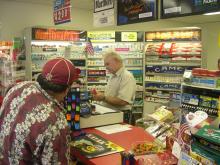 Behind the counter, manager Stanley Colburn rings up a customer at Cigaret Shopper in North Windham. Colburn says that smokers have been buying little cigars and roll-your-own tobacco to avoid paying the cigarette tax.
Comments are no longer available on this story