
With a little bit of help Kathy Eldrid will be one of just nine people to undergo an experimental cancer treatment at a Texas hospital, but first must find a reliable car to drive there.
Eldrid, a Scarborough resident, needs the car to transport her possessions with her during the outpatient treatment, which could last anywhere from one to six months. In addition, she and those who will assist her during the treatment will need it to drive around the city of Dallas.
It is her best hope to find a cure. Eldrid was diagnosed in 1992 with sarcoma, a rare form of cancer that attacks the body’s nerves, muscles, joints, bones and blood vessels. Her diagnosis came on the same day she started a new nursing job in Westbrook.
In 1993 she had a tumor, along with parts of her ribs, removed from her chest wall. The tumor was originally thought to be small cell lung carcinoma but in fact was a primitive neuroectodermal tumor (PNET).
But she elected not to follow the recommended course of follow-up treatment consisting of chemotherapy and radiation because she was unable to find other PNET patients who took the same course of action and survived. Two years later another tumor grew on her sixth rib, and is still there 10 years on.
Eldrid, a registered nurse who has become a sarcoma expert through her own research, said statistics indicate about half of those suffering from sarcoma have a form that resists surgery, chemotherapy and radiation. She believes she is the longest-living survivor of the disease.
She hopes that the clinical trial, which was tested in Germany and Japan, will prove successful at beating the disease. During the trials Eldrid will be given intravenous infusions of a virus genetically programmed to grow inside the cancer cells to kill them.
“It’s the first of its kind, but I know it’s going to work,” she said.
However, for her to get to Dallas she first needs to find a vehicle. Her current car has more than 200,000 miles on it and would not survive the trip. She is seeking community assistance to find a reliable car with air conditioning that will allow her to travel to Texas for the treatment and back home to Scarborough.
Eldrid said she is ready to go once she gets the car and had been expecting to be in Texas by July. She has now pushed back her arrival time to mid-October, but is becoming concerned since the trial will only accept nine patients.
Since being diagnosed Eldrid has been living on disability, has declared bankruptcy once, and cannot afford to buy the vehicle herself.
She has managed to raise $20,000 during the past four years, which she has earmarked for medical bills not paid for by Medicare and living expenses both here and in Texas during the trials.
“If it weren’t for the donations … I would not be here,” she said. “My insurance, which is Medicare, is almost worthless for this cancer treatment.”
Sarcoma is one of the rarest forms of cancer and accounts for only 1 percent of adult cancers. However, Eldrid believes many more people have sarcoma, but are not being properly diagnosed, which is what happened to her on several occasions.
The rarity of the cancer has lead to fewer research dollars being spent to fight it, Eldrid said, and fewer opportunities for those with the disease to survive.
The tumor attached to her rib is the size of a grapefruit and at this point is not too painful, as long as she does not move in the wrong direction. However, she did say she has shortness of breath, which is caused by the tumor growing into her lung.
If this continues to occur, it will become painful. As a member of Alcoholics Anonymous and Narcotics Anonymous, she has disavowed taking any form of narcotic to fight pain.
Over the years Eldrid has been approaching the cancer using a number of “futuristic” treatments, including experimental treatments from an immunologist, which reduced the tumor, when she could afford to pay for the treatments. When her doctor died in 2000, Eldrid continued researching the issue.
“I needed to know what caused my cancer,” she said.
Once she reached her $20,000 goal, Eldrid hand-wrote letters to 40 doctors studying cancer gene therapy explaining her situation and asking if any of them could help. That is where she learned about the Texas trial.
“I’m not waiting around for something to find a cure for me,” she said. “I had to find out for myself what was going to work.”
Those interested in contacting Eldrid may e-mail her at pnet9rn@webtv.net or call her at 883-9963.
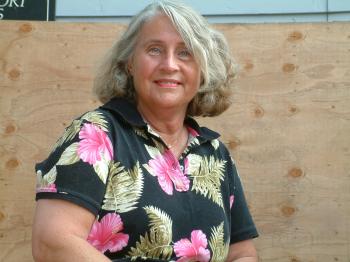 Kathy Eldrid is hoping to find a car so she can participate in a cancer trial in Texas this fall.
Comments are no longer available on this story