
About 75 Standish residents packed Council Chambers at town hall for Tuesday night’s range ways public hearing.
Town Councilor Terence Christy, who headed the two committees that investigated the development of the range ways, opened the meeting with an overview of the history of the roads and the steps taken to pursue their possible use.
Range ways, also called range roads or paper streets, were designed over 200 years ago in a grid that followed boundary lines of land parcels. The purpose of these roads, with widths that varied between four and eight rods or about 64 to 128 feet, was to provide access to each parcel of land.
In 1987, the state gave towns three alternatives regarding these range ways: develop them in the next ten years; take a 20-year option to research the roads and plan for their future use; or do nothing, allowing them to revert to the abutters.
Standish chose to delay the decision. They formed their first ad hoc committee in 2001 to identify possible future village roads.
When the first committee completed its charge, it recommended the development of two range ways, which would run parallel to Route 25 and would ease the town’s traffic problems.
The second committee, formed in 2002, pursued the steps required to develop these range ways.
Tuesday’s hearing was a culmination of that committee’s three years of work that included records research, ordinance changes and a survey done by Sebago Technics.
“We find we have a legal right to retain what was given us by the forefathers,” Christy said.
Many residents were present at the hearing because, as abutters to the range ways, they had received notification letters. When these Standish residents took the floor, most did not agree with Christy’s statement.
“I as a homeowner relied on my deed, relied on a plan…” Walter Butler said. “Neither made any mention of a range way abutting my property.”
Many speakers expressed similar concerns for their property and the potential for a decrease in its value.
Others, like Martha Corkery, questioned the town’s judgment through the years and its right to take over the roads today.
“How can the town have known since the 1700s about the range ways,” Corkery asked, “and yet allow development to come into existence with no documentation to appear on public records?”
At one point, Neil Rush drew a storm of applause for his pointed reminder: “One of the options handed down by the state Legislature was for the town to give up all rights to the range roads.”
And Paul Bulger, an attorney representing Standish residents Walter and Deborah Butler, reminded the council that the state’s purpose in forcing towns to take action was to “clear up paper streets” – to get them off the books.
“Just because you can (develop the range ways) doesn’t mean that you should.” Bulger said. “Fundamentally there’s a question of fairness.”
Although residents spoke with intensity and deep conviction, both sides remained civil and appeared to listen to each other.
After hearing many of the comments, Christy remarked, “I can see us looking at roads that lead to key areas. We don’t want them going through neighborhoods.”
Closing comments from the council stressed the need to manage traffic – looking ahead to the projected increase over the next five years – as well as to preserve the character of the village.
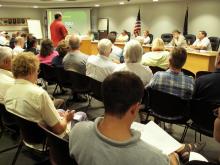 Residents filled Standish Town Hall for Tuesday night
Comments are no longer available on this story