
According to local and state history buffs, a sign recently found in Windham may have local roots or it may come from the famed J.B. Brown estate in Falmouth.
Two years ago while cleaning up her backyard, Tracy Rolland came across a piece of history long forgotten in the backwoods of Windham. She had been rummaging through automobile parts and other debris that had been left littered around her house by its former owner when she came across an old wooden sign.
“I was rummaging around and, low and behold, I found part of the sign and began to dig it out,” Rolland said.
What she uncovered was a large wooden sign in the shape of a shield with the words “Bramhall Field” routed out in two planks across the front. At the time, she tried to call the Windham Historical Society to find out more about the sign, but she was unable to get in contact with anyone. So Rolland went about trying to research where the sign might have come from.
“Someone had mentioned to me that it might have some historical value so I decided to check it out,” Rolland said. “When I was able to go to the public library and research the history, I was pretty excited.”
Through her research in the library and on the Internet, she found record of a “Bram Hall Field” in the area near her house. Details were scarce, but Rolland says it may have been a military training field during the early years of the American Revolution. Though she continued her research off and on, the sign lay in Rolland’s garage for two years until at last she decided to call the historical society again.
Kay Soldier, local historian and columnist for this paper, responded to her call and took the sign back to the Windham Historical Society. Many historical artifacts are discovered through people like Rolland, she said.
“Most of the things that the historical society receives are things that people have ‘found.’ They find things in walls of houses, in the attic, or in this case, behind a house,” Soldier said. “This sign is a perfect example of how the historical society acquires its artifacts for display and enriches the history of the Windham.”
Soldier is now conducting an investigation into the mysterious location of this sign.
The sign may have come from a field located on Falmouth Foreside, according to Nicholas Noyes, head librarian of the Maine Historical Society. Noyes says that there used to be an old sign off Brown Road in Falmouth denoting an area called “Bramhall Field.” That field was once part of the Thornhurst estate owned by John Bundy Brown – a “prominent local figure,” says Noyes, in Portland during the 1800s.
Brown, a New Hampshire native, had moved to Portland in the earlier half of the 19th century. There he became a “public and spirited man” who was a stakeholder in the Portland Sugar Company, built the Falmouth Hotel on Middle Street and engaged in banking with his firm J.B. Brown and Sons.
In addition to his summer estate in Falmouth, Brown owned a huge residential estate on the west end of Portland called “Bramhall,” named after an early settler. Most of that estate is now known as the Western Promenade.
“The J.B. Brown estate was called Bramhall,” Noyes said. “It was a great big place. The heirs didn’t want to maintain it, so it was torn down and (later) got developed.”
Noyes said he remembers a sign for the Bramhall Field at the Thornhurst estate in Falmouth on Brown Road many years ago which has since disappeared.
“I remember the sign very well but I’m 60 years old,” Noyes said. “I don’t know why or when it went away.”
There is the possibility that kids stole the sign from Falmouth and took it into the backwoods of Windham or that perhaps Rolland is correct in that there once was a “Bramhall Field” in the area. The sign is currently at the Windham Historical Society among other little mysteries of history and relics of Windham’s past.
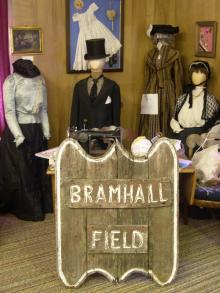 This sign, seen here at the Windham Historical Society, may be over 100 years old. It was uncovered by Tracy Rolland of Windham who gave it to the historical society to research.
Comments are no longer available on this story