
What does it mean to allude to the death of a central character in a novel’s title? For Paul Murray’s “Skippy Dies,” that memento mori looms ominously over the wry humor of a coming-of-age narrative, suggesting something bleak just a short distance up the road. Such deaths aren’t always literal, though. J.F. Powers’s “Mort d’Urban” is less about the death of its central character, an affable Catholic priest than the slow chipping away of his ambitions and reasons for being.
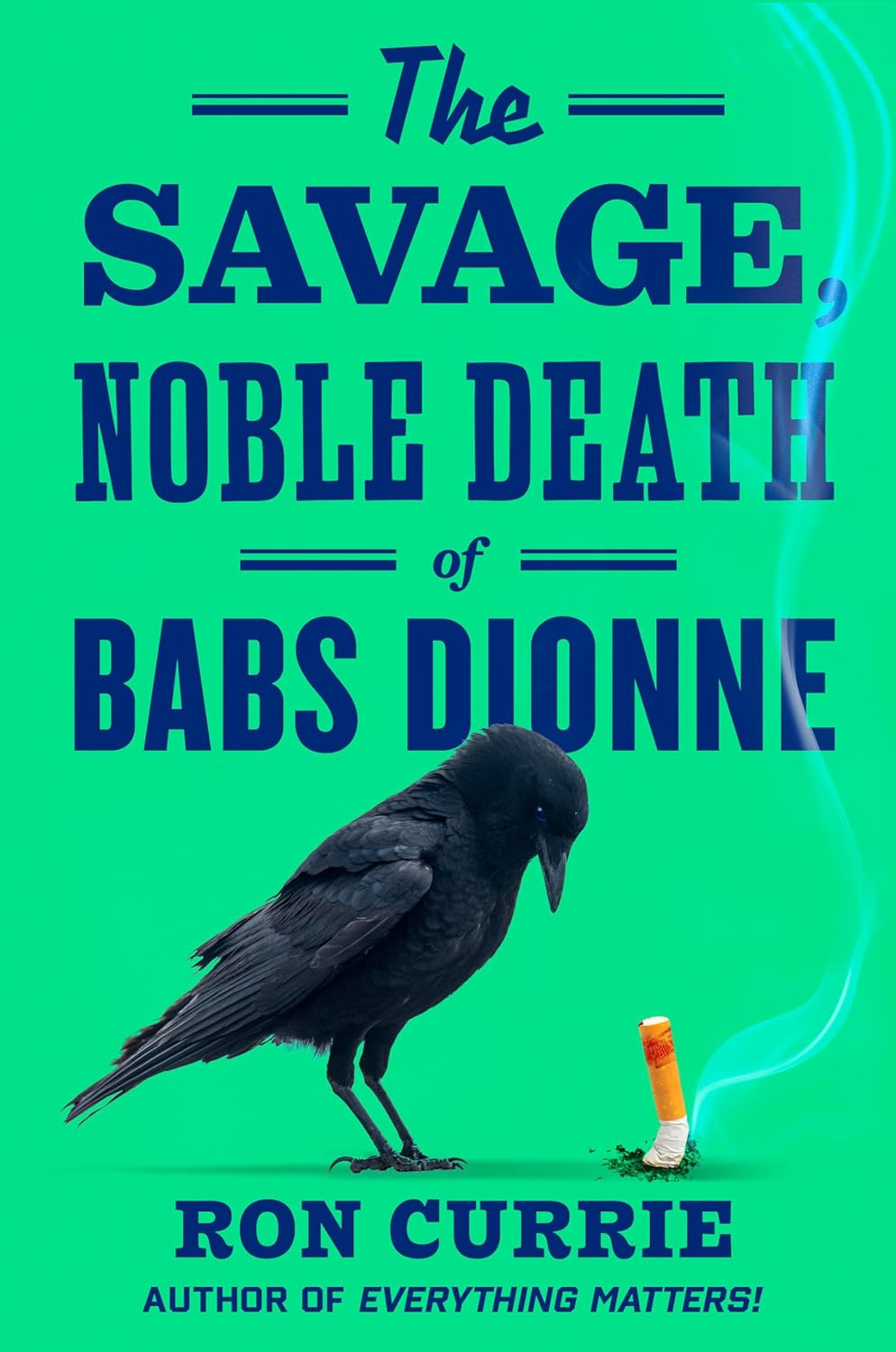
Like Powers, in “The Savage, Noble Death of Babs Dionne” writer Ron Currie reckons in a big way with Catholicism as both a moral and a social institution. One of the most moving subplots in Currie’s novel centers around the decades-long bond between the title character, who we first meet as a teenager and who evolves into a Waterville crime boss, and Father Clement Thibault, the Catholic priest who’s been her confidant over the decades.
The fact that Currie begins the novel with a prélude written in the second person and spanning 300 years is the first indication that this book is not a simple story of warring outlaws and fraught familial dynamics. Currie’s narration tracks the links that connect generations over the years, decades and centuries. Here he is, describing the title character in 1968, when she is 14 years old.
“You lived in Waterville, Maine, and had never known the Quebec of your forebears, because your grandfather Leonard Levesque had traveled by train to Waterville in 1918, braving the Spanish flu and the Klan to work at the Hollingworth & Whitney paper mill.”
The shuttering of the (real-life) mill decades later is one a few ways in which Currie weaves regional history into the narrative. Colby College also plays a role in a subplot about Babs working on opening a French-language school for the town’s Franco-American children.
Babs’s daughter Lori, a veteran who served in Afghanistan, is haunted, both by visions of the deaths she saw there and the drug addiction she brought home with her. When Currie introduces Lori Dionne to the reader, it’s in the wake of an overdose that has temporarily stopped her heart. Lori is resuscitated with the help of Narcan, but the novel’s narrator informs us that her sister Sis has just 24 hours remaining in her life.
Even before her death, Sis is a largely absent figure in the novel. (One of many, in fact. In this story, the dead continue to affect the living, sometimes literally.) The fact that Sis is missing spurs both Babs and Lori to go in search of her. Each of the two women is lethal in her own way. Currie makes this especially clear in the novel’s opening, when a loathsome local cop rapes teenage Babs, who immediately takes the bloodiest possible revenge on him.
Despite a core narrative set over only a few days in 2016 (one of which is the Fourth of July; the symbolism here is not always subtle), the novel sprawls, largely effectively. In the decades since her first act of violence, Babs has become the head of a criminal operation that illicitly dispenses prescription medication throughout Waterville. And for all that Lori is quite capable of dispensing violence herself, righteous and otherwise, she’s also working to stay one step ahead of her mother, lest Babs’s quest for the missing Sis make matters far worse.
Currie’s maximalist approach gives the book an operatic intensity at times, as is most apparent with a character referred to only as “The Man,” a philosophical bagman and killer in the Anton Chigurh mode who arrives in Waterville on behalf of a Canadian organized crime syndicate. There’s also a possibly uncanny fox that crops up in a few key scenes, and Lori’s ability to see and communicate with the spirits of the dead.
It’s possible to imagine a version of “The Savage, Noble Death of Babs Dionne” in which the more stylized elements were stripped away, a book in which Babs and Lori faced the consequences of their past actions in a more pared-down, realistic way. But Currie’s novel, though it is a gripping story of crime, corruption and redemption, isn’t solely about the Dionne family. It’s equally about the hardships in the Franco-American community and the pressures to assimilate. That the novel begins with an epigraph credited to Jean-Louis Lebris de Kérouac (and not the name by which he is better known, Jack Kerouac) makes its wider scope clear from the outset.
Above and beyond the death mentioned in its title, Currie’s book is haunted by mortality. Characters watch loved ones slip away to terminal illness or dementia. Late in the novel, one of the most nominally unsympathetic characters experiences a harrowing grief when he learns of the death of someone very close to him. Metaphorical deaths include the paper mill, which had provided an economic boost to the town – until it didn’t. Babs’s efforts to keep her family alive are one thing, but there’s also her larger project of keeping the Franco-American culture of Waterville and elsewhere afloat.
There are worse things than death, this novel implies; being forgotten is one of them. In the end, this complex story of corruption, family and betrayal ends up being less about death than a kind of resurrection. That isn’t the only surprise lurking within its pages.
New York City resident Tobias Carroll is the author of four books, most recently the novel “Ex-Members.” He has reviewed books for The New York Times, Bookforum, the Star Tribune and elsewhere.
You must be logged in to post a comment.