

This summer, Hogfish—the Maine-based, regenerative arts nonprofit production company and residency—concluded its most ambitious season yet. Anchored in themes of renewal, belonging and transformation, Hogfish’s fourth season brought audiences together across southern Maine for performances, workshops and conversations that redefined what art can be and whom it is for.
This year marked a historic milestone with the Maine premiere of SVADBA, a thrilling a cappella opera by Serbian-Canadian composer Ana Sokolović, and the first opera by a female composer ever presented on a professional mainstage in Maine. The evening was a first-of-its-kind hybrid experience that combined a community healing ritual on the theme of “thresholds,” the opera itself and a Balkan folk dance party. The final performance of SVADBA was sold out. In post-show testimonials, an audience member summed it up best with, “The whole experience was phenomenal… I’ve never experienced anything like this before!”
But the season’s impact extended well beyond that night. In July, Hogfish convened the inaugural Regenerative Arts Summit, co-hosted by the Portland Museum of Art and Wolfe’s Neck Center for Agriculture and the Environment. The Summit featured over 20 expert speakers from local arts public policy and immigration law to ninth generation regenerative agriculture, visual and performing arts, and healing modalities. Conversations reiterated the importance of examining our relationships to the places we live, work and play, the processes we engage in and the principles we apply. The Summit was so successful that Hogfish is already planning a second edition for next summer.
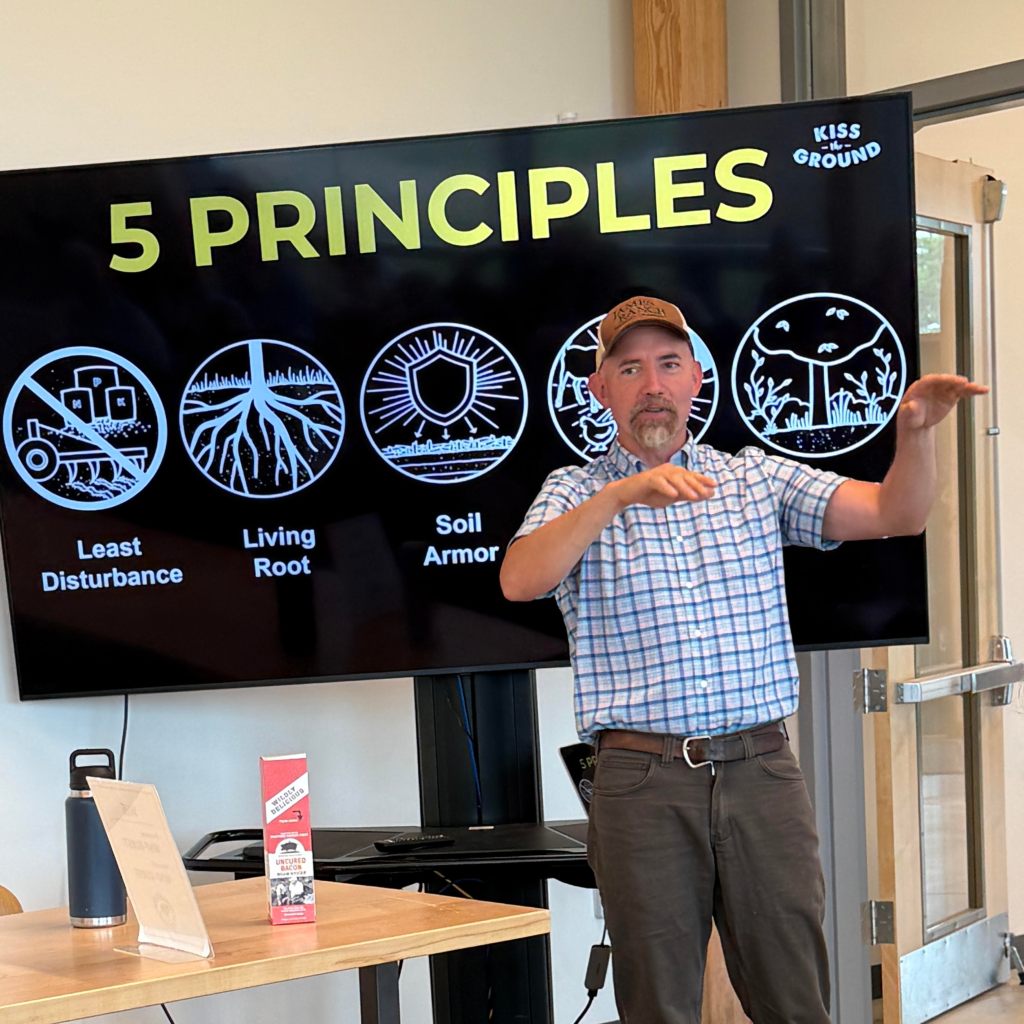
An intimate performance series in the Mallet Barn at Wolfe’s Neck Center was a highlight of the Summit, feeling especially resonant as it took place on a working regenerative farm where creativity and care for the land are intertwined. The evening began with deep listening and a sound bath led by Andrea Goodman of the Stillness Collective.
Hogfish artist-in-residence Laura Careless opened her performance by sharing that she had lost her mother earlier this spring. Her emotionally arresting solo dance explored the crossing between grief and acceptance, offering a moving meditation on love and letting go.
The evening also featured artist-in-residence Hailey McAvoy in a tour-de-force performance of “Wholly Unwinding,” an original work by the artist of songs, stories, and projected drawings. Born from her own journey as a performing artist with cerebral palsy, “Wholly Unwinding” explored the liberating power of the Alexander Technique in her path toward physical, creative and emotional regeneration. (The technique is offered to all Hogfish artists-in-residence and taught by co-founder Matt Cahill in Cape Elizabeth who also teaches the same technique to the Lindemann Young Artists at the Metropolitan Opera in New York City.) The audience—many moved to tears—rose in a standing ovation.
These performances weren’t isolated events, but part of a growing movement. Hogfish’s residencies, gatherings and regenerative arts model are creating ripples across the region. The nonprofit will soon announce a winter performance, as well as a new series of quarterly Regenerative Arts Salons. Most ambitiously, Hogfish is fundraising for a solar-powered performance tent, launching with the inaugural Regenerative Arts Tour that will bring performances to counties often left off the cultural map.
If this past season proved anything, it’s that in a time of division, regenerative art can bridge what separates us and remind us that community is not something we inherit—it’s something we plant, tend and grow together.
To learn more or support Hogfish’s mission, visit hogfish.org.

Comments are not available on this story. Read more about why we allow commenting on some stories and not on others.
We believe it's important to offer commenting on certain stories as a benefit to our readers. At its best, our comments sections can be a productive platform for readers to engage with our journalism, offer thoughts on coverage and issues, and drive conversation in a respectful, solutions-based way. It's a form of open discourse that can be useful to our community, public officials, journalists and others.
We do not enable comments on everything — exceptions include most crime stories, and coverage involving personal tragedy or sensitive issues that invite personal attacks instead of thoughtful discussion.
You can read more here about our commenting policy and terms of use. More information is also found on our FAQs.
Show less