
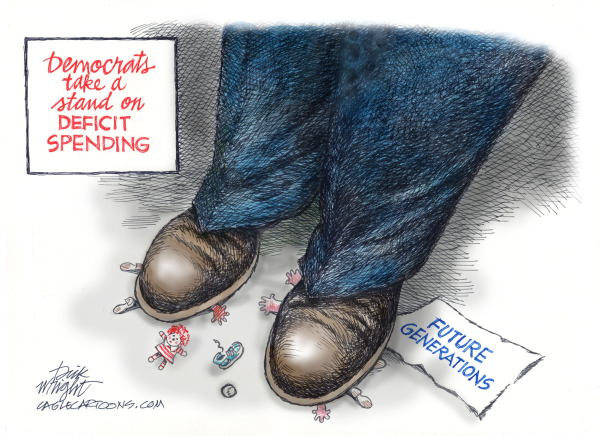
Gosh, I hate debt.
I’ve been in and out of debt from time to time. When I was younger I took out a car loan for a nice set of wheels that I really couldn’t afford.
I borrowed money I didn’t have to buy a really nice stereo system, too.
A few years after becoming self-employed, I had to get a line of credit to pay my income taxes.
Few things are less pleasant than taking on debt to pay your debt.
Being saddled with debt, therefore, is something I’ve worked hard to avoid throughout my life.
Borrowing isn’t always wrong, for sure. Borrowing for a home or to buy rental properties has worked out very well for me.
But reckless borrowing never works out well, and I cannot avoid the Mt. Everest of debt my government has taken on through a variety of spending policies that I consider reckless.
The federal government now holds a record $31 trillion in debt.
How much is a mind-boggling sum like $31 trillion?
According to one calculator, it is 31,000 billion or 31 billion thousand.
Here’s a number that may make a little more sense to you if you’re not Janet Yellen.
MSN.com reports that $31 trillion translates into more than $93,000 of debt for every person in the country.
Our political leaders haven’t worried much about our massive national debt because, for years, inflation rates were low and the interest rates on borrowed money also remained low.
Now inflation is going through the roof and the Federal Reserve hopes to tame it by increasing interest rates.
High interest rates are painful.
Consider: Not even a year ago, you could get a 3% mortgage. Now, the average is closer to 7%.
A 3% mortgage on $100,000 borrowed is about $420 a month for 30 years.
A 7% mortgage on $100,000 borrowed is about $665 a month for 30 years — a $245 increase in cost.
Well, unfortunately for all of us taxpayers, the same pain is happening with the federal debt.
When interest rates were very low, servicing our national debt was manageable.
But now interest payments are climbing fast and Fox Business says they are already projected “to be the fastest-growing part of the federal budget in fiscal year 2022, according to the Congressional Budget Office.”
How big?
This year the cost of servicing the debt will be about $400 billion, says the CBO. But within 10 years we’ll be paying $1.2 trillion.
We’ll be spending more on debt than many of our major government programs.
In other words, we’ll need to borrow more money we don’t have to pay interest on the money that we borrowed because we didn’t have it.
I may be an English major, but I’ve been worried about such a reckoning for a long time.
Consider that five years ago the federal debt was $21 trillion — and it’s grown $10 trillion in that short period of time.
Consider that 20 years ago it was a piddling $6 trillion.
These monstrous debt numbers have long been unsustainable and lots of people have been warning us what was coming. Heck, even I knew that historically low interest rates couldn’t last forever.
And now the bill for our drunken debt party is coming due — and our national pain has begun.
Tom Purcell, creator of the infotainment site ThurbersTail.com, is a Pittsburgh Tribune-Review humor columnist. Email him at Tom@TomPurcell.com.
Comments are not available on this story. Read more about why we allow commenting on some stories and not on others.
We believe it's important to offer commenting on certain stories as a benefit to our readers. At its best, our comments sections can be a productive platform for readers to engage with our journalism, offer thoughts on coverage and issues, and drive conversation in a respectful, solutions-based way. It's a form of open discourse that can be useful to our community, public officials, journalists and others.
We do not enable comments on everything — exceptions include most crime stories, and coverage involving personal tragedy or sensitive issues that invite personal attacks instead of thoughtful discussion.
You can read more here about our commenting policy and terms of use. More information is also found on our FAQs.
Show less