
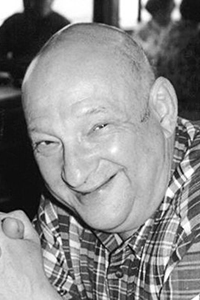
Willard Hertz
BRUNSWICK – Willard Hertz, my father, died on June 30, 2022, at Midcoast Senior Health in Brunswick. He was 97.
Will was born on Oct. 10, 1924 in Cleveland, Ohio. His mother, Marguerite Rosenberg Hertz was a French teacher; his father, David Ralph Hertz was a lawyer and political activist. Liberal politics shaped Will’s earliest moments, since Ralph was managing Robert LaFollette’s Progressive Party presidential campaign in the city as Will was being born. Ralph often said that his proudest achievement was to have carried Cleveland for LaFollette. That pride provoked lifelong annoyed amusement in Margs, who was doing another kind of carrying at the time. But maybe Will learned an important lesson in infancy: the successful integration of community service, career responsibilities and family commitments was a defining feature of his life.
Margs used to speak to her toddler in French. Will hated this, and his tantrums so perplexed Margs that she changed career. She returned to graduate school, studied clinical psychology, and became the first female full professor at Western Reserve University and a world-renowned expert on the Rorschach test. Will’s early misbehavior, Ralph’s busy legal practice, and her own blossoming professional life did not keep Margs from having another son, Harlan, nine years after Will.
The Hertz boys grew up in the Depression, and Will developed a sharp awareness of poverty and inequality which shaped his professional career. But the family was well established, prosperous, and actively engaged in Cleveland, Ohio’s flourishing cultural life. In Will’s case, this meant concerts of the Cleveland Symphony, violin lessons, and a passion for classical music. His ambitions as a performer were quickly cut short: he loved to tell the story of how, at an early recital, he butchered the Meditation from Massenet’s Thais so completely that his teacher left the room. At that point, he said, he knew he would be a listener, not a player.
Will was a great student, and Shaker Heights High School was one of the best public schools in the country: the result was a place at Harvard. But he arrived in Cambridge as the country went to war. While he waited to be drafted, he studied “useful” subjects like accounting and wrote elegantly for campus publications. He also served as air raid warden for Eliot House. Making his rounds one spring evening in 1942, he noticed a set of top floor rooms blatantly ignoring blackout regulations. Whistles and shouts from the ground had no effect, so Will climbed the steps and banged on the door – which was opened by the composer Bela Bartok. The Hungarian refugee was unimpressed by the American “phony war”, but he was flattered that this young busybody recognized and addressed him immediately as “Maestro”. So he invited Will in, played piano for him . . . and drew the curtains.
Will joined the army soon after. His flat feet exempted him from infantry service; nonetheless, his first assignment was as a messenger boy. He eventually ended up as “morale officer” on a troop ship. His primary function was to show the movie — he only had one, Meet John Doe, with Gary Cooper and Barbara Stanwyck — to groups of GIs in the only recreation space on the ship. He made 37 Atlantic crossings in slightly over two years, and 25 years later, he could still recite the screenplay from memory.
Will returned to Harvard in the fall of 1945 and graduated cum laude with a degree in economics in January 1947. His plan was to follow his father to Columbia Law School and into the family firm, but two weeks into his first term, he had a change of heart. He persuaded the university to let him transfer to the Journalism School, from which he graduated a year later: he was the last surviving member of his class. While in New York, he worked part-time at the Herald Tribune, but his first full-time reporting job was at the Minneapolis Tribune, where he covered city hall politics and to his utter bewilderment, midwestern state fairs. His greatest scoop was to interview Eleanor Roosevelt in the immediate aftermath of Winston Churchill’s Fulton, Missouri “Iron Curtain” speech. The former First Lady warned of the danger of turning our great wartime ally into an enemy.
In Minneapolis, Minn., Will also met Sylvia Frankel, a young, idealistic recent University of Minnesota graduate, who had just returned from a study trip to war-devastated Czechoslovakia. They married in 1950, and I was born in February 1953.
My mother’s journey may have been a catalyst for a career change. For in 1955, Will applied for a Ford Foundation Foreign Area Training Fellowship to do postgraduate study in development economics, then to write a series of feature articles on changes in newly independent India. We spent a year in Cambridge, then almost two years in the field. We lived with a Sikh family in Mumbai, in a tent village outside Agra, and in a dusty flashback of an imperial hotel in Bengaluru. The articles he wrote for the Tribune and for the Reporter still make excellent reading, and show a fearless willingness to listen to and learn from anyone. Will was enormously proud of the fan letter he received from Prime Minister Nehru.
We returned to the U.S. in the Spring of 1958, and my sister Miriam was born in September. The family settled in Hartsdale, N.Y., because Will had talked his way into a permanent job with the Ford Foundation, as a staff writer in their Office of Reports. Over the next six years, he wrote internal manuals for grantmakers and guides for grantseekers, as well as surveys of the foundation’s activities in a wide range of areas, and a great many rejection letters.
Will was eager to go overseas again, and in 1964, he was appointed Assistant Representative in Pakistan, based in Karachi. He was an imaginative and proactive administrator, a true “ideas man”. He helped bring the Green Revolution to both parts of Pakistan, and was particularly proud of being the founding inspiration for the School of Public Administration at the University of Dhaka, where he brought together expertise from the University of Indiana, seed money from Ford, and institutional infrastructure from the university itself.
We returned to New York in 1968, settling this time in White Plains. Will joined the central administrative team. He was responsible for grant management, and also for a range of special projects. For example, he proposed and implemented an affirmative action policy to increase the employment opportunities for women and minorities in organizations receiving grants from the foundation. He edited and coordinated annual reports and other publications. He was also responsible for relations with the board of rrustees, organizing one spectacular and unprecedented annual meeting in India. He also developed a new interest in local philanthropy, becoming the manager of the Foundation’s Fund for Michigan.
He was also developing a second, unpaid, career as a writer of program notes for classical concerts and performers in suburban New York. His work for the Westchester Chamber Music Society continued for over three decades.
After 23 years at Ford, Will made a change. He joined the Charles Stewart Mott Foundation as chief grantmaking officer and moved with my mother to Flint, Mich. Mott’s interests were narrower than Ford’s, and Will’s work largely involved the funding and encouragement of community organizations across the U.S. But he did initiate one very successful overseas venture: he took his new expertise in locally-based organizations into South Africa in the last years of apartheid. Some of the institutions supported by Mott included: the Durban Community Arts Center, the Community Development Resources Association in Capetown and Rural Advice Center in Johannesburg.
Meanwhile, he was continuing his musical activities in Flint, Mich., writing program notes for the Flint Symphony and in 1990 organizing a yearlong Schubertiade, with dozens of concerts, lectures and other events. In 1992, he retired from Mott, ending as senior vice president.
My mother died in 1989 after a long illness, and Will soon married an old family friend, Annette Bieringer. Annette brought us a second family: three adult stepchildren, a host of grandchildren, and eventually great-grandchildren. When he retired, the newlyweds left Flint, Mich. for Auburn to be near my stepsister, Shelley and her family. Soon they settled on White’s Cove Road in Yarmouth, in a house that everyone remembers as a haven of woodland bliss. It was beautifully laid out by my stepmother, and fascinatingly decorated with objects collected in two lifetimes of adventurous travel.
When Will and Annette weren’t traveling, he turned his formidable energy, enthusiasm, eloquence, and organizational skills to Maine’s cultural life. In the two decades that followed, he became a constant presence in the programs of Maine classical music organizations, festivals, and concerts. He also gave pre-concert lectures, and taught a chamber music appreciation course for the Osher Lifelong Learning Institute. He served on the Maine Arts Commission and the Maine Cultural Affairs Council, and on the boards of the Portland Conservatory of Music and the Lark Society, sponsors of the Portland String Quartet. He retired from this work when he turned 90 in 2014. His lasting legacy in Maine will be his library of music books and archive of program notes, which is now housed at the Portland Conservatory of Music.
Annette died in 2010, and Will spent one more winter on White’s Cove Road before moving to Thornton Oaks retirement community in Brunswick. He quickly took to his new collegiate life, rekindling old friendships and making new ones. Special mention should made of Lois Lamdin, Paule Hennin, Rudy Amann, and Charlotte Price, who gave him companionship and intellectual stimulation. He also brought classical music evenings, celebrations of Jewish holidays, and an enriched cultural life to the complex.
Will moved to the adjoining nursing home in 2021, as his health inevitably declined through the pandemic. But he loved decorating his new room, welcomed visitors, and even hosted a couple of musical events. Parkinson’s Disease took its toll, and he died peacefully on June 30, 2022.
Will’s memory will be cherished by two children; two stepchildren (one predeceased him); two grandchildren, five step-grandchildren; seven step-great-grandchildren; his brother and his family; the community at Thornton Oaks; as well as lovers of classical music all over Maine and beyond.
Maybe just as significant will be his legacy in India, Pakistan, Bangladesh, Africa and throughout the United States; millions of people who never knew him lead better lives because of his tireless and selfless work on their behalf. It is hard to imagine a life which more harmoniously combined devotion to family and friends, community service, and a useful and successful career.
Donations in his memory can be made to the
Portland Conservatory
of Music or Unicef.
Comments are no longer available on this story